Welcome to the second module of our course. Having established a firm understanding of how individual particle interactions are described through cross sections, we now shift our focus from the microscopic to the macroscopic. Our goal is to develop a mathematical framework that describes the collective behavior of a vast population of particles as they travel and interact within a medium. This is the essence of transport theory.
In this first lesson, we will lay the groundwork for this entire module by defining the fundamental quantities used to characterize a radiation field. We will start with the concept of a particle phase-space distribution and then use it to derive the precise definitions of angular flux, scalar flux, and current density. These three quantities form the vocabulary we will use to construct and interpret the Boltzmann transport equation in the lessons to come.
The Particle Phase-Space Distribution
To completely describe a classical particle, we need to know its position , its velocity , and the time of observation. This six-dimensional space of position and velocity, , is known as phase space. For radiation transport, it is often more convenient to describe the velocity vector by its magnitude (related to kinetic energy, ) and its direction (a unit vector, ). Thus, our phase space is described by the variables .
In transport theory, we do not track every single particle. Instead, we use a statistical approach, describing the expected number of particles within a small volume of this phase space. This leads to the fundamental quantity of the theory: the particle phase-space density, .
The following reading provides a formal introduction to this concept.
This document by M. Ragheb introduces the basic quantities of transport theory starting from first principles.
Please read the first few sections to understand how the description of the particle field is built up. Start at the beginning and read through Section 2, "PARTICLES DENSITY". Continue with Section 3, "PARTICLES DISTRIBUTION FUNCTIONS", which defines the phase-space density n(\vec{r}, \vec{v}, t). Finally, read Section 4, "ANGULAR PARTICLES DENSITY", to see how the variables are changed from velocity \vec{v} to energy E and direction \vec{\Omega}. Note that the text uses the symbol n for all these density functions, with the arguments clarifying which function is meant.
The quantity has units of particles per unit volume, per unit energy, per unit solid angle (e.g., particles⋅cm⁻³⋅MeV⁻¹⋅sr⁻¹). It tells us the expected density of particles at a specific point in space, with a specific energy, traveling in a specific direction, at a specific time. From this fundamental distribution, we can derive all the other quantities of interest.
Angular Flux
The particle density tells us how many particles are in a volume. However, reaction rates and particle flow depend not just on density, but also on how fast the particles are moving. This motivates the definition of angular flux, typically denoted by (psi).
The angular flux is defined as the particle density multiplied by the particle speed :
What does this quantity represent physically? The angular flux is the expected number of particles with energy traveling in direction that cross a unit area oriented perpendicular to , per unit time, per unit energy, per unit solid angle.
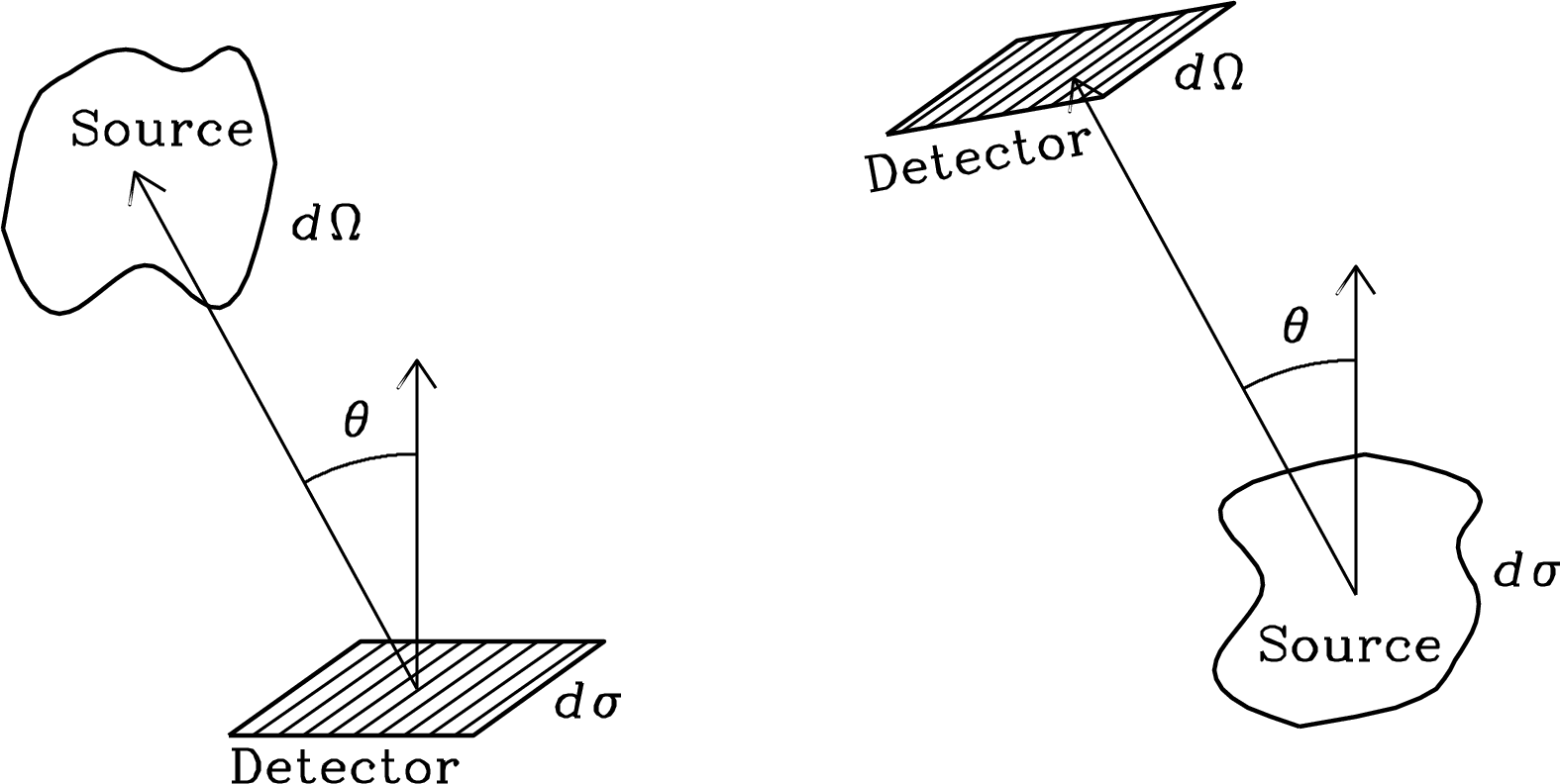
The units of angular flux are particles⋅cm⁻²⋅s⁻¹⋅MeV⁻¹⋅sr⁻¹. It is the most detailed description of the radiation field's flow and is the primary dependent variable in the Boltzmann transport equation.
The following short video provides a clear and concise definition of these quantities.
NE410/510 - Lecture 6: The Boltzmann Transport Equation
This lecture clip from Prof. Andrew L. Treasury's course at the University of New Mexico provides an excellent summary of the key field quantities.
Please watch the segment from the definitions, where the angular neutron density (n), angular neutron flux (\psi), and their relationship are explained.
Scalar Flux
While the angular flux provides a complete description, we often don't need that level of directional detail. For many applications, like calculating total reaction rates in a region, we only care about the total number of particles passing through a point, irrespective of their direction. This leads to the definition of the scalar flux, denoted by (phi).
The scalar flux is obtained by integrating the angular flux over all possible directions of travel (i.e., over the full steradians of the unit sphere):
The scalar flux has a powerful physical interpretation: it is the total path length traveled by all particles per unit volume, per unit time, per unit energy. Because of this, it is the central quantity for calculating reaction rates. If is the macroscopic cross section for some interaction, the reaction rate density (reactions per unit volume per unit time) is simply:
This is a cornerstone relationship in transport theory. It's also worth noting the connection to a term you're familiar with from medical physics: fluence. Fluence is the time integral of the scalar flux, , representing the total track length per unit volume over a period of time.
Current Density
The scalar flux tells us the total amount of particle "traffic", but it doesn't tell us if there's a net flow in any particular direction. For that, we need the current density, or simply current, denoted by the vector .
The current is defined as the first angular moment of the angular flux, which means we integrate the angular flux over all directions, but weight each direction by the direction vector itself:
The vector points in the direction of the net flow of particles. Its physical meaning is best understood by taking its dot product with a surface normal vector . The quantity gives the net number of particles crossing a unit area oriented with normal , per unit time, per unit energy.
A simple analogy helps distinguish scalar flux from current: imagine a perfectly sealed room filled with buzzing insects flying randomly in all directions. The scalar flux inside the room is very high (lots of track length per volume), but the net current is zero. If you open a window, the insects will begin to fly towards it, creating a non-zero net current pointing towards the window.
It is often useful to decompose the current into partial currents. For a surface with normal , the partial current represents the flow of particles across the surface in the positive direction (), while represents the flow in the negative direction (). The net current across the surface is then simply .
This next video segment explains how scalar flux and current are derived from the angular flux and clarifies the concept of partial currents.
NE410/510 - Lecture 6: The Boltzmann Transport Equation
Continuing with the same lecture clip.
Watch the segment from this point. It shows how integrating the angular quantities over all directions gives the scalar flux and current density. It provides an excellent explanation of partial currents and their calculation.
Summary of Key Quantities
To consolidate these definitions, here is a summary table:
| Quantity | Symbol | Definition (at specific ) | Physical Meaning | Units (typical) |
|---|---|---|---|---|
| Angular Flux | Particle flow rate per unit area normal to , per unit solid angle. | |||
| Scalar Flux | Total particle track length per unit volume, per unit time. Used for reaction rates. | |||
| Current Density | Net rate of particle flow across a unit area. A vector quantity. |
(Note: The dependence on energy and time is omitted for brevity in the table, but is present in the full definitions).
Conclusion
In this lesson, we have defined the three essential quantities that describe a radiation field in transport theory.
Key Takeaways:
- The particle phase-space density is the most fundamental statistical description of the particle population.
- The angular flux is the primary variable of the transport equation, describing the directional flow of particles at a point.
- The scalar flux , obtained by integrating over all angles, is a measure of the total particle traffic and is used to calculate reaction rates.
- The current density , the first angular moment of , is a vector describing the net flow of particles.
These quantities, and the relationships between them, are the mathematical language of our field. You will see them appear repeatedly from now on.
Preview of the Next Lesson:
Now that we have defined our primary variable, the angular flux, we are ready to derive the equation that governs its behavior. In the next lesson, we will construct the steady-state, linear Boltzmann transport equation by performing a rigorous particle balance on an infinitesimal volume of phase space. We will see exactly how each physical process—streaming, collision, scattering, and emission from sources—contributes a term to this master equation.