Hello! Last time, you found the strongest syllable in words such as market and achieve. Now you will work on what often happens to a weaker syllable: its vowel becomes a short, relaxed sound called schwa. This helps you keep the word’s stress clear without giving every syllable equal weight.
Allow about 35–40 minutes, including the listening and speaking practice.
A small sound that changes a word’s rhythm
Schwa is written /ə/ in pronunciation guides. It is a vowel sound, not a letter: different written vowels can become /ə/ when their syllable is unstressed.
Look at banana. The middle syllable carries the main stress: ba-NA-na. The vowels on either side can both be schwas, giving /bəˈnænə/. The mark ˈ comes just before the stressed syllable.
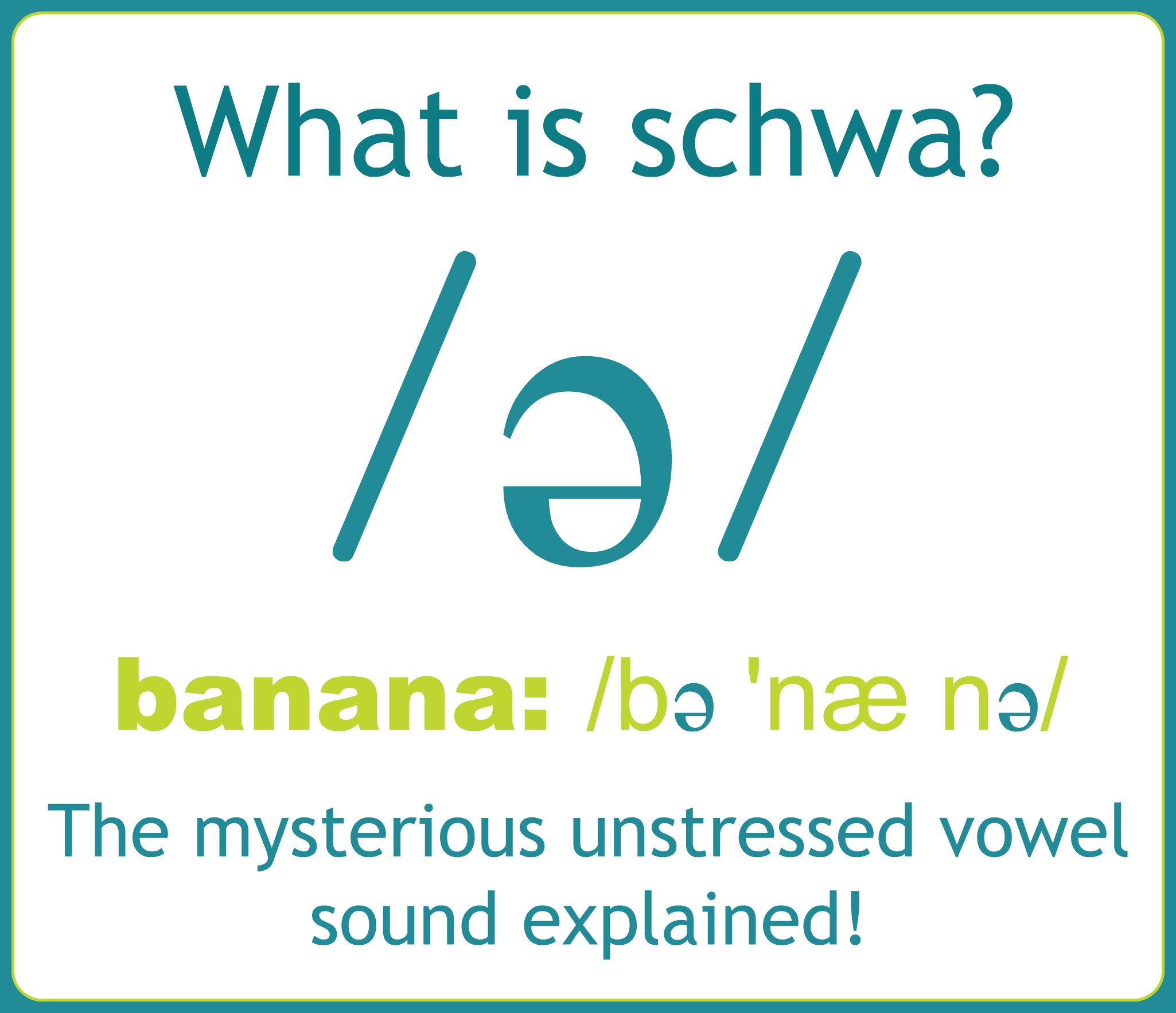
Schwa is often described as a quiet “uh,” but quiet matters as much as “uh.” If you hold it for a long time, it no longer does its job. In about, the first syllable is quick and light; BOUT has the clear vowel and most of the word’s prominence: ə-BOUT.
Make the sound without working hard
Watch the start of Rachel’s English’s American English Sounds – UH [ə] Vowel – How to make the SCHWA Vowel. The close view is useful here: schwa requires less mouth movement, not a special exaggerated shape.
American English Sounds - UH [ə] Vowel - How to make the SCHWA Vowel
Rachel’s English demonstrates the relaxed mouth position for schwa and shows how the sound fits into an unstressed syllable.
Watch the mouth position for the slightly lowered jaw and relaxed lips. Continue with the close view; listen especially for how brief and unaccented the vowel is in sofa.
Try saying a soft “uh” with your voice on, your lips loose, and your jaw only slightly open. Then put it into SO-fə (sofa). Give SO the longer, clearer vowel; let -fə pass quickly. Do not drop the final syllable entirely: the goal is a reduced vowel, not a missing syllable.
It may feel easier to make each written vowel distinct. But compare SA-lad spoken with a full, carefully pronounced second a against SA-ləd with a brief /ə/. In the second version, the strong first syllable has room to stand out. The contrast between the two syllables is what you are practising.
Listen for schwa before you copy it
Watch the examples in How to improve your American Accent: Understanding Schwa from Clear English Academy with Keenyn Rhodes. The speaker contrasts the strong syllable with the reduced one in several familiar words.
How to improve your American Accent: Understanding Schwa
Clear English Academy with Keenyn Rhodes models schwa on both sides of a stressed syllable and explains why spelling alone cannot tell you which vowel sound to use.
In the word examples, listen to the first syllable of about, today, and connect, then the last syllable of salad. In the spelling discussion, focus on the point that more than one vowel letter can represent the same reduced sound.
Here are the words to keep from those models. Capitals identify the stressed syllable; ə marks the reduced vowel you are aiming to produce.
| Schwa comes before the stress | Schwa comes after the stress |
|---|---|
| ə-BOUT | SA-ləd |
| tə-DAY | SO-fə |
| kə-NECT | BA-lənce |
The spelling changes, but the speaking task stays much the same: find the stressed syllable, then give the schwa syllable less time and a relaxed vowel. Unstressed does not mean “always schwa,” however. Use the pronunciation you hear or find in a dictionary rather than automatically changing every weak vowel to /ə/.
Put the reduction into your own speech
Spend 10–12 minutes moving from deliberate practice to ordinary pace. First say each stressed syllable clearly on its own: BOUT, DAY, NECT, SA, SO. Then add the rest of each word without giving it a second strong beat: about, today, connect, salad, sofa. Replay the video models when a word is uncertain.
Next, use banana to practise schwa on both sides of the stress. Say NA once, then say banana as one continuous word: bə-NA-nə. Avoid pausing between syllables or making the two a vowels at the edges as clear as the middle one.
Finally, record these short lines at a comfortable speaking pace:
I’ll do it tə-DAY.
Let’s kə-NECT soon.
I made a SA-ləd.
There’s a bə-NA-nə on the table.
Listen for the shape of each target word. Does one syllable stand out while its schwa syllable stays brief and audible? If the word sounds evenly paced, rerecord that line after saying its stressed syllable alone. If a weak syllable vanishes altogether, slow down slightly and give it a small, relaxed vowel.
Takeaway
Schwa /ə/ is a short, relaxed vowel in an unstressed syllable. It can appear under different vowel spellings, so start with the word’s stress and a reliable spoken model rather than the letters alone. Keep the stressed vowel clear; make the schwa lighter and quicker without deleting its syllable.
You have now practised contrast within words. Next, you will use sentence stress to make the most important information stand out within a statement.