Hello! In the previous lesson, you made a stressed syllable stand out by giving its schwa syllables less weight. Now you will use a similar contrast across a whole statement. Sentence stress helps your listener hear which information matters most—and lets you change that focus without changing the words.
Allow about 35–40 minutes, including the listening, reading, and speaking practice.
Give the message a shape
In ordinary English speech, words rarely receive equal emphasis. Meaning-bearing words such as sent, blue, and file usually stand out more than a short grammatical word such as the. A prominent word may be a little longer, clearer, and higher in pitch. Its neighbours remain audible, but do not compete for attention.
The image below shows one possible pattern. The green words carry noticeable beats; the words between them are lighter. It is a picture of relative emphasis, not an instruction to make every beat arrive at an exact interval.
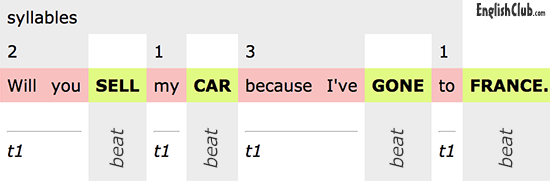
Watch the two selected parts of Sentence Stress in American English: Emphasize Content Words for English Rhythm from English with Kim. Listen for length and pitch as well as loudness: emphasis is more than simply raising your voice.
Sentence Stress in American English: Emphasize Content Words for English Rhythm
English with Kim explains how prominent and less prominent words work together in an American English statement.
Watch the introduction for the audible features of stress and reduction. Then watch the word groups for the usual difference between meaning-bearing words and grammatical words. Treat these as a starting pattern, not a rule that fixes the stress of every sentence.
That starting pattern gives your speech a shape. But it does not yet tell your listener which particular detail you want to bring to the foreground. For that, context matters.
Move the strongest emphasis to the intended detail
Take the statement I sent the blue file yesterday. You can say the same words in response to different situations. In the versions below, bold capitals mark the strongest emphasis, not the only words that have any stress.
| What needs clarifying? | Say the statement with this focus |
|---|---|
| Someone thinks the file was red. | I sent the BLUE file yesterday. |
| Someone thinks you sent it today. | I sent the blue file YESterday. |
| Someone thinks you only received it. | I SENT the blue file yesterday. |
| Someone thinks another person sent it. | I sent the blue file yesterday. |
Notice the connection to word stress: when yesterday receives the strongest sentence stress, its first syllable becomes especially prominent. You do not move the word’s stress to -day. And although I is often relatively light, it can become prominent when who did something is the point.
Watch how the speaker in the next segment corrects and contrasts details. The speaker’s accent is not the model for this course; focus here on where the extra emphasis goes and why.
Sentence Stress in English Pronunciation
In Sentence Stress in English Pronunciation, Oxford Online English demonstrates how a speaker gives one detail extra emphasis to correct or contrast it with another.
Watch changing the focus. In the opening exchange, notice how a corrected order gets a stronger stress on the disputed item. Near the end, listen for the explanation that this extra emphasis sits on top of ordinary sentence stress; it does not make every other word flat.
This is why “stress the content words” is useful but incomplete. In I sent the BLUE file yesterday, sent, file, and yesterday can still sound natural and clear. Blue simply receives the extra prominence that directs the listener to the correction. Stress can even fall on a usually light pronoun, as in I sent it—not someone else.
Let the question guide your answer
A good way to choose your focus is to notice what the listener already knows and what remains uncertain. Contrasting and Clarifying gives short question-and-answer pairs in which the answer sentence stays nearly the same, but its strongest stress changes.
Read the “Practice 2” examples from Baruch College’s Tools for Clear Speech. They show how a preceding question makes a different word in the answer important.
In “Practice 2,” read the question pairs, continuing through the brief “What do you do now?” subsection. In particular, compare the three questions answered with “I had the textbook yesterday.” Before revealing each answer, listen for what the question puts in doubt; then use the page’s answer recordings to hear where the reply places its emphasis.
The useful habit is to decide what your statement is doing before you speak. Are you supplying a missing detail, correcting a mistaken one, or distinguishing two possibilities? That decision guides the strongest stress. There is not always one universally correct pattern for a sentence on its own.
Make the contrast audible
Spend 10–12 minutes saying and recording the four versions of I sent the blue file yesterday from the table. Before each version, briefly imagine the misunderstanding it answers. Say the statement at a comfortable pace, with a modest lift in pitch and a little extra length on the highlighted word or syllable. Keep the light; do not omit it or rush the whole sentence.
Listen back without looking at the table. The detail you intended to highlight should be the easiest one to pick out. If all four recordings sound alike, make the focused word slightly longer and pitch it a little higher. If they sound shouted, reduce the volume and preserve the contrast through pitch and duration instead.
Then try the same approach with a shorter statement: I bought a new coat. Say it once to clarify who bought it, once to clarify whether you bought or borrowed it, and once to clarify whether the coat was new or used. Keep a brief—you can use the relaxed /ə/ from the previous lesson—but remember that a reduced word is still part of the sentence.
Takeaway
Sentence stress directs attention. Meaning-bearing words usually provide the basic pattern, while context determines which word receives the strongest emphasis. Put that emphasis on the word’s already-stressed syllable, and keep surrounding words clear but less prominent.
This completes the pronunciation foundation in this module. In the later English-speaking module, you will put these contrasts into longer, more connected speech.