Hello! In the previous lesson, you worked on making a clear General American r in words such as red and car. This time, the unit of practice is larger: a whole word with two or more syllables. You will learn to hear which syllable is most prominent and place that primary stress when you speak.
Allow about 35–40 minutes, including time to listen, repeat, and record your voice.
What makes one syllable stand out?
Say market naturally. Its first syllable stands out: MAR-ket. Now say achieve. Its second syllable stands out: a-CHIEVE. The bold capitals in this lesson show which syllable receives primary stress; they are pronunciation cues, not changes to the spelling.
A stressed syllable often lasts longer, has a clearer vowel, and carries a noticeable change in pitch. It may also be louder, but making it loud alone can sound forced. The other syllables are still there; they simply receive less time and energy. Think of the contrast within each word, rather than trying to give every syllable equal weight.
Watch the opening of Primary Stress Quiz: Can You Get It Right? from Accent’s Way English with Hadar. Then listen for the strongest syllable as she says several longer words. You do not need to master every word in the quiz yet.
Primary Stress Quiz: Can You Get It Right?
In Primary Stress Quiz: Can You Get It Right?, Hadar explains what makes a syllable prominent and models stress in familiar English words.
Watch the introduction for the sound of primary stress. Then watch the first words and more models. Pay particular attention to develop, vegetable, and photography: listen for the strongest syllable, even if you cannot yet catch every sound around it.
If you replay develop, you can hear the middle syllable claim the most space: de-VEL-op. The lesson is not to say that syllable as forcefully as possible. Give it a clear, unhurried moment, while the syllables on either side stay lighter.
Place the beat in two- and three-syllable words
The worksheet below uses a large O for a stressed syllable and a small o for an unstressed one. In a two-syllable word, Oo means stress first, as in MAR-ket; oO means stress second, as in a-CHIEVE. Use it as a visual guide to the pattern, not as a reason to pronounce the letters differently.
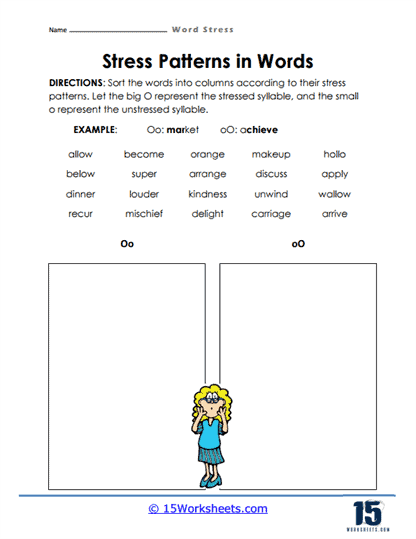
Compare DIN-ner with de-LIGHT, and CAR-riage with ar-RIVE. Say each pair aloud at a comfortable pace. If both syllables sound equally strong, lengthen and clarify the one in capitals a little; then make the other one shorter. Keep the r sound you practised last time in carriage and arrive, but let stress placement be your main focus here.
Three-syllable words give the strong syllable three possible positions:
| Stress position | Pattern | Model |
|---|---|---|
| First | Ooo | POP-u-lar |
| Middle | oOo | de-VEL-op |
| Last | ooO | in-tro-DUCE |
The breaks shown here help you feel the rhythm; they are not a guide to where you must pause. Say each word as one continuous word. It can help to tap once on the strong syllable, but avoid tapping every syllable with the same force.
Spelling is not a reliable stress guide. Rather than guessing from the number of letters, learn a new word’s stress along with its sounds. In a dictionary pronunciation, the primary-stress mark usually appears just before the stressed syllable. This gives you a way to check an unfamiliar word instead of relying on its spelling.
Build a longer word around its strong syllable
A long word can feel difficult if you try to pronounce every part with equal care. A more useful approach is to find its stressed syllable first, say that syllable clearly, and then fit the lighter syllables around it.
Watch Rachel’s English demonstrate this with underestimate and inevitable. These are longer than the words you need to practise first; concentrate on the method, not on memorising both words.
How to Practice Multi-Syllable Words - American English Pronunciation
In How to Practice Multi-Syllable Words, Rachel’s English demonstrates how to isolate a word’s strongest syllable before putting the whole word back together.
Watch find the stress to see how she identifies and practises the strongest syllable. In lighter syllables, notice the difference in pace and vocal energy. Finish with whole words to hear her put the parts together. The video briefly mentions secondary stress; for now, listen for the one strongest syllable.
Apply that method to ex-AM-ple. Say AM clearly once, then say ex-ample as a single word, keeping ex- and -ple lighter. Do the same with pho-TOG-ra-phy. Your aim is not to erase the lighter syllables or rush until they disappear. The aim is for a listener to hear immediately where the word’s main stress belongs.
Carry the pattern into speech
Spend 10–12 minutes with this small set. The first four words have two syllables; the others let you move the stress to different positions in longer words.
| Stress first | Stress later |
|---|---|
| MAR-ket, DIN-ner | a-CHIEVE, ar-RIVE |
| POP-u-lar | de-VEL-op, ex-AM-ple |
| in-tro-DUCE, pho-TOG-ra-phy |
First, say each word slowly enough to make its strong syllable unmistakable. Say it again at an ordinary pace, preserving the same pattern. For develop and photography, replay the models in Hadar’s video if you are unsure where the stress falls. For the others, use the marked pattern as your guide.
Next, record these lines at a natural speaking pace:
The MAR-ket is open.
They will ar-RIVE soon.
Can you give an ex-AM-ple?
I enjoy pho-TOG-ra-phy.
Listen once without looking at the text. Then listen again while checking the capitalised syllables. Can you hear one clear peak inside each target word? If a word sounds flat, say its stressed syllable on its own once and rerecord just that line. The capitals mark word stress here; you do not need to give every capitalised syllable the strongest emphasis in the whole sentence.
Takeaway
Primary stress is the most prominent syllable in a word. Make it clear and give it a little more time and pitch movement; let surrounding syllables be lighter. The pattern may put that syllable first, in the middle, or last, so check a new word’s pronunciation rather than trusting its spelling.
Today you concentrated on where stress belongs. In the next lesson, you will look more closely at a common sound that appears in unstressed syllables: the reduced vowel called schwa.