Introduction
Hello! In our last lesson, we dissected the concept of credible and non-credible threats, using Subgame Perfect Nash Equilibrium (SPNE) to distinguish between them. You learned that the power of SPNE lies in its ability to eliminate equilibria that rely on empty threats—actions a player wouldn't rationally take if called upon. We analyzed a pre-made game tree for an entry-deterrence scenario to see this principle in action.
Today, we take a crucial step from analysis to application. Your learning outcome is to model a simple entry-deterrence scenario as a sequential game and solve for the SPNE. This means you won't be given a finished game tree. Instead, you'll start with a story—a strategic situation described in words—and translate it into the formal structure of a game. This process of modeling is the heart of applied game theory and a core skill for using it as a tool for "meaningful planning."
1. From Narrative to Game Tree
Let's begin with a classic strategic story:
A market is currently dominated by a single firm, the Incumbent. A new firm, the Challenger, is considering entering this market. If the Challenger decides to Stay Out, it gets a safe payoff from investing its resources elsewhere, and the Incumbent continues to enjoy its monopoly profits. If the Challenger Enters, the Incumbent must react. It can either Accommodate the new firm, leading to a duopoly where both make a profit (though less than a monopoly profit), or it can start a price War. A price war is costly for both firms, leading to losses for each.
Your first task in modeling is to break this story down into the core components of a game:
- Players: Who are the decision-makers?
- Sequence of Moves: Who moves when?
- Actions: What can each player do at each decision point?
- Payoffs: What are the outcomes for each player for every possible sequence of actions?
To see this process in action, the following video provides a concise walkthrough of translating this exact type of story into a game tree with specific payoffs.
Game Theory 101 (#16): Subgame Perfect Equilibrium
Watch this segment from William Spaniel's 'Game Theory 101' series. It begins with the narrative of an entry-deterrence game, just like the one above, and then systematically translates it into an extensive-form game tree.
Please watch the first 1 minute and 47 seconds (00:00 - 01:47). Focus on how the narrative description of the players' choices and consequences is mapped directly onto the nodes, branches, and terminal payoffs of the game tree.
The game tree you saw constructed in the video is a formal model of our strategic story. Let's use a standard representation of this game to analyze it further.
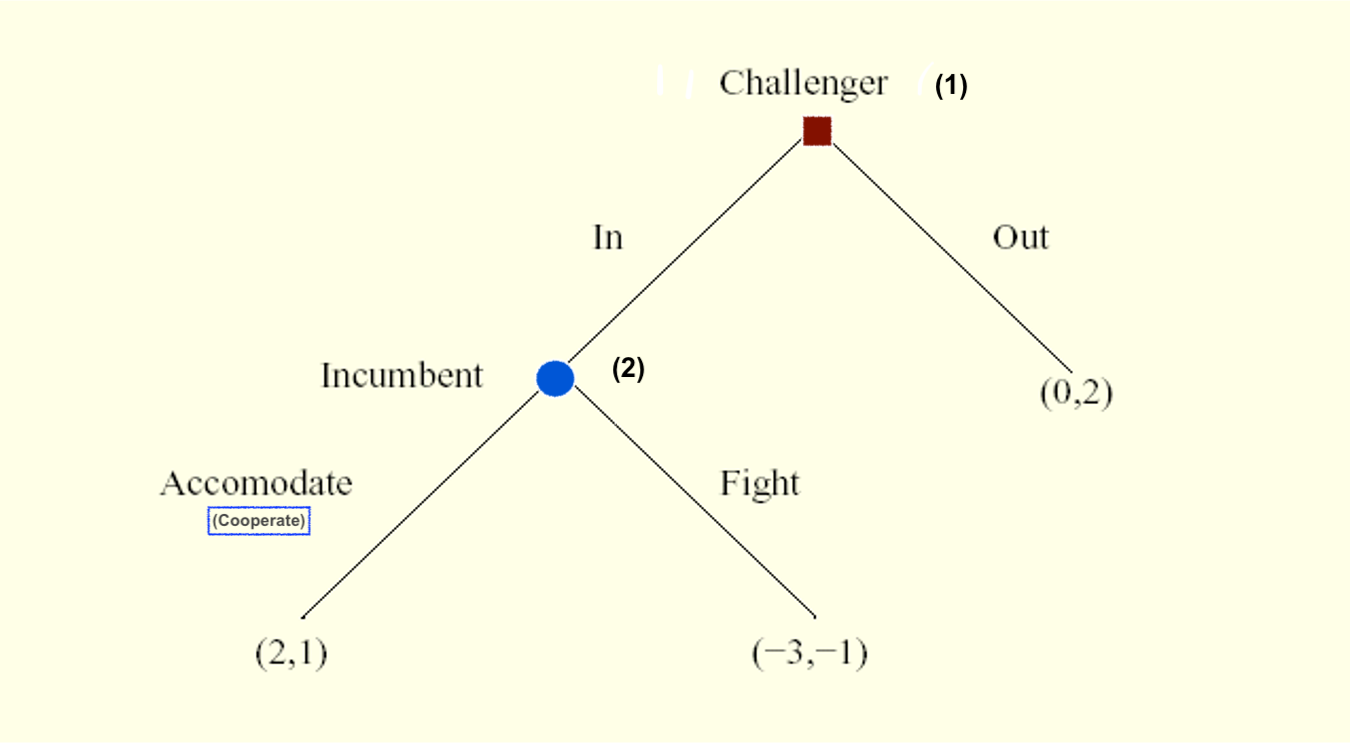
This tree perfectly captures the narrative:
- Players: Challenger, Incumbent.
- Sequence: Challenger moves first. The Incumbent only moves if the Challenger plays 'In'.
- Actions: Challenger: {In, Out}. Incumbent: {Accommodate, Fight}.
- Payoffs:
- (Out) -> (0, 2): Challenger gets a neutral payoff, Incumbent keeps monopoly profit.
- (In, Accommodate) -> (2, 1): They share the market; the Challenger does better than staying out, but the Incumbent does worse than being a monopolist.
- (In, Fight) -> (-3, -1): A price war hurts everyone.
2. Solving the Model with Backward Induction
Now that we have our model, we can solve it. As you know from previous lessons, the appropriate solution concept is Subgame Perfect Nash Equilibrium (SPNE), which we find using backward induction.
Let's continue with the video you started, which now applies this exact technique.
Game Theory 101 (#16): Subgame Perfect Equilibrium
This next segment of the same video analyzes the game we just modeled. It first considers two potential Nash Equilibria and then uses the logic of sequential rationality (which you know as backward induction) to discard the one based on a non-credible threat.
Watch from 01:47 to 05:59. Pay close attention to the reasoning at 04:27. Why is the Incumbent's threat to 'declare war' not credible? How does the Challenger use this knowledge to make its own decision?
As the video demonstrates, the analysis is straightforward:
- Analyze the final subgame: If the Challenger enters, the Incumbent is at its decision node. It compares its payoff from Fighting (-1) to its payoff from Accommodating (1). Since , a rational Incumbent will Accommodate.
- Analyze the first decision: The Challenger anticipates the Incumbent's rational response. It compares its payoff from Staying Out (0) to the payoff it knows it will get if it Enters (2, because the Incumbent will Accommodate). Since , the Challenger will Enter.
The unique Subgame Perfect Nash Equilibrium is (In, Accommodate). Our model predicts that entry will occur and the incumbent will not fight. The Nash Equilibrium (Out, Fight) is ruled out because it relies on the Incumbent's non-credible threat to Fight.
3. A Deeper Look: Making Threats Credible
The simple model seems to give a bleak outlook for the incumbent: entry is inevitable. This might feel unsatisfying. You mentioned an interest in "meaningful planning," which often involves finding ways to alter a disadvantageous situation. So, could a clever incumbent change the game to make its threat to fight credible?
This leads us to the concept of strategic pre-commitment. The incumbent might take an action before the challenger decides to enter, fundamentally changing the payoffs of the game. For example, the incumbent could invest in excess production capacity, sign exclusive deals with suppliers, or launch a massive advertising campaign focused on its low prices.
Such an investment, let's call it , can alter the payoffs of the subsequent competition. This is where we can apply a more rigorous mathematical lens, which I know you appreciate.
Please read the following excerpt from a Stanford University course note by Jonathan Levin. It formalizes the idea of strategic pre-commitment and entry deterrence, providing a richer, more mathematical framework.
Please read the sections titled '6.2 Strategic Pre-Commitment' and '6.3 Entry Deterrence' (these start on page 16). Don't worry about the details of 'Strategic Complements and Substitutes' for now. Focus on understanding how an initial investment, 'k', can influence the game. Pay special attention to the equation for 'dπ2/dk' and the classification of strategies ('Top Dog', 'Lean and Hungry Look', etc.).
Let's unpack the key insight from that reading. The incumbent's investment can deter entry if it makes the post-entry duopoly unprofitable for the challenger. The total effect of the investment on the challenger's profit () is given by:
This equation elegantly decomposes the strategy:
- Direct Effect (): The investment might directly harm the challenger (e.g., an advertising campaign that builds brand loyalty, making it harder for any new entrant).
- Strategic Effect (): The investment changes how the incumbent will compete if entry occurs (), which in turn affects the challenger's profit. For instance, investing in cost-reducing technology () makes price wars () less costly for the incumbent, making it a more aggressive competitor. This is a "Top Dog" strategy: be big to look tough.
By investing in a way that makes , the incumbent makes itself "tough" and can lower the potential profits of an entrant, possibly to the point where staying out becomes the challenger's best option. This makes the threat to compete fiercely credible, not because the incumbent is irrational, but because it has rationally changed the structure of the game to its own advantage.
Conclusion
In this lesson, you have moved from being an analyst of games to a modeler. This is a significant leap. You have seen how to translate a strategic narrative into a formal game tree and solve it for its most plausible outcome.
Key Takeaways:
- Modeling a strategic scenario involves identifying the players, the sequence of actions, and the resulting payoffs for all possible outcomes.
- The extensive form (game tree) is the natural tool for representing sequential games like entry deterrence.
- Solving the model via backward induction reveals the Subgame Perfect Nash Equilibrium, which filters out outcomes based on non-credible threats.
- In the basic entry-deterrence model, the incumbent's threat to fight is typically non-credible, leading to entry.
- Sophisticated players don't just play the game; they try to change it. Through strategic pre-commitment, an incumbent can make investments that alter the game's payoffs, making a threat to fight credible and successfully deterring entry.
This concludes our module on sequential games. We've focused on interactions that happen once. But what happens when players face the same strategic situation over and over? In our next lesson, we will begin our exploration of Repeated Games, distinguishing between finitely and infinitely repeated interactions and setting the stage to understand how cooperation can emerge even between self-interested players.