Introduction
Welcome back to our study of sequential games. In the last lesson, you mastered the algorithm of backward induction, a powerful tool for finding the Subgame Perfect Nash Equilibrium (SPNE) of a game. We saw how it works by solving for the optimal move at the end of the game and reasoning backward to the beginning.
Today, we will explore the strategic significance of this concept. Your learning objective is to use subgame perfection to distinguish credible from non-credible threats. You'll discover that the entire point of refining the Nash Equilibrium concept to SPNE is to filter out "empty threats"—strategic promises or warnings that a rational player would not actually carry out if put to the test. This will connect the mechanical process of backward induction to the deeper behavioral insight of strategic credibility, a key element for "meaningful planning in a chaotic world."
As a brief recap, remember that a Subgame Perfect Nash Equilibrium is a strategy profile that constitutes a Nash Equilibrium in every subgame of the original game.
1. The Problem with Threats in Nash Equilibria
In simultaneous-move games, threats are not really an issue; players act at the same time. In sequential games, however, players can make their choices conditional on the prior actions of others. This opens the door for players to try to influence behavior with threats.
Consider the following scenario:

This is the essence of a non-credible threat: a stated intention to take an action that, when the time comes, is not in the threatener's best interest. The concept of Nash Equilibrium, when applied naively to a sequential game, is not always sufficient to rule out these empty threats. Let's see why with a classic example.
2. The Entry-Deterrence Game
Imagine a market with a single Incumbent firm. A Challenger is considering entering the market. If the Challenger enters, the Incumbent can either Fight (e.g., slash prices) or Accommodate (share the market).
This situation can be modeled by the following game tree:
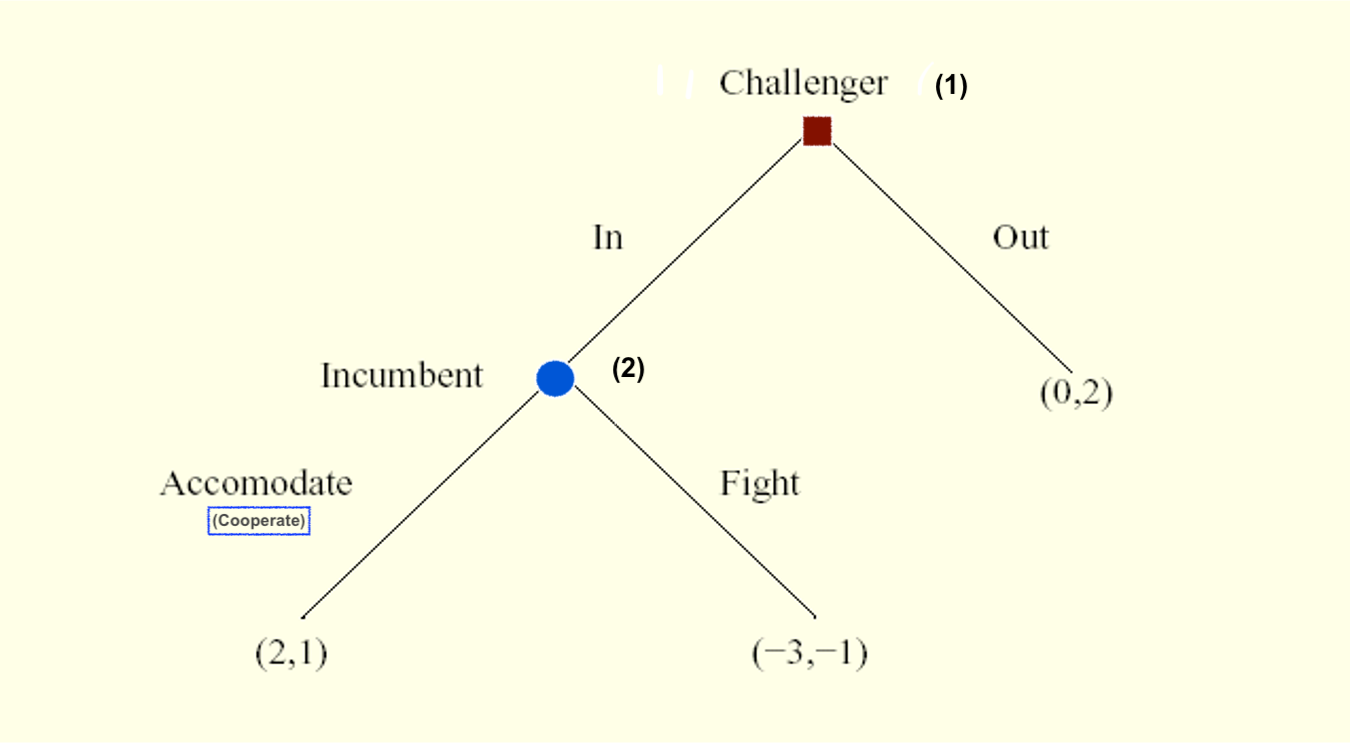
Let's analyze this game first by finding its pure-strategy Nash Equilibria. To do this, we can convert the extensive form into its normal (matrix) form. The Challenger has two strategies: {In, Out}. The Incumbent also has two strategies: {Fight, Accommodate}.
| Incumbent: Fight | Incumbent: Accommodate | |
|---|---|---|
| Challenger: In | (-3, -1) | (2, 1) |
| Challenger: Out | (0, 2) | (0, 2) |
By finding the best responses for each player (as we did in Module 2), we can identify two pure-strategy Nash Equilibria:
- (In, Accommodate): The Challenger enters, and the Incumbent accommodates.
- (Out, Fight): The Challenger stays out, and the Incumbent's strategy is to fight if entry occurs.
We have a problem: the model gives two contradictory predictions. In one, the market becomes a duopoly. In the other, the monopoly persists. Which one is more plausible?
The second equilibrium, (Out, Fight), relies on the Incumbent's threat to Fight. The Challenger stays out because of this threat. But is the threat credible?
3. Using Backward Induction to Test Credibility
Let's apply the backward induction algorithm you learned in the previous lesson to the game tree.
-
Start at the final subgame: This is the subgame that begins after the Challenger chooses "In". Here, the Incumbent must decide whether to Fight or Accommodate.
- If the Incumbent Fights, their payoff is -1.
- If the Incumbent Accommodates, their payoff is 1.
- Since , a rational Incumbent will Accommodate. The threat to "Fight" is irrational at the moment it would need to be carried out.
-
Move back to the initial node: The Challenger, being rational, anticipates the Incumbent's rational choice.
- If the Challenger chooses "Out", their payoff is 0.
- If the Challenger chooses "In", they know the Incumbent will Accommodate, leading to a payoff of 2.
- Since , a rational Challenger will Enter.
Backward induction gives us a single, unambiguous outcome: The Challenger enters, and the Incumbent accommodates. This corresponds to the (In, Accommodate) equilibrium. The other Nash Equilibrium, (Out, Fight), is eliminated.
4. Subgame Perfection as a Refinement
The reason backward induction works is that it enforces optimality at every stage. This is precisely what the definition of Subgame Perfect Nash Equilibrium requires.
- A Subgame Perfect Equilibrium is a strategy profile that induces a Nash Equilibrium in every subgame.
- The strategy profile (Out, Fight) is not an SPNE because in the subgame following the Challenger's entry, the strategy "Fight" is not a best response for the Incumbent. It is not a Nash Equilibrium of that subgame.
- The threat to "Fight" is non-credible precisely because the action "Fight" is not optimal in the subgame where the threat would be executed.
SPNE, therefore, serves as an equilibrium refinement. It refines the set of Nash Equilibria by eliminating those that rely on non-credible threats.
To see this logic explained in a lecture setting, and to connect it to the precise definition of strategies in sequential games, watch the following video.
15. Backward induction: chess, strategies, and credible threats
Professor Ben Polak from Yale University explains exactly why some Nash Equilibria in sequential games are unconvincing. He first shows how to find multiple Nash Equilibria in a game's matrix form, then uses backward induction to identify the one that is 'subgame perfect' and eliminate the one based on a non-credible threat.
Please watch from 51:54 to 01:09:57. The first part (until 01:01:38) analyzes an abstract game, showing that a Nash Equilibrium can contain a 'silly' or irrational action off the equilibrium path. The second part (starting at 01:01:38) applies this exact reasoning to the entry-deterrence game we just discussed, explicitly defining the concept of a non-credible threat.
As Professor Polak highlights, the reason a non-credible equilibrium like (Out, Fight) can exist as a Nash Equilibrium is that the threat is off the equilibrium path. Since the Challenger plays "Out", the Incumbent's node is never reached, so the plan to "Fight" is never tested. The NE concept doesn't require off-path actions to be rational, but SPNE does.
This is a crucial insight, so let's reinforce it from another perspective.
7. A Review Example for Subgame Perfect Nash Equilibrium (Game Theory Playlist 6)
This short clip succinctly explains why SPNE is considered a 'stronger' concept than NE. It directly addresses the issue of 'non-credible threats' and how they lead to Nash Equilibria that don't make sense from a sequential rationality perspective.
Watch from 20:53 to 22:30. Pay attention to the explanation that SPNEs are a subset of NEs, created by eliminating equilibria that contain these 'stupid' or non-credible threats. The idea of a player having 'regret' is a good intuitive check for whether an equilibrium is subgame perfect.
Conclusion
You have now connected the procedural tool of backward induction to the powerful strategic concept of credibility. You can now not only solve for the SPNE of a sequential game but also articulate why it is a more compelling solution than a Nash Equilibrium that is not subgame perfect.
Key Takeaways:
- A threat is a conditional strategy used to influence another player's actions.
- A threat is credible only if it is in the player's best interest to carry it out when the time comes. Otherwise, it is non-credible.
- The Nash Equilibrium concept alone is not sufficient to weed out non-credible threats, as it does not require rationality in off-equilibrium-path subgames.
- Subgame Perfect Nash Equilibrium (SPNE) is an equilibrium refinement that solves this problem by requiring strategies to be optimal in every subgame.
- Backward induction is the algorithm used to find the SPNE and, in doing so, systematically discards all non-credible threats.
In our next lesson, we will take this one step further. Instead of being given a game tree for an entry-deterrence scenario, you will learn how to build the model yourself from a narrative description and then solve for the SPNE. This will move us from analyzing games to modeling strategic situations.