Introduction
Welcome to a new module! In our previous lessons on sequential games, we focused on interactions that happen once, like a firm deciding whether to enter a market. We saw how backward induction and Subgame Perfect Nash Equilibrium (SPNE) help us predict outcomes by eliminating non-credible threats. The core logic relied on reasoning back from a known final action.
But what happens when interactions aren't a one-off event? Many strategic situations in business, politics, and even personal life involve repeated encounters with the same players. This module is dedicated to Repeated Games.
Today, we will address the most fundamental distinction in this area. Your learning outcome is to distinguish between finitely and infinitely repeated games. You will learn how the simple fact of whether a game has a known endpoint completely transforms its strategic logic and potential outcomes. This distinction is the bedrock for understanding how cooperation can emerge between self-interested individuals, a central theme in game theory.
1. What is a Repeated Game?
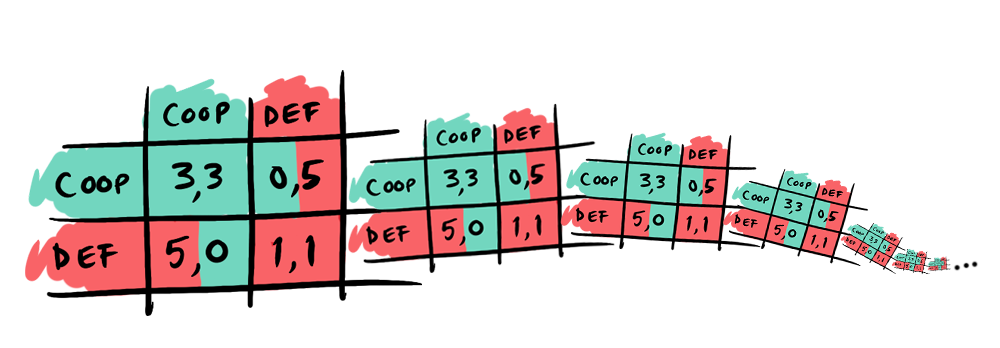
A repeated game is a type of sequential game where a simpler, simultaneous-move game—called the stage game—is played over multiple periods. After each period, players observe the actions taken and payoffs received before proceeding to the next stage.
The following video provides a concise definition of this concept.
7. An Overview of Repeated Games (Game Theory Playlist 8)
This clip from Selcuk Ozyurt's game theory series offers a clear and straightforward definition of a repeated game and introduces the two main types we will be discussing.
Please watch the first 48 seconds (00:00 - 00:48). Focus on the definition of the 'stage game' and the basic distinction between finite and infinite repetition.
Essentially, we are taking a familiar game, like the Prisoner's Dilemma, and playing it over and over.
For a more formal introduction to the structure of these games, the following reading sets the scene.
[PDF] Chapter 12 Repeated Games
Please read the introduction of this chapter from an MIT OpenCourseWare text on game theory. It frames the importance of repeated interactions and formally defines the setup.
Read the first two paragraphs of the chapter (ending before section 12.1). Notice how it connects the idea of repeated play to the influence of the future on present actions.
The key takeaway is that in a repeated game, a player's strategy is no longer a single action, but a complete plan that specifies what action to take in any given period, based on the entire history of play up to that point.
2. Finitely Repeated Games: The Logic of Unravelling
A finitely repeated game is one where the stage game is played a fixed and commonly known number of times, let's call it .
Since there is a known final period, , we can analyze the game using the powerful tool you mastered in the last module: backward induction.
The consequences of this are profound and, at first, may seem counter-intuitive. Let's see how this works using our classic example, the Prisoner's Dilemma.
Game Theory 101 (#54): Repeated Prisoner's Dilemma (Finite)
This video by William Spaniel provides an excellent step-by-step walkthrough of the logic for a finitely repeated Prisoner's Dilemma. It shows why attempts to cooperate are doomed to fail.
Please watch from the beginning to 09:15. Pay close attention to the reasoning: What happens in the final stage of the game? Knowing the outcome of the final stage, what is the rational choice in the second-to-last stage? How does this logic 'unravel' all the way back to the first period?
As the video demonstrates, the logic is inescapable:
- In the final period , there is no future. The game is effectively a one-shot Prisoner's Dilemma. The dominant strategy and unique Nash Equilibrium is for both players to Defect.
- In period , both players know that no matter what they do now, they will both defect in period . Therefore, their actions in cannot influence future play. The "shadow of the future" has vanished. Period becomes, in essence, a one-shot game. The rational choice is to Defect.
- This logic cascades backward. Because play in period is fixed as (Defect, Defect), there is never an incentive to cooperate in period . This holds true all the way back to .
The unique Subgame Perfect Nash Equilibrium is for both players to defect in every single period.
Given your preference for mathematical rigor, the following reading formalizes this result.
[PDF] Chapter 12 Repeated Games
This section of the MIT text provides the formal proof for the 'unravelling' phenomenon we just observed. It uses the Prisoner's Dilemma and another game as examples and then states the general theorem.
Read section 12.1, 'Finitely-repeated games' (starts on page 199). Focus on the logic applied to the Prisoner's Dilemma and the statement of Theorem 12.1. This theorem generalizes the result: if a stage game has a unique equilibrium, the only SPNE in its finite repetition is to play that equilibrium in every stage.
3. Infinitely Repeated Games: The Shadow of the Future
Now, let's change one simple thing: what if there is no known end to the game? This is an infinitely repeated game.
This doesn't necessarily mean the game goes on for eternity. It can be interpreted in a few ways:
- The game literally never ends.
- After each period, there is a constant probability, , that the game will continue for at least one more period.
The crucial feature is the absence of a terminal period. Because there is no "last stage," we cannot use backward induction. The unravelling logic we just saw collapses.
This single change opens up a vast new world of strategic possibilities.
7. An Overview of Repeated Games (Game Theory Playlist 8)
Let's return to the first video, which now contrasts the finite case with the infinite case and highlights the stark difference in outcomes.
Watch from 02:11 to 04:39. Focus on how the equilibrium possibilities change when moving from a finite to an infinite horizon in the Prisoner's Dilemma. Notice the mention that cooperation can now be supported as an equilibrium.
In an infinitely repeated game, the "shadow of the future" is always present. Your actions today can influence your opponent's actions tomorrow, and forever after. This allows for strategies that sustain cooperation through credible threats and promises.
For example, a player can adopt a strategy like: "I will cooperate in the first period. I will continue to cooperate as long as you do. But if you ever defect, I will defect for all future periods."
Faced with this, a player must weigh the short-term gain from defecting now against the long-term loss of all future gains from cooperation. If the future is valued highly enough, cooperation can become a rational, sustainable equilibrium outcome.
4. A Summary of the Distinction
The difference between these two types of games is fundamental. Here is a table summarizing the key points:
| Feature | Finitely Repeated Game | Infinitely Repeated Game |
|---|---|---|
| Horizon | A fixed, commonly known number of periods (). | No known terminal period; game continues indefinitely or with some probability. |
| Key Property | There is a last period. | There is no last period. |
| Solution Method | Backward Induction. | Backward induction is not applicable. Other methods are needed. |
| Strategic Logic | Unravelling from the final period ("end-game problem"). | The "shadow of the future" allows for credible long-term incentives. |
| Outcome in PD | Unique SPNE is to defect in every period. | Cooperation can be sustained as a Nash Equilibrium. |
Conclusion
In this lesson, you have learned the critical distinction between finitely and infinitely repeated games. This is not just a technical detail; it is a structural feature that fundamentally alters the strategic landscape.
Key Takeaways:
- Repeated games consist of a stage game played over multiple periods, with past actions observed.
- In finitely repeated games, the existence of a known final period allows for backward induction. This often leads to an "unravelling" where the logic of the one-shot game dominates every period.
- In infinitely repeated games, the absence of a final period makes backward induction impossible. The "shadow of the future" is always present, allowing for contingent strategies that can support outcomes—like cooperation in the Prisoner's Dilemma—that are impossible in the one-shot or finitely repeated versions.
We've established that cooperation is possible in infinitely repeated games, but under what conditions? How patient must players be for the promise of future cooperation to outweigh the temptation of immediate defection? Our next lesson will equip you with the tool to answer this question precisely. We will define the discount factor and interpret its role in modeling player patience.