Introduction
Hello! In our last lesson, we put all the pieces of a static Bayesian game together to compute the Bayesian Nash Equilibrium (BNE). We saw how an uninformed player uses their beliefs about their opponent's "type" to calculate expected utilities and make an optimal choice. This ability to model situations with hidden information is a powerful tool.
Today, we'll explore two of the most famous and widespread problems that arise from such information asymmetries: adverse selection and moral hazard. This lesson will equip you to distinguish between these two concepts, which are fundamental to economics, contract theory, and policy design. Understanding them is a key step toward applying game theory to the "meaningful planning in a chaotic world" that you're interested in.
The Fundamental Distinction: Information vs. Action
Games of incomplete information create what is often called a Principal-Agent problem. In this framework, a Principal (e.g., an employer, an insurer) designs a contract for an Agent (e.g., an employee, an insured person) to perform a task. The information asymmetry gives rise to two distinct challenges, depending on when the hidden element comes into play.
A great way to start is with a direct and clear definition of each.
Principal Agent Models Part 1: Moral Hazard with Observability
This short clip from BurkeyAcademy offers a precise and clear distinction between moral hazard and adverse selection. Pay close attention to the keywords 'hidden action' and 'hidden information'.
Watch the segment from 00:59 to 02:41.
As the video explains:
- Adverse Selection is a problem of hidden information. The Agent has private information about their "type" before entering into a contract. The Principal doesn't know this information and risks contracting with an undesirable type.
- Moral Hazard is a problem of hidden action. The Agent takes an unobservable action after the contract is agreed upon. The Principal cannot verify if the Agent is behaving as desired.
The timing is the crucial difference. The following diagrams, from the resource Games and Information, illustrate this perfectly.
Diagram of Moral Hazard and Adverse Selection Timing
These diagrams show the sequence of events for Moral Hazard and Adverse Selection. In Adverse Selection, a random event ("N chooses the type of A") occurs before the Principal designs the contract. In Moral Hazard, the Agent's non-verifiable effort occurs after the contract is accepted.
Let's break down each concept with classic examples.
Adverse Selection: The Problem of Hidden Information
Adverse selection occurs when one party in a negotiation has relevant information that the other party lacks. This pre-contractual asymmetry can lead to a "selection" of participants that is "adverse" to the uninformed party.
The Market for Lemons
The most famous example is George Akerlof's 1970 paper on the market for used cars, which he called "The Market for Lemons."
24. Market Failures II: Informational Asymmetry
This video from MIT OpenCourseWare explains Akerlof's 'lemons problem'. It vividly illustrates how the fear of buying a low-quality car (a 'lemon') can depress the price buyers are willing to pay, potentially driving all the high-quality cars ('peaches') out of the market.
Watch the segment from 02:43 to 07:33.
The core logic is as follows:
- Sellers know the quality of their car (e.g., Peach or Lemon). Buyers do not.
- A buyer, unable to distinguish between them, will offer a price based on the average quality of cars on the market.
- This average price might be below the value of a high-quality car (a Peach).
- Consequently, sellers of Peaches will refuse to sell, pulling their cars from the market.
- As Peaches leave, the average quality of cars on the market drops, further lowering the price buyers are willing to pay, until only Lemons remain. The market for good cars collapses.
The Insurance Death Spiral
The same logic applies forcefully to health insurance. Healthy individuals are "Peaches" and unhealthy individuals are "Lemons" from the insurer's perspective.
24. Market Failures II: Informational Asymmetry
Now, let's apply the same logic to health insurance. This segment of the MIT video uses a numerical example that you'll appreciate, demonstrating how adverse selection can lead to a 'death spiral' where only the highest-risk individuals remain insured, making the system unsustainable.
Watch the detailed example from 07:52 to 18:12.
Let's formalize the expected cost calculation from the video.
- Population: 90% healthy, 10% sickly.
- Expected Cost (Healthy):
- Expected Cost (Sickly):
- Pool Average Cost:
If the insurer sets a premium just above this, say at $1,500, to make a profit:
- Sickly people see a great deal: their expected cost is $5,000, but they only pay $1,500. They will definitely buy.
- Healthy people face a bad deal: their expected cost is only $1,000, but the premium is $1,500. Only those who are very risk-averse might buy.
If, as in the video's example, only half the healthy people buy, the pool of customers changes. The new pool is not 90/10 but 45 healthy people and 10 sickly people. The insurer's expected cost per customer is now much higher, and they lose money. Raising the price further just chases more healthy people away, hence the "death spiral."
Moral Hazard: The Problem of Hidden Action
Moral hazard occurs when an agent's behavior changes after a contract is signed because they are insulated from risk. The action is "hidden" because the principal cannot perfectly monitor the agent's effort or choices.
Insurance and Risky Behavior
Insurance is the classic context for moral hazard.
24. Market Failures II: Informational Asymmetry
The same MIT video also provides a great introduction to moral hazard. Listen for how insurance encourages 'adverse behavior' after the policy is in place.
Watch the segment from 30:54 to 32:04.
Once you have theft insurance for your bike, you might not be as diligent about locking it up. Once you have health insurance, you might engage in riskier hobbies. The key is that the insurance contract changes your incentives.
A stark real-world example is in the financial sector.
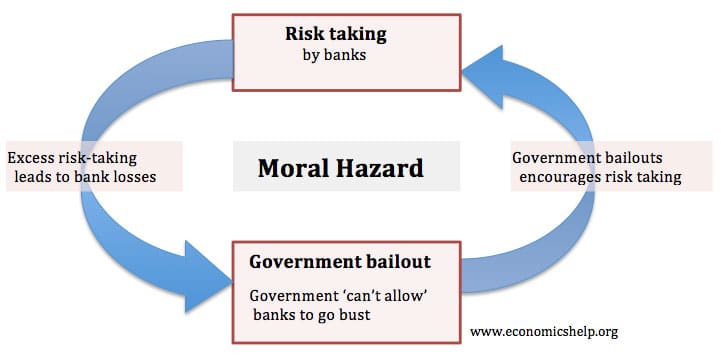
The Cost of Moral Hazard
This change in behavior isn't just a curiosity; it creates real economic costs, or "welfare loss." When an agent doesn't bear the full cost of their actions, they may exert less effort than is socially optimal.
24. Market Failures II: Informational Asymmetry
This final clip from the MIT lecture explains why moral hazard is a problem. It discusses the loss of efficiency when people work less hard because they are insured against job loss, a concept that connects to our understanding of incentives and rational behavior.
Watch from 32:04 to 38:49.
The video explains two main costs:
- Lower Efficiency: The Agent (e.g., an unemployed worker receiving benefits) takes "too much" leisure because they don't face the full cost of not working. The socially optimal balance between work and leisure is distorted.
- Increased Costs for Others: The costs of the Agent's behavior are borne by the Principal (e.g., taxpayers funding unemployment benefits). This can require higher taxes, which in turn distorts the incentives of others.
Summary Table
Here is a table to consolidate the key distinctions:
| Feature | Adverse Selection | Moral Hazard |
|---|---|---|
| Core Problem | Hidden Information (about Agent's type) | Hidden Action (by the Agent) |
| Timing | Asymmetry exists before the contract is signed. | Asymmetry arises after the contract is signed. |
| Nature of Issue | The type of agents in the pool is the problem. | The behavior of the agent (post-contract) is the problem. |
| Classic Example | Used cars ("lemons"), insurance applicants. | Insured drivers taking risks, bailed-out banks. |
| Metaphor | "Choosing the wrong player for your team." | "Your chosen player not trying hard enough during the game." |
For a more formal, mathematical treatment of these Principal-Agent problems, which you might find interesting, you can refer to documents like the notes from Mishra, particularly sections 2 and 3, which set up and analyze models for adverse selection and moral hazard, respectively. You can find these at [PDF] 1 The principal-agent problems 2 Adverse selection problem.
Conclusion
You've now explored the two primary forms of market failure caused by information asymmetry. This distinction is not just academic; it dictates the solutions.
- To fight adverse selection, principals need ways to screen for types (e.g., medical exams for insurance, offering different contracts to let agents self-select).
- To fight moral hazard, principals need ways to monitor actions or align incentives (e.g., deductibles in insurance, performance-based pay).
Key Takeaways:
- Adverse Selection is a pre-contractual problem of hidden information about an agent's type.
- Moral Hazard is a post-contractual problem of hidden action taken by an agent.
- The classic example of adverse selection is the "market for lemons," where bad types can drive out good types.
- The classic example of moral hazard is when insurance leads to riskier behavior, as the agent no longer bears the full cost of their actions.
This lesson concludes our module on static games of incomplete information. In the next module, we'll dive into a major real-world application where these informational problems are paramount: auctions. We will begin by comparing the strategic implications of first-price and second-price sealed-bid auctions.