Introduction
Hello! In our previous lesson, we established the mathematical foundation for making decisions under uncertainty: the expected utility calculation. We saw that to choose an action, a player must average the potential payoffs from that action across all possible types their opponent could be, weighted by their beliefs.
Today, we will use this crucial skill to reach the final goal of this module: computing the Bayesian Nash Equilibrium (BNE) for a 2x2 game with one-sided incomplete information. We'll integrate the concepts of types, beliefs, and expected utility to find a complete strategy profile where every player's type is making the best possible choice, given their information and their beliefs about others.
The Algorithm for Finding a BNE
A Bayesian Nash Equilibrium is a set of strategies—one for each type of player—such that no type has an incentive to unilaterally change their strategy.
For a 2x2 game with one-sided incomplete information (Player 1 has types, Player 2 does not), we can find the pure-strategy BNE using a systematic, four-step process. This method leverages the asymmetry of information to simplify the problem.
-
Analyze the Informed Player (Player 1): For each of Player 1's possible types (e.g., Type A, Type B), determine their best response to each of Player 2's possible actions. Since Player 1 knows their own type, this is a standard best-response analysis within a known payoff matrix. If a dominant strategy exists for a given type, the analysis is even simpler.
-
Calculate the Uninformed Player's (Player 2's) Expected Utility: Player 2 does not know Player 1's type. Therefore, Player 2 must calculate their expected utility for each of their actions. This calculation uses Player 2's beliefs (let's call the probability of Player 1 being Type A as ) and anticipates the actions Player 1 will take for each type (which we found in Step 1).
-
Determine the Uninformed Player's Best Response: Compare the expected utilities Player 2 calculated in Step 2. This will allow you to find the conditions on the belief that make each of Player 2's actions optimal. For example, Player 2 might prefer action 'Left' if is high, and 'Right' if is low.
-
State the Bayesian Nash Equilibrium: Assemble the results from the previous steps into a complete strategy profile. This profile must specify an action for each of Player 1's types and an action for Player 2, which may be conditional on the belief .
A Worked Example
This algorithm is best understood by walking through an example. The following video provides a clear, step-by-step computation.
Game Theory 101 (#64): Bayesian Nash Equilibrium
In this video from his 'Game Theory 101' series, William Spaniel solves for the BNE of a classic one-sided incomplete information game. Watch how he first analyzes the informed player's dominant strategies and then uses that information to calculate the uninformed player's best response.
Please watch the segment from 03:59 to 08:51. Follow the logic closely as he determines Player 1's strategy for each type and then calculates Player 2's optimal choice based on the probability 'p'.
Let's break down the solution in the video according to our four-step algorithm.
The game setup is:
- Player 1 can be Type A (with probability ) or Type B (with probability ).
- If Player 1 is Type A, the game is Matrix A. If Type B, the game is Matrix B.
- Player 2 does not know Player 1's type.
Matrix A (P1 is Type A)
| Left | Right | |
|---|---|---|
| Up | 3, 4 | 1, 3 |
| Down | 4, 3 | 2, 0 |
Matrix B (P1 is Type B)
| Left | Right | |
|---|---|---|
| Up | 6, 2 | 0, 4 |
| Down | 5, 1 | -1, 4 |
Step 1: Analyze the Informed Player (Player 1)
- If Player 1 is Type A: We look only at Matrix A. For Player 1, the action 'Down' yields payoffs (4, 2) which are strictly better than the payoffs from 'Up' (3, 1), regardless of what Player 2 does. Thus, Down is a strictly dominant strategy for Type A. A rational Type A player will always play Down.
- If Player 1 is Type B: We look only at Matrix B. For Player 1, the action 'Up' yields payoffs (6, 0) which are strictly better than 'Down' (5, -1). Thus, Up is a strictly dominant strategy for Type B. A rational Type B player will always play Up.
So, Player 1's strategy is fixed: (Down if Type A, Up if Type B).
Step 2: Calculate the Uninformed Player's (Player 2's) Expected Utility
Player 2 knows Player 1's strategy. Now, Player 2 must calculate the expected utility of her own actions, 'Left' and 'Right'.
-
Expected Utility of 'Left':
Plugging in the payoffs for Player 2 from the matrices:
-
Expected Utility of 'Right':
Plugging in the payoffs for Player 2:
Step 3: Determine the Uninformed Player's Best Response
Player 2 will choose 'Left' if its expected utility is greater than that of 'Right'.
This gives us Player 2's best response, which depends on her belief :
- If , Player 2 plays Left.
- If , Player 2 plays Right.
- If , Player 2 is indifferent and can play either Left, Right, or a mix of the two.
Step 4: State the Bayesian Nash Equilibrium
We can now state the complete BNE by combining our findings:
The Bayesian Nash Equilibrium is the strategy profile:
- Player 1: Plays Down if Type A; plays Up if Type B.
- Player 2: Plays Left if ; plays Right if .
This is a complete description of equilibrium behavior for all players and all types.
Practice Problem
Now it's your turn to apply the algorithm. Consider the game depicted in the image below.
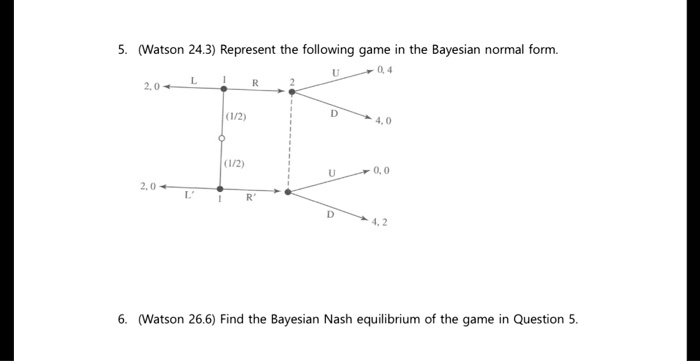
Your Task:
Using the 4-step algorithm we just practiced, compute the Bayesian Nash Equilibrium for the game in the image (Problem 26.6).
- First, write down the two 2x2 payoff matrices corresponding to Player 1's top and bottom "types".
- Follow the four steps to find the BNE. Assume the probability of Player 1 being the "top type" is .
Take some time to work through this. I will provide the solution below for you to check your work.
Click here to see the solution
1. The Payoff Matrices:
Let's call the top initial node "Type T" and the bottom initial node "Type B".
Type T Matrix (p=1/2)
| U | D | |
|---|---|---|
| L | 3, 1 | 0, 0 |
| R | 0, 0 | 1, 3 |
Type B Matrix (1-p=1/2)
| U | D | |
|---|---|---|
| L' | 3, 1 | 0, 0 |
| R' | 0, 0 | 1, -1 |
2. The BNE Calculation:
-
Step 1 (Informed Player):
- Type T: Player 1's best response is L if P2 plays U, and R if P2 plays D. No dominant strategy.
- Type B: Player 1's best response is L' if P2 plays U, and R' if P2 plays D. No dominant strategy.
This is more complex than the last example. We need to check for equilibria under different assumptions about P2's play. Let's hypothesize an equilibrium and check for consistency.
-
Let's analyze Player 2 first for a moment.
- If P2 plays U: P2's expected payoff is .
- If P2 plays D: P2's expected payoff is .
Player 2 seems indifferent between U and D if Player 1 plays (L, L'). Let's see if (L, L') is a best response for P1 if P2 is playing U. - If P2 plays U: Type T P1 gets 3 from L and 0 from R, so L is best. Type B P1 gets 3 from L' and 0 from R', so L' is best.
This looks like an equilibrium!
BNE 1: Player 1 plays (L if Type T, L' if Type B). Player 2 plays U.
Let's check payoffs: EU(P1) = 0.5(3)+0.5(3)=3. EU(P2)=0.5(1)+0.5(1)=1. No one wants to deviate. -
Is there another? What if P2 plays D?
- If P2 plays D: Type T P1 gets 1 from R and 0 from L, so R is best. Type B P1 gets 1 from R' and 0 from L', so R' is best. So P1's strategy must be (R, R').
- Now check P2's choice. If P1 plays (R, R'):
- EU(P2, U) = 0.5(0) + 0.5(0) = 0
- EU(P2, D) = 0.5(3) + 0.5(-1) = 1
- P2's best response to (R, R') is D. This is also consistent.
BNE 2: Player 1 plays (R if Type T, R' if Type B). Player 2 plays D.
Payoffs: EU(P1)=0.5(1)+0.5(1)=1. EU(P2)=0.5(3)+0.5(-1)=1.
This game has two pure-strategy Bayesian Nash Equilibria. This is common in coordination-style games, even with incomplete information.
Conclusion
You have now successfully combined all the elements of a static Bayesian game to solve for its equilibrium. This is a significant step in your game theory journey.
Key Takeaways:
- Computing a BNE involves a step-by-step process of analyzing each player's best response based on their information.
- The analysis begins with the informed player, determining their strategy for each of their types.
- The uninformed player then uses this information, combined with their beliefs (), to calculate their own best response via expected utility maximization.
- The final BNE is a full strategy profile that specifies an action for every type of every player, ensuring mutual best responses across the board.
In our next lesson, we will briefly explore two important concepts that arise from incomplete information: adverse selection (hidden information) and moral hazard (hidden action). These concepts bridge the gap from pure theory to many real-world applications where information is asymmetric.