Introduction
Hello! In our last lesson, we explored adverse selection and moral hazard, two key problems arising from incomplete information. We saw that in many strategic situations, players act without knowing the "type" or hidden information of their opponents. This is the central feature of Bayesian games.
Today, we dive into one of the most significant and practical applications of Bayesian games: auctions. You're constantly surrounded by auctions, from eBay to Google ads to government contracts. They are fundamental mechanisms for resource allocation.
This lesson addresses your goal of understanding strategic behavior by focusing on two foundational auction designs. We will compare the rules and, more importantly, the strategic implications of first-price and second-price sealed-bid auctions. This will lay the groundwork for analyzing more complex bidding strategies and auction designs later in the course.
Setting the Stage: Auction Environments
Before we dissect the rules, it's crucial to understand the environment in which an auction takes place. The most important distinction is how bidders value the item.
24. Asymmetric information: auctions and the winner's curse
This segment from a Yale University lecture on game theory clearly explains the difference between 'common value' and 'private value' auction settings. This distinction is fundamental to how we analyze bidding strategy.
Please watch from 00:15:41 to 00:21:24. Focus on the definitions of common and private values and the examples given for each (like an oil well vs. a cake).
To summarize the key ideas from the video:
- Private Value Auctions: Each bidder's valuation for the item is personal and independent of others' valuations. The value I place on a piece of art I want for my own enjoyment doesn't depend on how much you value it. This is the setting we will focus on for this lesson.
- Common Value Auctions: The item has a single true, objective value that is the same for everyone, but this value is unknown at the time of bidding. Each bidder has an estimate of this value. The oil well example from the video is classic: the amount of oil is the same no matter which company wins the drilling rights.
For the rest of this module, unless stated otherwise, we will assume a private value setting. This allows us to isolate the strategic choices related to the auction rules themselves.
First-Price Sealed-Bid (FPSB) Auction
This is perhaps the most intuitive auction format.
Rules
The rules are simple:
- There are bidders, each with a private valuation .
- Each bidder simultaneously and secretly submits a bid, .
- The bidder with the highest bid wins the item.
- The winner pays the price they bid.
- A bidder's surplus (or payoff) is if they win, and 0 if they lose.
Strategic Implications
In a first-price auction, you face a fundamental trade-off.
GTO2-4-04: Bidding in First-Price Auctions
This short video from Game Theory Online concisely explains the strategic dilemma in a first-price auction.
Watch the first 53 seconds (00:00 - 00:53). Notice the emphasis on the incentive to 'shade' your bid.
As the video explains, bidding your true valuation is not a good idea. If you win by bidding , your surplus is . You gain nothing.
This creates a powerful incentive to shade your bid—that is, to bid some amount .
- The lower you bid, the higher your potential surplus if you win.
- The higher you bid, the higher your probability of winning.
Your optimal bid depends on what you believe other bidders will do. How much you should shade your bid depends on how many bidders there are and what you believe about their valuations. This is a complex Bayesian game with no simple dominant strategy.
Second-Price Sealed-Bid (SPSB) Auction
This auction format, also known as a Vickrey auction, has a clever twist in its rules that dramatically changes the strategic landscape.
Rules
The bidding process is the same, but the payment rule is different:
- There are bidders, each with a private valuation .
- Each bidder simultaneously and secretly submits a bid, .
- The bidder with the highest bid wins the item.
- The winner pays the price of the second-highest bid.
- A bidder's surplus is if they win, and 0 if they lose.
Let's look at a direct visual comparison of the two auction types.
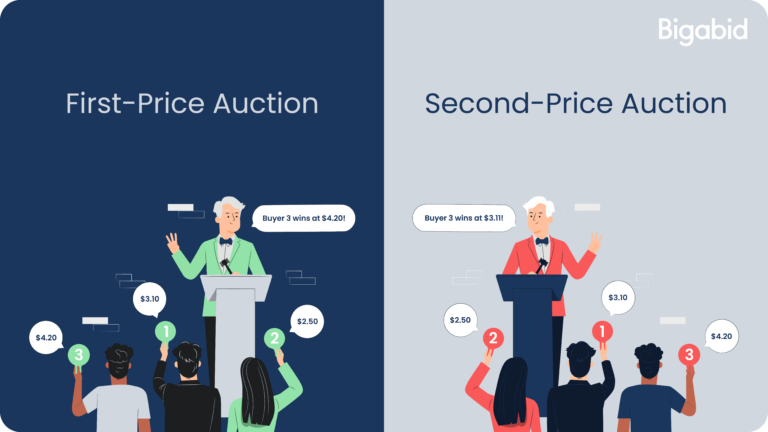
Strategic Implications
The magic of the second-price auction is that it removes the trade-off that complicates the first-price auction. The optimal strategy is surprisingly simple and powerful.
[PDF] Auctions - Computer Science
This document from the University of Liverpool provides a detailed analysis of auction strategies. We will focus on the section that explains the dominant strategy in a second-price auction.
Read the section 'Truth-telling is a dominant strategy' (starting on page 21 of the PDF). You don't need to follow the formal proof on pages 22-25 just yet, but focus on the intuitive explanation provided.
In a second-price auction, bidding your true valuation is a dominant strategy.
This means that bidding is your best possible move, regardless of what any other bidder does. Let's build the intuition for this remarkable result:
Your bid only does one thing: it determines whether you win or lose. The price you pay is determined entirely by your opponents' bids. Let be the highest bid among all other players.
-
Case 1: Your valuation is higher than the competition ()
- If you bid your true value , you win and pay . Your surplus is , which is positive. This is a good outcome.
- Could you have done better? If you bid lower (), you risk bidding below and losing, getting a surplus of 0 instead of a positive one. If you bid higher (), you still win and pay the same price . So, bidding differently doesn't help and might hurt.
-
Case 2: Your valuation is lower than the competition ()
- If you bid your true value , you lose and your surplus is 0. This is the correct outcome, because winning would mean paying , giving you a negative surplus of .
- Could you have done better? If you bid lower, you still lose and get 0. If you bid higher () enough to win (i.e., ), you are forced to pay a price higher than your valuation, resulting in a loss. Again, bidding differently doesn't help and might hurt.
In every possible scenario, you cannot improve your outcome by bidding anything other than your true value.
Comparing the Auctions
We've now seen that a seemingly small change in the payment rule leads to a profound difference in strategy. Let's summarize the comparison.
First-Price and Second-Price Auctions
The QuantEcon project provides excellent computational economic resources. The webpage on auctions includes a fantastic summary table comparing FPSB and SPSB auctions.
Please study the 'Summary of FPSB and SPSB results' table on this webpage. It provides a side-by-side comparison of the rules, strategies, and outcomes.
Here are the key points from that table and our discussion, presented in a slightly different format:
| Feature | First-Price Sealed-Bid (FPSB) | Second-Price Sealed-Bid (SPSB / Vickrey) |
|---|---|---|
| Winner | Highest bidder | Highest bidder |
| Payment Rule | Winner pays their own bid | Winner pays the second-highest bid |
| Bidder's Goal | Maximize | Win if and only if |
| Optimal Strategy | Shade your bid (). A complex trade-off between winning probability and surplus. | Bid truthfully (). This is a dominant strategy. |
| Strategic Mindset | Requires thinking about opponents' strategies and valuations. | Requires only knowing your own valuation. It is "strategy-proof". |
The fact that the SPSB auction induces truthful bidding is incredibly useful for auction designers who want to discover the true valuations of bidders.
Conclusion
In this lesson, we have taken our first steps into the world of auction theory. By comparing first-price and second-price sealed-bid auctions, we have uncovered a core principle in game theory and mechanism design: the rules of the game dictate the players' strategies.
Key Takeaways:
- In a First-Price Sealed-Bid (FPSB) auction, the winner pays their own bid, creating a strategic incentive to "shade" your bid below your true valuation.
- In a Second-Price Sealed-Bid (SPSB) auction, the winner pays the second-highest bid. This rule change makes bidding your true valuation a dominant strategy.
- The SPSB is considered "strategy-proof" because a bidder's best action is to be truthful, regardless of their beliefs about other players. The FPSB, in contrast, requires complex reasoning about your opponents.
We've established the intuition for why truthful bidding is dominant in a second-price auction. Given your interest in mathematical rigor, our next lesson will be dedicated to formalizing this critical result. We will walk through the complete proof to show, step-by-step, why any bid other than your true value is a weakly dominated strategy in an SPSB auction.