Hello! Welcome to your next lesson.
In our last session, we focused on how to ask for information using question words like What?, How?, When?, and Where?. These are essential for understanding your tasks and diagnosing problems in the engine room.
Today, we'll focus on how to answer the questions "Where?" and "When?" with precision. This lesson addresses the learning outcome: Use basic prepositions of time and place in engine room contexts. Using the correct preposition is critical for safety and efficiency. For example, saying "The leak is under the pump" gives very different information than "The leak is in the pump." Clear communication can prevent mistakes and accidents.
We will cover:
- Prepositions of time (
at,on,in) to describe schedules and events. - Prepositions of place (
at,on,in,under,behind, etc.) to describe the location of equipment. - How to apply these prepositions in realistic engine room reports and instructions.
1. Prepositions of Time: When did it happen?
In the engine room, everything runs on a schedule. Maintenance tasks, watch handovers, and safety drills all happen at specific times. We use three main prepositions to talk about time: at, on, and in.
A good way to remember them is to think of a pyramid, from the most specific time at the top to the most general at the bottom.
- AT (Specific time):
at 0800,at noon,at midnight - ON (Days and dates):
on Monday,on May 15th - IN (Longer periods):
in the morning,in April,in 2023
To get a clear overview of these rules, let's look at a helpful guide.
Prepositions Exercises (In, On, At)
The article 'Master English Prepositions' provides a quick reference table and some simple memory tricks for using 'in', 'on', and 'at' for both time and place. We will start by focusing on time.
First, find the heading '📋 Preposition Rules Quick Reference'. Study the 'Time Usage' column in the table. Then, scroll down to '💡 Tips for Mastering English Prepositions' and read the 'Memory Tricks' for IN, ON, and AT. This will give you the core rules.
As the resource explains, the choice of preposition depends on the specificity of the time you are describing.
Here are some examples relevant to your work:
- The watch handover is at 08:00 and at 20:00.
- The safety meeting is on Wednesday.
- We will perform the main engine overhaul in June.
A common exception to remember is at night. We say, "The duty engineer works at night," not "in the night."
Applying Prepositions of Time
Now, let's use these prepositions with a real-world document: a maintenance schedule. Your background in civil engineering means you are very familiar with plans and schedules like this.
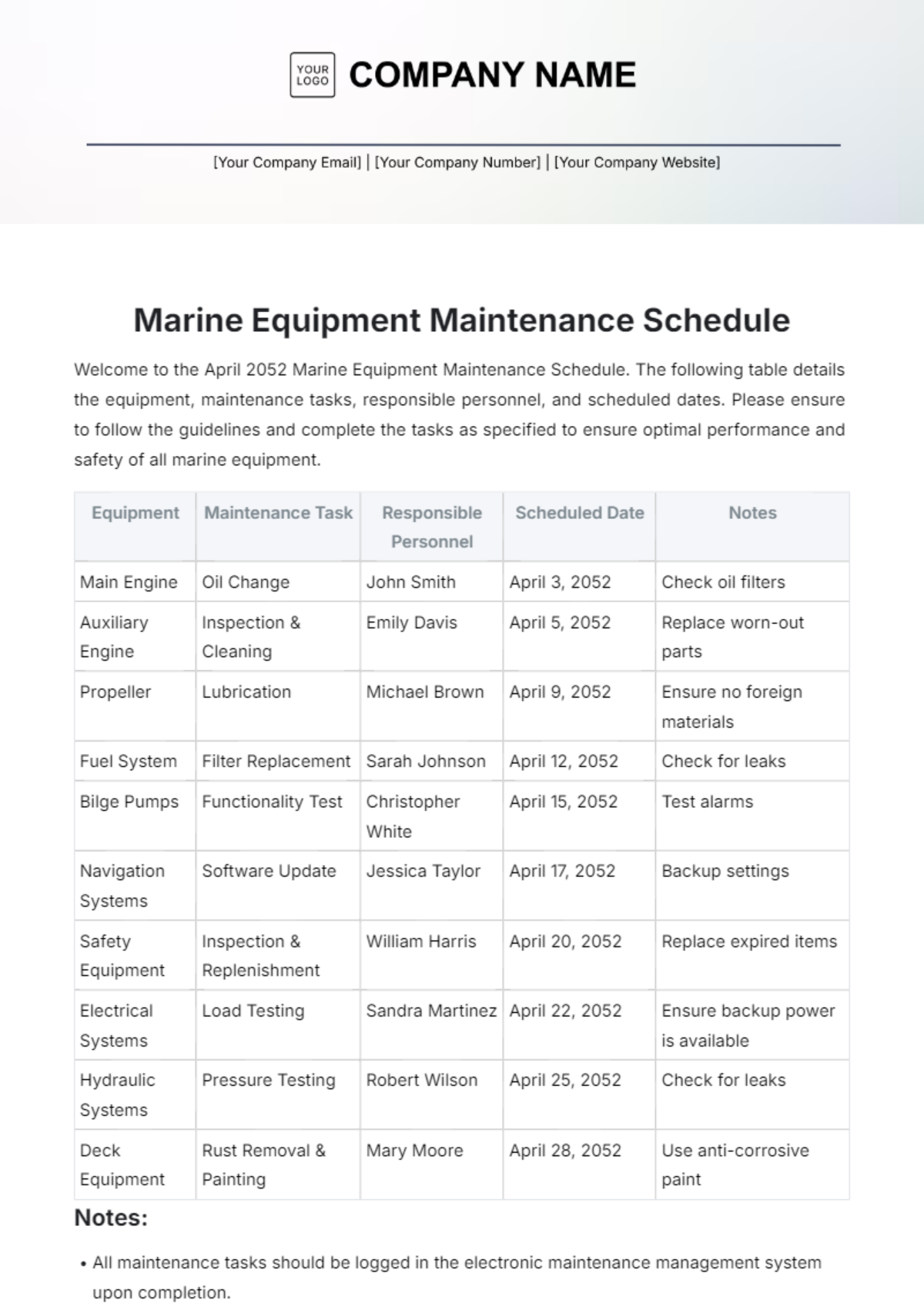
Look at the schedule and use it to form sentences about the planned work.
Test your understanding!
Complete the following sentences using information from the maintenance schedule and the correct preposition (in or on).
- The oil change for the Main Engine is scheduled ______ April 3, 2052.
- The crew will inspect the safety equipment ______ April.
- The propeller inspection will happen ______ April 5, 2052.
Show answer
- The oil change for the Main Engine is scheduled on April 3, 2052.
- The crew will inspect the safety equipment in April.
- The propeller inspection will happen on April 5, 2052.
2. Prepositions of Place: Where is it?
Knowing where things are is fundamental to working safely in the engine room. Just like with time, we use in, on, and at to describe locations, but their meaning changes.
- IN: Inside an enclosed space (e.g.,
inthe engine room,ina drawer,inthe fuel tank). - ON: On a surface (e.g.,
onthe floor,onthe control panel,onthe workbench). - AT: At a specific point or general area (e.g.,
atthe pump station,atthe bottom of the ladder).
You can review the Place Usage column in the Preposition Rules Quick Reference table you looked at earlier to reinforce this.
For an engine rating, you need more specific prepositions to describe the exact position of machinery and tools.
| Preposition | Meaning | Engine Room Example |
|---|---|---|
| under / below | Lower than something | The sump tank is under the main engine. |
| above | Higher than something | The exhaust pipe runs above the generator. |
| behind | At the back of something | The emergency stop button is behind this cover. |
| in front of | At the front of something | Don't stand in front of the switchboard. |
| next to / beside | At the side of something | The fire extinguisher is next to the door. |
| between | In the space separating two things | There is a small leak between pump A and pump B. |
Visualizing Locations on a Ship
Ships are complex, multi-level structures. Technical drawings, like the one below, help everyone understand the layout.

Using this kind of diagram, we can describe locations vertically.
- "The main engine is on the lower platform, below the control room."
- "The emergency generator is usually located on an upper deck, above the main engine room."
- "You will find the workshop in the engine room, next to the auxiliary engines."
Test your understanding!
Imagine you are giving instructions to a new crew member. Fill in the blanks with the most logical preposition of place (in, on, under, next to, between).
- "The spare gaskets are ______ that blue cabinet, ______ the bottom shelf."
- "You'll find the logbook ______ the desk in the control room."
- "There is a drip tray ______ the pump to catch any oil."
- "The main seawater valve is located ______ the two large filters."
Show answer
- "The spare gaskets are in that blue cabinet, on the bottom shelf."
- "You'll find the logbook on the desk in the control room."
- "There is a drip tray under the pump to catch any oil."
- "The main seawater valve is located between the two large filters."
3. Practice and Consolidation
Now let's put it all together. The best way to master prepositions is through practice and repetition. The following resource contains short quizzes that give you immediate feedback. Completing them will help solidify your understanding of the rules for in, on, and at.
Prepositions Exercises (In, On, At)
Now it's time to actively practice what you've learned. This resource has two great exercises for 'in', 'on', and 'at' for both time and place.
On the main page, find the section '📚 The 13 Prepositions Exercises'. First, click 'Start Exercise' for 'In, On, At for Time' and complete the 20 questions. Then, go back and click 'Start Exercise' for 'In, On, At for Place' and complete those 20 questions. Focus on understanding why each answer is correct.
These exercises use general English, but the rules are exactly the same for the technical language you use in the engine room. Getting them right here will help you get them right on the job.
Conclusion
Great work today. You have learned how to use the most fundamental prepositions to accurately describe when an action happens and where equipment is located. This is a small but vital detail that makes your communication clear, professional, and safe.
Key Takeaways:
- For Time: Use
infor long periods (months, years),onfor days and dates, andatfor specific clock times. - For Place: Use
infor enclosed spaces,onfor surfaces, andatfor specific points. - Mastering other prepositions like
under,above,next to, andbetweenis crucial for giving precise instructions in the engine room.
Preview of the next lesson:
We have now covered how to describe routines, ask questions, and describe time and place. In the next lesson, we will learn how to describe the quality and performance of equipment. We will focus on the learning outcome: Form and use comparative and superlative adjectives to describe equipment performance. This will allow you to say things like, "The new pump is more efficient than the old one," or "This is the hottest part of the engine."