Hello! Welcome back to your English course.
In our last lesson, we focused on using prepositions to describe when a task happens and where equipment is located. This is essential for giving and understanding clear instructions.
Today, we will build on that by learning how to describe and compare the quality and performance of that equipment. This lesson will cover the learning outcome: Form and use comparative and superlative adjectives to describe equipment performance. This skill is critical in the engine room. You'll need it to report changes ("The engine is running hotter than yesterday"), compare equipment ("The new pump is more efficient"), or identify extremes ("This is the loudest alarm").
We will cover three main areas:
- The difference between comparative and superlative adjectives.
- The rules for forming them correctly.
- How to use them in sentences to describe machinery.
1. What are Comparatives and Superlatives?
When we want to compare things, we change the form of our adjectives.
- Comparative adjectives compare two people, places, or things.
- Superlative adjectives compare three or more people, places, or things, to find the one with the 'most' of a certain quality.
For example, look at this image of an engine room.
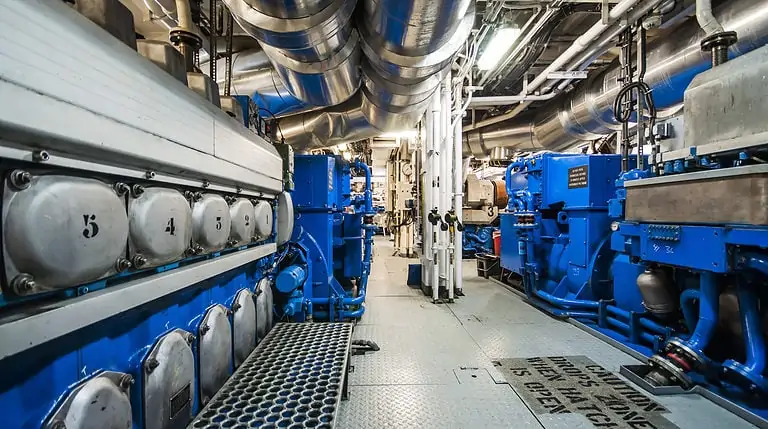
We could make some simple comparisons:
- The blue engine is large. (Simple adjective)
- The blue engine is larger than the yellow pipe. (Comparative: comparing two things)
- The blue engine is the largest piece of equipment in this picture. (Superlative: comparing one thing to all the others)
To get a very clear explanation of this basic principle, please watch the first part of the following video.
Comparative and Superlative Adjectives - English Grammar Lesson
The video 'Comparative and Superlative Adjectives' by Woodward English gives a great introduction to the main idea. We'll start by watching the section that explains the basic difference.
Watch from the beginning until 01:44. Focus on understanding the difference between comparing two animals (comparative) and comparing one animal to the whole group (superlative).
2. How to Form Comparatives and Superlatives
Now that you understand the concept, let's learn the rules for forming these adjectives. The rules depend on the number of syllables in the adjective and its spelling.
The video you just started explains these rules very clearly. Please continue watching it to learn how to form comparatives and superlatives correctly.
Comparative and Superlative Adjectives - English Grammar Lesson
Let's continue with the Woodward English video to learn the specific grammar rules for forming comparatives and superlatives.
Watch from 01:44 to 10:17. Pay close attention to the different rules for: One-syllable adjectives (like fast, big) Adjectives ending in '-y' (like happy) Longer adjectives with two or more syllables (like expensive) Irregular adjectives (like good and bad)
Summary of Formation Rules
Let's summarize those rules with examples relevant to your work in the engine room.
| Adjective Type | Comparative (-er / more) | Superlative (-est / most) | Example Sentence |
|---|---|---|---|
| One Syllable | old → older | old → the oldest | The new pump is faster than the old one. |
(e.g., old, hot, loud) |
hot → hotter | hot → the hottest | Cylinder 3 is hotter than Cylinder 2. |
| Ends in -y | noisy → noisier | noisy → the noisiest | The auxiliary engine is noisier today. |
(e.g., noisy, heavy) |
heavy → heavier | heavy → the heaviest | This spare part is heavier than I expected. |
| 2+ Syllables | efficient → more efficient | efficient → the most efficient | The LED lights are more efficient. |
(e.g., efficient, powerful) |
powerful → more powerful | powerful → the most powerful | This is the most powerful generator on board. |
| Irregular | good → better | good → the best | The oil pressure is better now. |
(e.g., good, bad) |
bad → worse | bad → the worst | The vibration is getting worse. |
Test your understanding!
Complete the sentences below with the correct comparative or superlative form of the adjective in parentheses.
- The temperature in the engine room is always ______ (high) than on the deck.
- After the repair, the engine is running ______ (smooth) than before.
- Of all the tools in the workshop, the hydraulic press is the ______ (heavy).
- This new lubricant has ______ (good) performance in high temperatures.
- Reporting a minor issue is always ______ (easy) than fixing a major failure.
- The main engine is the ______ (important) piece of machinery on the ship.
Show answer
- The temperature in the engine room is always higher than on the deck.
- After the repair, the engine is running smoother than before.
- Of all the tools in the workshop, the hydraulic press is the heaviest.
- This new lubricant has better performance in high temperatures.
- Reporting a minor issue is always easier than fixing a major failure.
- The main engine is the most important piece of machinery on the ship.
3. Using Comparatives and Superlatives in Practice
Knowing the rules is the first step. The next is using them correctly in sentences. As you've seen in the examples, there are two key words to remember:
- We use
thanwith comparatives to connect the two things being compared. - We use
thebefore superlatives.
The following resource provides excellent examples of how these adjectives are used when describing machines and points out common mistakes to avoid.
Adjectives for Machines: Describing Mechanical Marvels
Let's read a short text from 'Adjectives for Machines'. It gives clear examples in a technical context and has a very useful table of common mistakes.
Please read the section 'Comparative and Superlative Forms' for examples. Then, carefully study the table under 'Common Mistakes When Using Adjectives for Machines'. Pay special attention to the incorrect examples like 'more better' and 'most largest', which are very common errors.
As you saw, a common mistake is to use more with an -er adjective (e.g., "more faster") or most with an -est adjective (e.g., "the most biggest"). By remembering the rules based on syllables, you can avoid this.
An Advanced Structure: "The..., the..."
There is a special structure using two comparatives that is very useful for describing cause and effect in engineering.
- The higher the pressure, the higher the temperature.
- The faster the engine runs, the more fuel it consumes.
- The older the filter gets, the less effective it becomes.
This structure shows that when one thing changes, another thing also changes as a result.
Conclusion
Well done. Today you've learned a fundamental grammar point that is directly applicable to your daily work. Being able to compare equipment performance is essential for technical reporting and clear communication with your fellow crew members.
Key Takeaways:
- Use comparative adjectives (
-erormore) to compare two items. Always usethanin the comparison. - Use superlative adjectives (
-estorthe most) to compare three or more items. Always usethebefore the superlative. - The form you use depends on the number of syllables in the adjective.
- Remember the irregular forms:
good, better, bestandbad, worse, worst. - Avoid common mistakes like "more bigger" or "the most oldest".
Preview of the next lesson:
We have now completed the first module on A2 Grammar Foundations. In the next lesson, we will begin Module 2: A2 Maritime Orientation and Basic Communication. We'll start by learning to identify key areas on a ship (bridge, deck, engine room, galley) and use basic directional terms (port, starboard, forward, aft). This will expand your ability to describe locations from inside the engine room to the entire vessel.