Hello! Welcome to your next lesson.
In our last session, we learned how to use will and going to to make statements about the future, which is essential for discussing planned maintenance. For example, "I am going to inspect the compressor."
Today, we'll build on that by learning how to ask for information. This lesson focuses on the learning outcome: Form questions using question words to ask about machinery and procedures. Knowing how to ask clear questions is one of the most important communication skills in an engine room. It helps you understand your tasks, diagnose problems, and ensure safety for everyone on board.
We will cover:
- The main "Wh-" question words: What, Where, When, Why, Who, and How.
- The correct sentence structure for forming questions.
- How to apply these questions in realistic engine room scenarios.
1. The Basic Tools: "Wh-" Question Words
In English, we use a specific set of words to ask for information, not just a "yes" or "no" answer. These are often called "Wh-" words because most of them start with "wh".
Let's watch a short video to learn the purpose of each word.
Wh- Questions – English Grammar Lessons
This video, 'Wh- Questions' from Ellii, provides a clear and simple introduction to the main question words and what kind of information each one asks for.
Watch from the beginning until 01:30. Pay attention to the six key words and the example given for each one (e.g., 'who' for a person, 'where' for a place).
As the video explained, here is a summary of the question words and their functions in a maritime context:
| Question Word | Asks About... | Engine Room Example |
|---|---|---|
| What | A thing or an action | What is the normal operating pressure? |
| Where | A place or location | Where are the spare parts for the purifier? |
| When | A time or date | When does the watch change? |
| Why | A reason or cause | Why is the alarm sounding? |
| Who | A person | Who is the duty engineer today? |
| How | A manner or process | How do I start the emergency fire pump? |
2. The Structure of a "Wh-" Question
Now that you know the words, let's look at how to build a grammatically correct question. There are two main patterns you will use constantly.
The video you just watched also explains these patterns clearly. Let's continue with it.
Wh- Questions – English Grammar Lessons
We will continue with the Ellii video to understand the two most common sentence structures for asking Wh- questions in the present tense.
Watch from 01:30 to 03:18. Focus on the two patterns: one with the verb 'be' (is, are) and one with the auxiliary verb 'do/does'.
To reinforce this, let's look at some maritime-specific examples from a training document. This will help you see how these grammar rules are used in your field.
Maritime Technical English Course
The document 'Maritime Technical English Course' shows how to form these questions with examples related to ship operations.
Please read page 9 of the PDF. Start at the section 'Now we are going to see how we form questions with this tense' and stop before the heading '4 SHIPYARDS'. Focus on the 'Information questions' formula and the examples provided.
Here's a summary of the two structures you've just learned:
Structure 1: With the verb be (is, am, are)
This is used for questions about identity, state, or location.
Formula: Wh-word + be + subject?
What **is** this lever?Where **are** the fire extinguishers?Who **is** on watch?
Structure 2: With all other verbs (using do/does)
This is used for questions about actions.
Formula: Wh-word + do/does + subject + verb?
What **does** this button **do**?When **do** you **check** the bilges?How **do** they **start** the main engine?
Remember: Use does for he, she, it, or a singular noun (e.g., the pump, the engineer). Use do for all others (I, you, we, they, plural nouns).
Test your understanding!
Use the words provided to create a correct question.
- Where / the main engine / is ?
- How / I / do / operate this machine ?
- What / the Chief Engineer / does / need ?
- When / you / do / clean the filters ?
Show answer
- Where is the main engine?
- How do I operate this machine?
- What does the Chief Engineer need?
- When do you clean the filters?
3. Asking Questions in the Engine Room
Let's apply these skills to a real-world situation. Imagine you see a colleague working at a control panel.
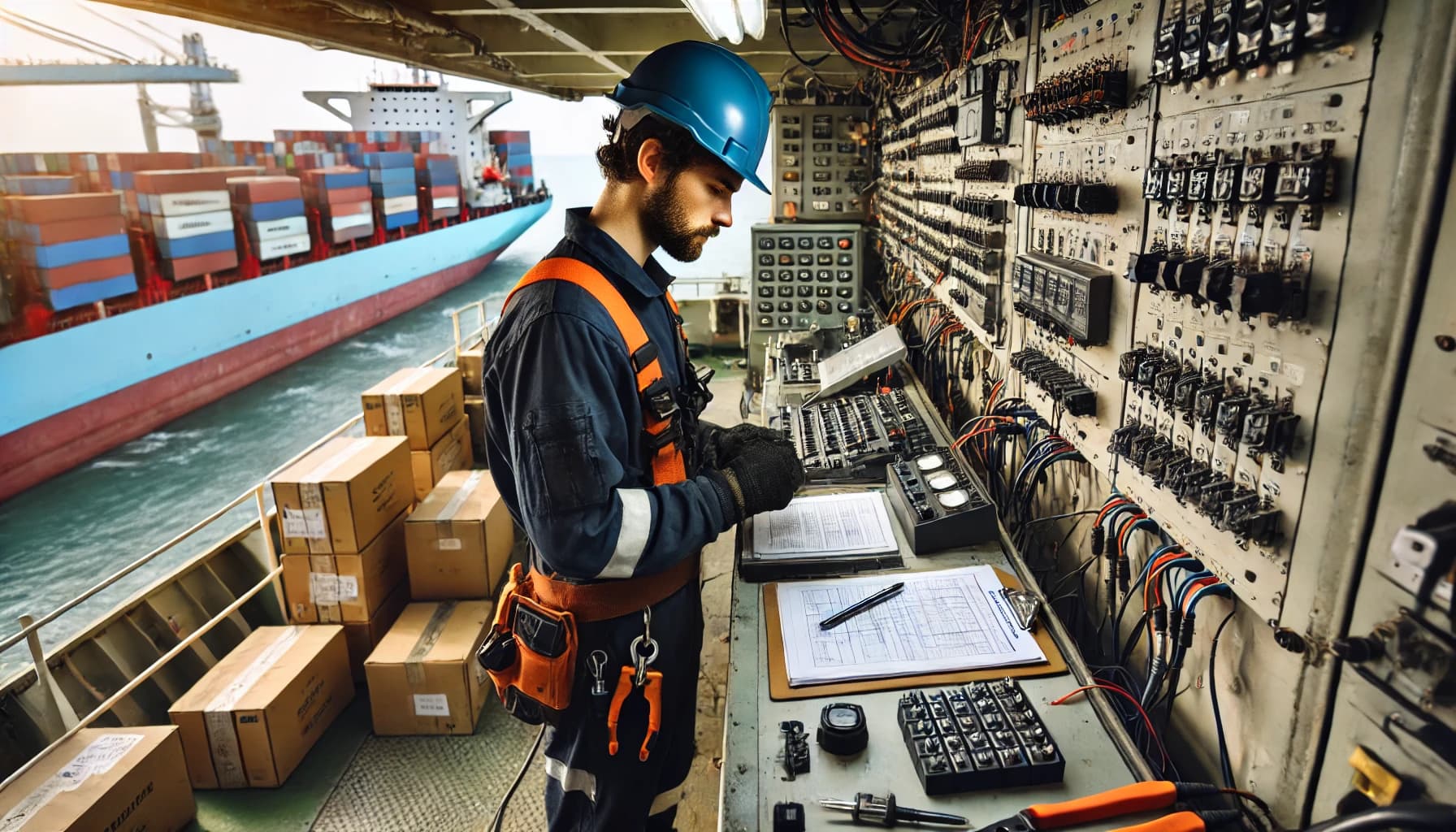
You need to understand what is happening. You could ask:
- What are you checking? (Describes the action)
- Why is that light blinking? (Asks for a reason)
- How can I help you? (Asks about the process/manner)
Now, let's look at some examples from a set of maritime English exercises. These show how questions are used to check understanding of technical information.
Maritime English Exercises for Ship Engineers and ...
This resource, 'Maritime English Exercises for Ship Engineers', contains a short reading passage followed by questions. We will focus on the questions themselves as models.
Find '6. Safety and Backup Systems – Reading Practice'. You don't need to answer the questions. Instead, read the four questions (6.1 to 6.4) and notice how they are formed using 'What' to ask about function, role, process, and fluid type.
Notice how those questions are direct and specific. They use "What" to ask for important information:
What function does a hydrophore unit perform?(Wh-word + does + subject + verb)What is one role of an air compressor...?(Wh-word + is + subject)
Finally, let's see how these questions appear in a natural conversation between engineers.
Maritime English Exercises for Ship Engineers and ...
In the same exercise document, there is a dialogue completion exercise that shows a realistic fault report. This is a perfect example of how questions are used to solve problems.
Find '26. Communication Practice – Fault Dialogue Completion'. Read the short conversation between the Third Engineer and the Chief Engineer. Pay close attention to the two questions the Chief Engineer asks.
In that dialogue, the Chief Engineer needs to understand the problem quickly. He asks two critical questions:
When did it start?(Asks for time)What actions have you taken so far?(Asks about action)
These are exactly the kinds of questions you will need to ask and answer. Now, try to complete the dialogue yourself. What information do you think the Third Engineer provides?
Practice: Complete the dialogue
Fill in the blanks in the dialogue from exercise 26 with logical information.
Third Engineer: Chief Engineer, we have a problem with the [machine name]. It’s showing an abnormal vibration.
Chief Engineer: When did it start?
Third Engineer: Around [time] hours during engine rounds.
Chief Engineer: What actions have you taken so far?
Third Engineer: We checked the coupling and found [a problem, e.g., a loose bolt]. We are isolating it now.
Chief Engineer: Log it and inform the bridge. Monitor closely.
There are many possible correct answers. The goal is to practice thinking about what information is needed.
Conclusion
Excellent work. You can now form the essential questions needed to function effectively and safely in an engine room. This skill is a critical foundation for everything from daily routines to emergency procedures.
Key Takeaways:
- Use the "Wh-" words (What, Where, When, Why, Who, How) to ask for specific information.
- Remember the two main question structures:
- Wh-word +
be+ subject? (e.g., Where is the leak?) - Wh-word +
do/does+ subject + verb? (e.g., How does this pump work?)
- Wh-word +
- Asking clear questions is vital for understanding your job, reporting problems, and ensuring safety.
Preview of the next lesson:
In this lesson, you learned how to ask "Where?" and "When?". In our next lesson, we will focus on how to answer those questions accurately. We will cover the learning outcome: Use basic prepositions of time and place in engine room contexts. This will allow you to describe locations (e.g., "The valve is behind the generator") and time (e.g., "Check the pressure at 8:00 AM").