Hello! Welcome back to your English course.
In our last lesson, we focused on the past simple tense to report on completed tasks, such as "I repaired the pump yesterday." Now, we will shift our attention from what has been done to what needs to be done.
This lesson addresses the learning outcome: Use future tenses with 'will' and 'going to' to discuss planned maintenance. This is a critical skill for your work in the engine department, as you'll constantly be discussing work schedules, planning tasks with your team, and communicating future actions to your supervisor.
We will cover:
- The main difference between using
willandgoing to. - How to form sentences with both structures.
- How to apply these tenses in common engine room scenarios, from discussing a maintenance schedule to making a quick decision.
1. The Core Difference: Plans vs. Spontaneous Decisions
The most important rule to remember is the difference in intention.
- We use
be going tofor plans, intentions, or decisions made before the moment of speaking. - We use
willfor spontaneous decisions, offers, or promises made at the moment of speaking.
Let's watch a video that explains this key difference with a clear example.
Learn English Tenses: FUTURE – “will” or “going to”?
The video 'Learn English Tenses: FUTURE – “will” or “going to”?' by Learn English with Rebecca · engVid is excellent for understanding this topic. We'll start with the section that explains the difference between a planned action and a spontaneous one.
Please watch from 02:41 to 05:18. Pay close attention to the example about getting coffee. Notice how the person who already decided uses 'going to', and the person who decides at that moment uses 'will'.
Now, let's apply this to an engine room context:
-
Scenario 1 (Plan): You are looking at the weekly maintenance schedule in the morning. You see that "Clean fuel filters" is on the list for today. You say:
"I am going to clean the fuel filters this afternoon."
This is a plan you made before speaking. -
Scenario 2 (Spontaneous Decision): You are doing your rounds and you notice a small water leak from a pipe joint. You decide to fix it immediately. You say to your partner:
"I will tighten that fitting right now."
This was not a previous plan; you decided at the moment you saw the problem.
2. How to Form Sentences with 'Will' and 'Going to'
Now that you understand the main difference in meaning, let's look at the grammar. The structure for each is consistent and straightforward.
The article "Expressing the Future With 'Will' and 'Going to'" provides a very clear summary of the sentence structures.
Expressing the Future With 'Will' and 'Going to'
Let's read the first part of this article from ThoughtCo. It gives a simple, direct explanation of the positive, negative, and question forms for both 'will' and 'going to'.
Read the sections titled 'The Future With Will' and 'The Future With Going To'. Focus on the structure examples for positive, negative, and question sentences. You can skip the initial 'Key Takeaways' section.
Here's a quick summary of the structures you just read:
| Type | will |
be going to |
|---|---|---|
| Positive | Subject + will + verb | Subject + am/is/are + going to + verb |
| I will check the oil. | I am going to check the oil. | |
| Negative | Subject + will not (won't) + verb | Subject + am/is/are + not + going to + verb |
| He won't start the engine. | He is not going to start the engine. | |
| Question | Will + subject + verb? | Am/Is/Are + subject + going to + verb? |
| Will you inspect the pump? | Are you going to inspect the pump? |
Note on Contractions: In spoken English and informal writing, we almost always use contractions:
I will->I'llwill not->won'tI am->I'mhe is->he'sthey are->they're
Test your understanding!
Complete these sentences using the correct form of will or going to and the verb in parentheses.
- (Positive,
going to) The maintenance plan says we ____________ (overhaul) the auxiliary engine next month. - (Negative,
will) I see the pressure is normal, so I ____________ (shut down) the system. - (Question,
going to) ____________ you ____________ (test) the emergency generator today as scheduled? - (Positive,
will) The alarm is ringing. I ____________ (check) it!
Show answer
- The maintenance plan says we are going to overhaul the auxiliary engine next month.
- I see the pressure is normal, so I won't shut down the system.
- Are you going to test the emergency generator today as scheduled?
- The alarm is ringing. I**'ll check** it!
3. Application: Discussing Planned Maintenance
Your primary use for these future tenses will be discussing the work plan. Let's look at a realistic example.
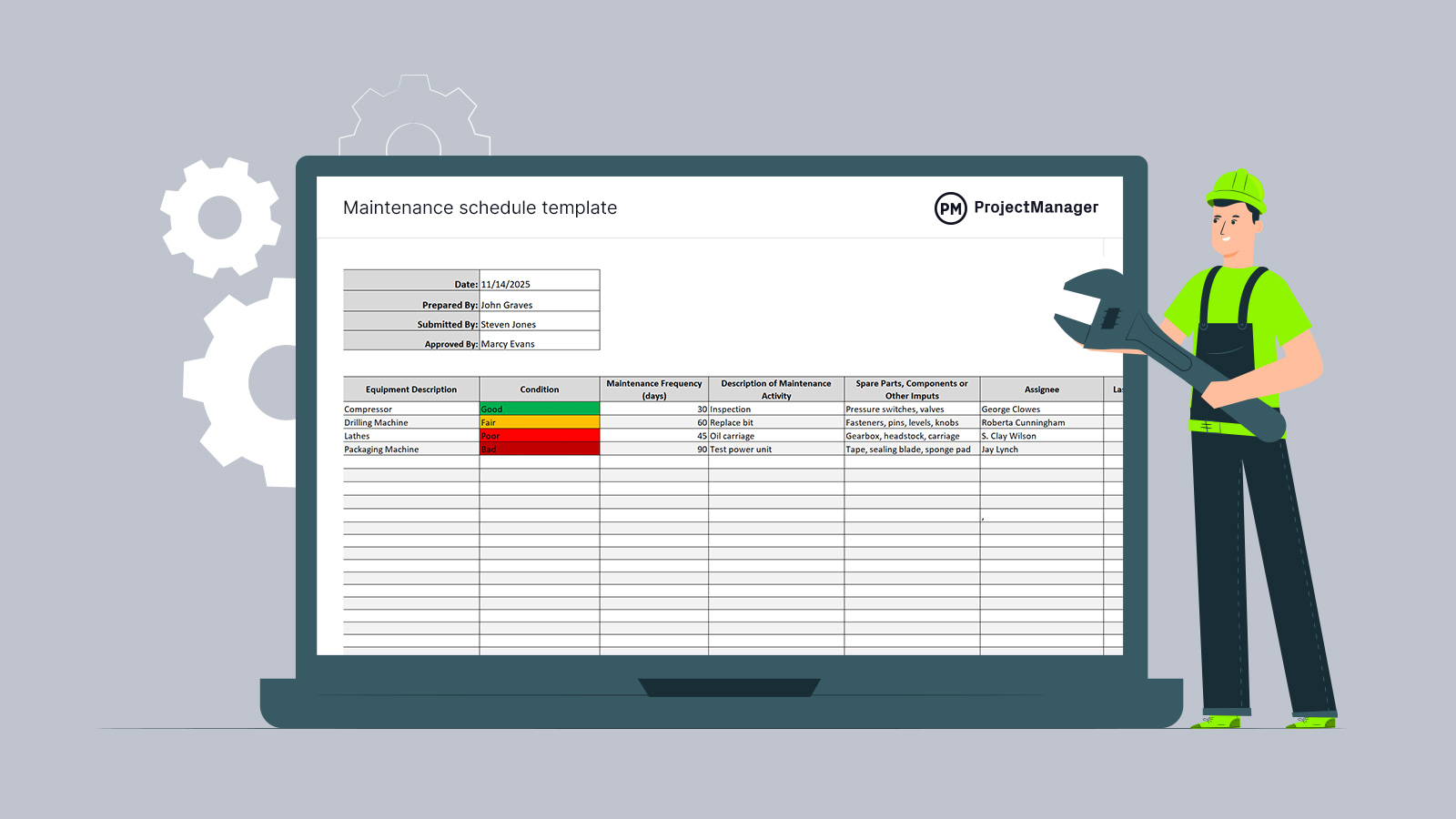
When you discuss this schedule with your supervisor or colleagues, you will use going to because these are all pre-decided plans.
- "On Monday, I am going to inspect the compressor."
- "The assignee for the drilling machine is David. He is going to replace the bit."
- "We are going to test the power unit next week."
Now, imagine you are in the engine room discussing the day's work with a colleague.

A conversation might mix both going to and will:
Engineer A: "What are you working on this morning?"
Engineer B: "I'm going to change the oil on the auxiliary engine. It's on the schedule for today." (Plan)
(Later, an alarm sounds)
Engineer A: "That's the low-pressure alarm for the cooling system."
Engineer B: "Okay, I'll go and check the sea water inlet valve right away." (Spontaneous decision)
4. Other Uses of 'Will'
Besides spontaneous decisions, will is also commonly used for offers, promises, and formal announcements. These are very relevant on a ship.
Will vs Going To: Understanding the Difference | EasyTeaching
The video 'Will vs Going To: Understanding the Difference' by EasyTeaching provides a quick summary of these other uses.
Watch from 00:30 to 01:58. Focus on the examples for promises, offers, and refusals.
Here are some maritime examples:
- Offer: "That toolbox looks heavy. I'll help you carry it."
- Promise: "Don't worry, I'll finish the report before the end of my watch."
- Formal Announcement: "The vessel will begin bunkering operations at 14:00."
Final Practice
Let's put it all together. Choose the best option (will or be going to) for each engine room scenario.
-
A: "I can't reach the valve handle."
B: "Stay there, I (will get/am going to get) you the stepladder." -
According to the work plan, we (
will inspect/are going to inspect) the fire pump tomorrow morning. -
The Chief Engineer just looked at the temperature gauge and it's in the red zone. He decided, "I (
will shut down/am going to shut down) the engine now!" -
A: "Have you made any plans for after your watch?"
B: "Yes, I (will watch/am going to watch) a movie in my cabin." -
The captain announced over the PA system: "All crew members (
will attend/are going to attend) the safety drill at 15:00."
Show answers
- will get (This is an offer made at the moment of speaking).
- are going to inspect (This is a pre-decided plan from the schedule).
- will shut down (This is a spontaneous decision based on new information).
- am going to watch (This is a plan made before the conversation).
- will attend (This is a formal announcement or order).
Conclusion
Great job! You have now learned how to talk about future actions, which is essential for planning and coordinating work in the engine room.
- Key Takeaways:
- Use
be going tofor actions you have already planned or decided. This is key for discussing maintenance schedules. - Use
willfor spontaneous decisions made at the moment of speaking, and also for offers, promises, and formal announcements. - The grammatical structures are simple but distinct, so practice using them correctly.
- Use
Preview of the next lesson:
Now that you can make statements about the past and the future, our next step will be to ask for information. In the next lesson, you will learn to form questions using question words (what, where, when, why, how). This will allow you to ask important questions like, "When are you going to inspect the generator?" or "Why did the alarm sound?"