Hello! Welcome to your next lesson in our module on NoSQL databases.
In the previous lesson, we established a high-level comparison between relational (SQL) and non-relational (NoSQL) databases, contrasting their approaches to schema, scaling, and consistency. We ended with a promise to explore the different types of NoSQL databases one by one.
Today, we'll fulfill that promise by diving into the first and simplest type. This lesson addresses the learning outcome: Describe the data model and typical use cases for key-value stores (e.g., Redis). We will dissect this fundamental NoSQL model and see why its simplicity is its greatest strength, making it a go-to solution for specific, high-performance problems in modern software.
The Key-Value Data Model: A Digital Dictionary
At its heart, the key-value model is the most straightforward of all database models. You can think of it as a massive dictionary or, given your background, a hash table.
The model consists of just two parts:
- Key: A unique string that acts as an identifier.
- Value: The data associated with that key.
You use the key to store (PUT or SET) a value, and you use the same key to retrieve (GET) that value. It's that simple. The crucial characteristic is that you can only retrieve data using its key. There's no way to query the contents of the values themselves, unlike a SQL database where you can use a WHERE clause on any column.
The article 'What is a Key-Value Database?' on the official Redis website provides a great introduction to this concept.
Please read the first two sections, 'What is a Key-Value Database?' and 'Understanding Key-Value Databases'. Focus on the simplicity of the model and the explicit mention that values cannot be queried.
This model provides incredible performance for read and write operations because finding data by its key is an extremely fast, direct lookup. The trade-off is the lack of a complex query language.
Redis: The Swiss Army Knife of Key-Value Stores
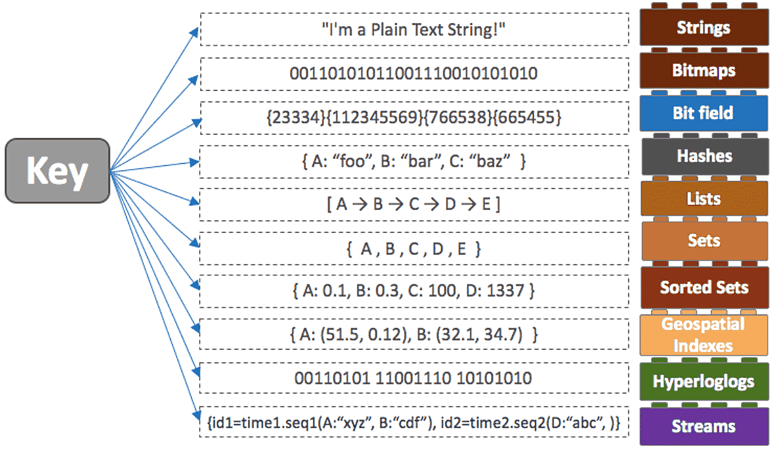
While the basic concept is simple, modern key-value stores like Redis have evolved. Redis is not just a key-value store; it's often called a data structure server. This is because the "value" associated with a key isn't limited to a simple string. It can be a list, a set, a hash (an object-like structure), a sorted set, and more.
Let's watch a video that explains the core characteristics that make Redis so powerful and popular.
Redis Deep Dive w/ a Ex-Meta Senior Manager
The video 'Redis Deep Dive' from Hello Interview gives a fantastic overview of Redis's fundamental design.
Please watch from 02:03 to 05:26. Pay close attention to the three core properties discussed: Single-threaded: This will resonate with your interest in systems programming. It simplifies the execution model to 'first in, first out'. In-memory: This is the source of its speed, but also has implications for data durability. Data structure server: This is the key idea. Understand how a value can be more than just a string.
As the video explained, thinking of Redis as a distributed implementation of the data structures you'd learn about in a computer science course is a powerful mental model. This makes it far more versatile than a simple key-value store.
Common Use Cases: Where Key-Value Stores Shine
So, when would you choose a fast but simple key-value store over a powerful relational database? It's all about picking the right tool for the job. Key-value stores excel in scenarios where you need extremely fast access to data and your access pattern is based on a known key.
The following resource provides an excellent catalogue of these use cases. We'll explore the most important ones.
Redis - Hello Interview System Design in a Hurry
The 'Redis Deep Dive' article from Hello Interview (the same source as the video) details the most common applications of Redis.
Skim through the sections under 'Capabilities': 'Redis as a Cache', 'Redis as a Distributed Lock', 'Redis for Leaderboards', and 'Redis for Rate Limiting'. You don't need to memorize the commands, but focus on understanding why Redis is a good fit for each problem.
Let's consolidate the most critical use cases:
1. Caching
This is the number one use case for Redis. Applications often have data that is read frequently but updated infrequently (e.g., a user's profile, a product details page). Instead of hitting the slower, disk-based primary database (like PostgreSQL or MySQL) for every request, the application first checks the Redis cache.
- Cache Hit: If the data is in Redis (a "hit"), it's returned to the user almost instantly.
- Cache Miss: If the data is not in Redis (a "miss"), the application queries the primary database, returns the data to the user, and—crucially—stores it in Redis for next time.
This dramatically reduces the load on the main database and improves application response time.
2. Session Management
When you log into a website, the server needs to remember who you are as you navigate from page to page. This "session" information (e.g., user ID, permissions, shopping cart contents) needs to be stored and retrieved quickly on every request. A key-value store is perfect for this:
- Key: A unique session ID stored in the user's browser cookie.
- Value: A hash or JSON object containing the user's session data.
3. Real-Time Applications
Because Redis is an in-memory data structure server with atomic operations, it's ideal for applications that need to process real-time data with very low latency.
- Counters: The
INCRcommand is atomic, meaning Redis guarantees that even with many simultaneous requests, a counter will be incremented correctly. This is great for tracking likes, views, or API usage for rate limiting. - Leaderboards: The "Sorted Set" data structure is perfect for building real-time leaderboards in games or contests. It automatically keeps a collection of items sorted by a score. Adding a new score and retrieving the top N players are both incredibly fast operations.

Test your understanding!
Consider the following scenarios. Which one is the best fit for a key-value store like Redis? Explain your choice by identifying what the "key" and "value" would be.
- A banking system needs to store customer transaction histories, requiring queries that can sum all transactions for a user within a specific date range.
- A blog platform wants to display the number of "claps" on an article in real-time. Thousands of users might be clapping at the same time.
- A company's employee directory needs to be searchable by name, department, and job title.
Show answer
Scenario 2 is the best fit.
- Why: This is a classic real-time counter problem. Speed and handling many concurrent updates are critical, while strict transactional consistency like in a bank is not.
- Key: A string that uniquely identifies the article, e.g.,
article:12345:claps. - Value: An integer. You would use the atomic
INCRcommand to increment the clap count.
Why not the others?
- Scenario 1 (Banking System): Requires complex queries (filtering by date, aggregation with
SUM) and absolute data consistency (ACID guarantees). This is a job for a relational (SQL) database. - Scenario 3 (Employee Directory): Requires searching on multiple, different fields (name, department). A key-value store only allows lookups by a single key. A document database or even a relational database would be a much better fit.
A Peek Under the Hood: Scaling Key-Value Stores
In the last lesson, we discussed how NoSQL databases scale horizontally. But how does that work in practice for a key-value store? If you have billions of keys, how do you know which of your thousands of servers holds the key you're looking for? The answer is a clever algorithm called consistent hashing.
Given your interest in low-level computer theory, you'll find this fascinating.
How Key value Stores Work (Redis, DynamoDB, Memcached)?
The channel ByteByteGo creates excellent animations of complex system design concepts. This video explains how large-scale key-value stores solve the problem of distributing data.
Watch the segment on consistent hashing from 00:35 to 02:17. Focus on how it solves the problem of re-mapping all the data when you add or remove a server.
This concept is a cornerstone of many distributed systems, not just key-value stores, and is a great example of the kind of computational thinking used to build scalable services.
Conclusion
Today we took our first step into the practical world of NoSQL by examining the key-value model. It's a prime example of a tool designed for a specific purpose: providing blazing-fast access to data when you know its key.
Key Takeaways:
- Data Model: A key-value store is a simple data map where each unique key points to a value. Data retrieval is done only by key.
- Redis: A popular in-memory key-value store that extends the model by allowing values to be complex data structures (lists, sets, hashes, etc.).
- Performance: Its in-memory nature makes it extremely fast, but this comes at the cost of weaker durability guarantees compared to disk-based relational databases.
- Primary Use Cases: Key-value stores are the go-to solution for caching, session management, and real-time applications like counters and leaderboards where speed is paramount.
Preview of the Next Lesson:
Key-value stores are powerful, but their simple structure isn't ideal for storing complex, nested information like a user profile with multiple addresses or a blog post with nested comments. What if you need that kind of structure but still want the schema flexibility and scalability of NoSQL? In the next lesson, we'll answer that question by exploring document databases like MongoDB.