Hello! Welcome to the first lesson in our new module on NoSQL databases.
In all our previous lessons, we've focused on mastering the relational model and the SQL language. You've learned how to structure data into tables and write complex queries to analyze it. Now, we're going to broaden our perspective significantly.
This lesson addresses the learning outcome: Compare the relational (SQL) and non-relational (NoSQL) data models. We will explore the fundamental philosophies, architectural differences, and trade-offs that distinguish these two major families of databases. This is about understanding the "why" behind their existence, which will equip you to make better technology choices in your future roles.
A Tale of Two Philosophies
The database world isn't a battle between "old" SQL and "new" NoSQL. Instead, it's a story of different tools designed to solve different problems. Relational databases were born from a need for data consistency and integrity. NoSQL databases emerged from the need to handle the immense scale and variety of data generated by the modern web.
To understand this evolution, let's start with a short history.
The video 'The Untold Story of Databases' by CodeSource provides an excellent narrative of how the database landscape evolved. It explains the revolutionary idea behind the relational model and why its limitations at web-scale led to the creation of NoSQL.
Please watch two key segments: The Relational Revolution (05:24 - 06:33): Focus on how Edgar Codd's relational model was a shift towards describing what data you want, not how to get it, moving away from rigid, hard-to-change systems. The Rise of NoSQL (10:18 - 12:11): Pay close attention to the challenges that companies like Google and Amazon faced (web scale, unstructured data) and the radical solution they proposed: abandoning some of the relational model's guarantees to achieve massive scale.
As the video highlights, the core differences between SQL and NoSQL databases stem from their answers to fundamental questions about data structure, scaling, and consistency. Let's break these down.
1. Data Model and Schema: Structure vs. Flexibility
The most immediate difference between SQL and NoSQL lies in how they model data.
-
SQL (Relational): Uses a structured, predefined schema. Data is organized into tables with fixed columns and data types. Think of it as a strict blueprint that all data must follow. This ensures high data quality and integrity.
-
NoSQL (Non-relational): Typically uses a dynamic or flexible schema. This doesn't mean "no schema," but rather that the schema is enforced by the application, not the database. Data can be stored in various formats without a predefined structure.
This image provides a great visual summary of the different structural approaches.
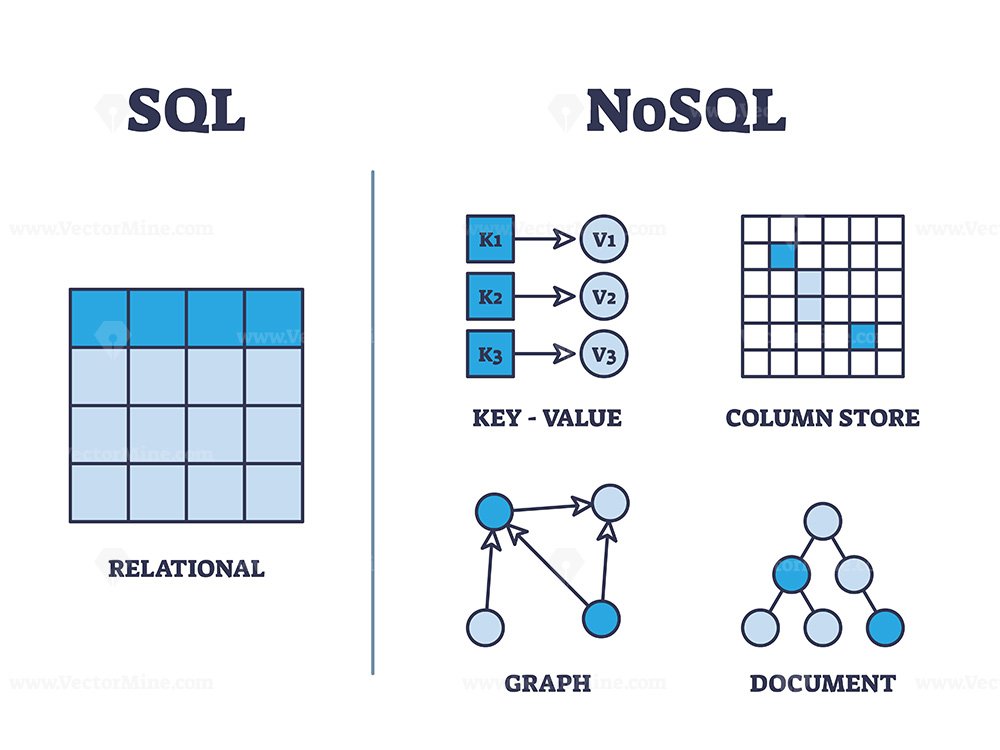
The non-relational world is diverse, but the most common models are:
- Document: Stores data in documents, often using JSON-like formats. This is great for hierarchical data.
- Key-Value: The simplest model, where every item is a key paired with a value. Excellent for fast lookups.
- Wide-Column: Organizes data into columns rather than rows. Efficient for queries over large datasets.
- Graph: Uses nodes and edges to represent and store relationships. Ideal for connected data like social networks.
NoSQL vs SQL: Choosing the Right Database
The article 'NoSQL vs SQL: Choosing the Right Database' on Skyvia.com offers a clear explanation of these different models.
Please read the section 'The 4 Main Types of NoSQL Databases'. Don't worry about mastering the details of each type now; focus on seeing how different they are from the familiar table-and-row structure of SQL.
This flexibility in NoSQL databases helps solve what's known as the object-relational impedance mismatch. Since your programming background includes C, you can think of this as the friction of trying to fit complex, nested data structures (like C structs or objects in other languages) into flat, normalized database tables. Document databases, in particular, often allow you to store your application's data objects in a more natural format.
2. Scaling Architecture: Vertical vs. Horizontal
Your work in technical support has likely given you a sense of how systems handle increasing load. Databases are no different, but SQL and NoSQL approach scaling from opposite directions.
-
Vertical Scaling (SQL): Traditionally, to handle more load, you "scale up" a relational database server by adding more CPU, RAM, or faster storage. This is like upgrading a single PC to be more powerful. It can become very expensive and has physical limits.
-
Horizontal Scaling (NoSQL): NoSQL databases are typically designed to "scale out." Instead of making one server more powerful, you add more commodity servers and distribute the load and data across them. This is architecturally more complex but can scale to massive levels more cost-effectively.
How do NoSQL databases work? Simply Explained!
The video 'How do NoSQL databases work?' by Simply Explained provides a concise and clear visual explanation of this core architectural difference.
Watch from the beginning to 04:10. Focus on the distinction between vertical and horizontal scaling and how NoSQL databases use partitioning (or 'sharding') and a hash function to distribute data across many servers. This connects to your interest in low-level systems.
3. Data Organization: Independence vs. Locality
This is a deeper, more philosophical difference that underpins the architectural choices. It gets to the "why" of their design.
-
SQL (Data Independence): The relational model was designed for data independence. This means the logical model (the tables, columns, and relationships you query) is intentionally separated from the physical storage model (how the data is actually laid out on disk). You, the developer, don't need to know where the data is physically stored; the database optimizer figures out the best way to retrieve it. This is a database-centric approach.
-
NoSQL (Data Locality): Many NoSQL databases are designed for data locality, following the principle: "store together what is accessed together." Here, the goal is to structure the data in the database to match how the application will access it. For example, in a document database, an order and its line items might be stored together in a single document because the application usually needs both at the same time. This minimizes disk I/O and network requests, leading to predictable performance. This is an application-first approach.
Data Locality vs. Independence (NoSQL vs. SQL)
The article 'Data Locality vs. Independence' by Franck Pachot is a fantastic deep dive into this exact topic. It explains the core philosophies that guide SQL and NoSQL design.
Please read these three short sections: The introduction (the first six paragraphs, ending just before 'Why Locality Still Matters'). 'The Relational Promise: Physical Data Independence'. 'The NoSQL Approach: Modeling for Access Patterns'. Focus on understanding the contrast between the 'database-centric' world of SQL and the 'application-first' world of NoSQL.
4. Consistency Model: ACID vs. BASE
Finally, we come to the guarantees that each database provides.
-
SQL (ACID): Relational databases prioritize consistency. They follow the ACID properties for transactions:
- Atomicity: All parts of a transaction succeed, or none do.
- Consistency: The database is always in a valid state.
- Isolation: Concurrent transactions don't interfere with each other.
- Durability: Once a transaction is committed, it's saved permanently.
This makes them extremely reliable for things like financial transactions.
-
NoSQL (BASE): To achieve high availability and scale, many NoSQL databases relax the strictness of ACID and instead follow the BASE model:
- Basically Available: The system guarantees availability.
- Soft state: The state of the system may change over time, even without input.
- Eventual consistency: The system will eventually become consistent once it stops receiving input. In a distributed system, this means that if you write data to one node, it will take a short amount of time to replicate to other nodes. A read request immediately after a write might get stale data from a node that hasn't been updated yet.
This is a fundamental trade-off: SQL prioritizes consistency, while NoSQL often prioritizes availability and speed.
Test your understanding!
For each of the following scenarios, decide whether a relational (SQL) or non-relational (NoSQL) database would be a more suitable initial choice. Justify your answer based on the concepts we've discussed (schema, scale, consistency).
- A system to manage user profiles for a new social media app. Each profile might have different fields (some users link a blog, others a gaming profile, others have different contact info).
- An inventory management system for a warehouse. The system must track product quantities with 100% accuracy to prevent overselling.
- A data store for IoT sensor readings. Millions of devices will send temperature and humidity data every few seconds. The primary use is to display trends on a dashboard.
Show answer
- NoSQL (likely a Document database): The data has a flexible schema (different profiles have different fields). Social media apps need to scale horizontally to millions of users. Eventual consistency is acceptable (it's not critical if a profile update takes a few seconds to be visible everywhere).
- SQL: Data integrity is paramount. You need the strict schema and ACID guarantees of a relational database to ensure inventory counts are always accurate. A transaction that sells a product must reliably decrease the count.
- NoSQL (likely a Wide-Column or Time-Series database): This is a classic "big data" problem with a massive write volume that requires horizontal scaling. The data has a simple, semi-structured format. Eventual consistency is fine for a dashboard, and high availability/write throughput is more important than perfect, up-to-the-millisecond consistency across the whole system.
Conclusion
We've covered the core distinctions between the relational and non-relational worlds. It's not about one being better, but about understanding the trade-offs and choosing the right tool for the job.
Key Takeaways:
- Data Model: SQL is structured (tables, rows), while NoSQL is flexible (documents, key-value, etc.).
- Schema: SQL uses a predefined, rigid schema. NoSQL uses a dynamic, application-defined schema.
- Scaling: SQL scales vertically (bigger servers), while NoSQL scales horizontally (more servers).
- Consistency: SQL guarantees ACID consistency (reliability), while NoSQL often uses BASE (availability and eventual consistency).
- Philosophy: SQL focuses on data independence, while NoSQL focuses on data locality to match application access patterns.
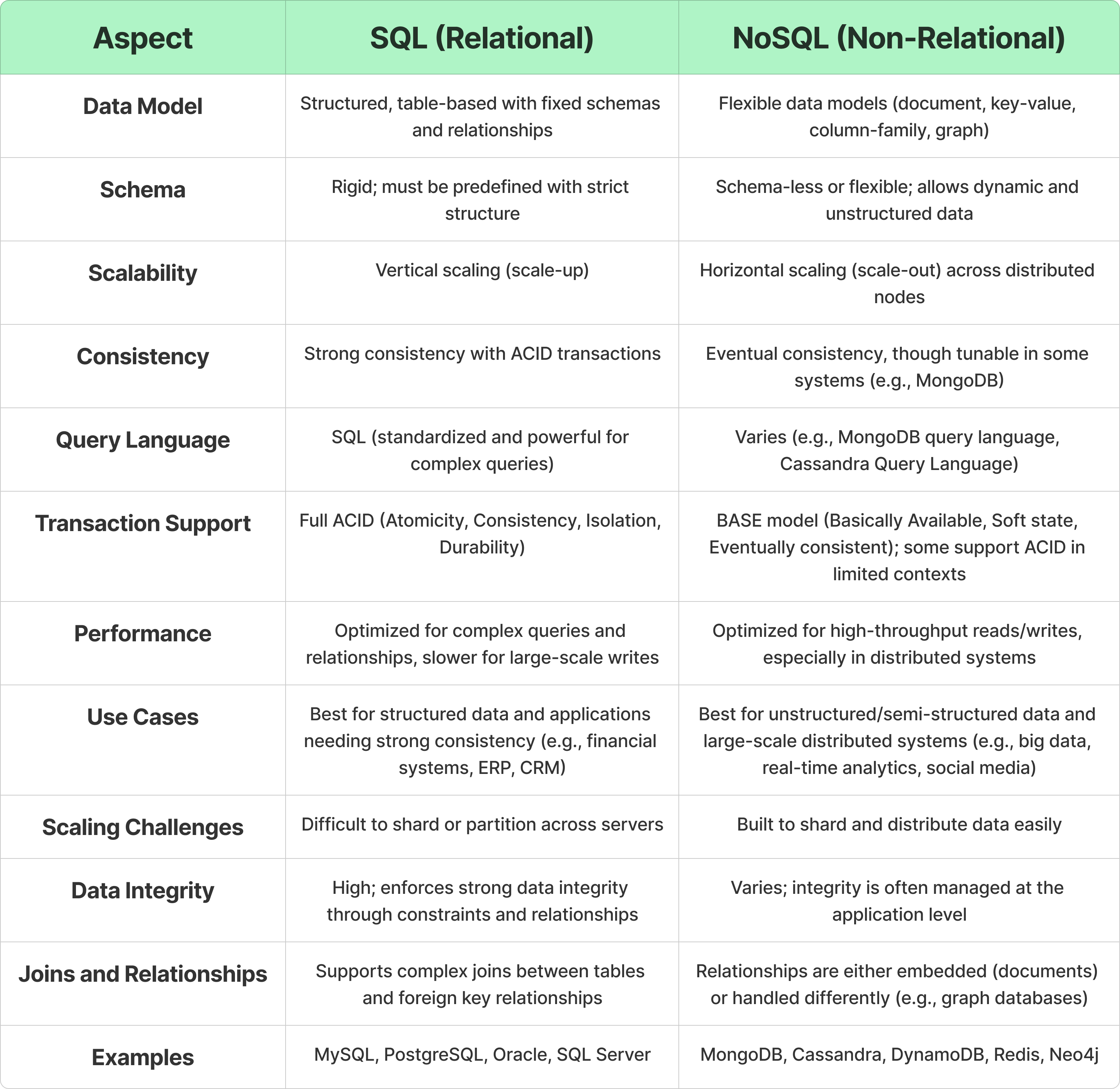
This detailed comparison table provides a great final summary of everything we discussed.
Preview of the Next Lesson:
Now that you have a high-level understanding of the differences, we'll start exploring the specific types of NoSQL databases. In the next lesson, we will dive into the simplest and one of the most common types: the key-value store. You'll learn its data model and discover its primary use cases, such as high-speed caching in web applications.