Hello! Welcome to our lesson on a fascinating and crucial aspect of reaction mechanisms.
In our last session, we saw how complex transformations can be built from sequences of distinct mechanistic steps, like elimination followed by addition. Today, we'll zoom in on a powerful process that often occurs within these sequences: the rearrangement of carbocations. While we've treated carbocations as relatively fixed intermediates so far, they are dynamic species that can reorganize their own skeletons in a quest for greater stability.
Our learning outcome for this lesson is to propose a plausible mechanism for a given reaction involving a carbocation rearrangement as a key step. You'll learn to recognize when a rearrangement is likely, predict what kind of shift will occur, and draw the complete mechanism, integrating this step into the overall reaction pathway. This is a critical skill, as rearrangements can dramatically alter the structure of a product, often in ways that are not immediately obvious.
1. The Fundamental Drive: Why Do Carbocations Rearrange?
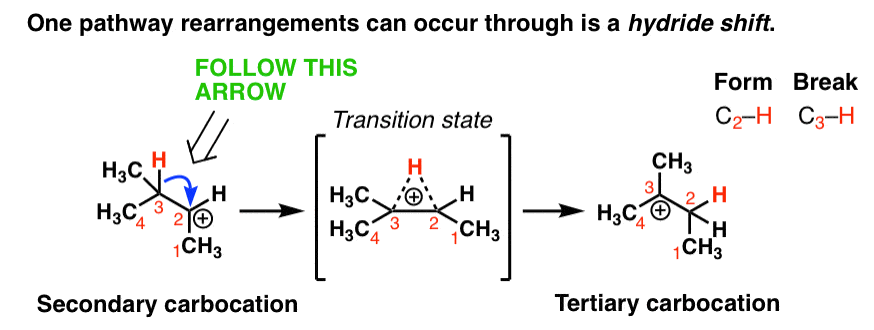
A carbocation rearrangement is an intramolecular process where a group (typically a hydrogen or an alkyl group) migrates from one carbon atom to an adjacent, electron-deficient carbon. This is known as a 1,2-shift.
The primary driving force is simple and powerful: the formation of a more stable carbocation. As you know, stability follows the order: tertiary > secondary > primary, with resonance-stabilized cations (like allylic or benzylic) being especially stable.
But this begs a deeper question that aligns with your interest in fundamental principles: Why are carbocation rearrangements so common and rapid, while analogous rearrangements in carbanions or radicals are rare?
The answer lies in the quantum mechanics of the transition state, specifically in the concept of aromaticity applied to transition states.
Chapter 1: Molecular Orbital Concepts
To understand this profound difference in reactivity, let's explore a resource that connects molecular orbital theory to reaction mechanisms. This explanation provides the 'hyper deep' justification you're looking for.
Please read the section titled 'a. Carbocation vs Carbanion or Radical Rearrangements'. Focus on the analysis of the transition state for each type of rearrangement. Pay close attention to the electron count in the cyclic system formed during the shift and how this relates to Hückel's rule.
As you've just read, the key is the nature of the three-center transition state:
- Carbocation (1,2-shift): The migrating group's C-H or C-C sigma bond (2 electrons) and the empty p-orbital of the carbocation form a 3-center cyclic system. With only 2 electrons, this transition state is analogous to the cyclopropenyl cation—it is aromatic and thus highly stabilized.
- Carbanion (1,2-shift): Here, the migrating group's sigma bond (2 electrons) and the filled lone-pair orbital of the carbanion (2 electrons) would form a 3-center cyclic system with 4 electrons. This is antiaromatic and highly destabilized, making the rearrangement extremely unfavorable.
This is a beautiful example of how fundamental quantum principles directly govern the macroscopic behavior we observe in organic reactions.
2. Types of Rearrangements and Driving Forces
Now that we understand the fundamental "why," let's categorize the common types of shifts and the specific situations that trigger them.
6 Rearrangement In Carbonium Ions | General Org Chemistry-2 | JEE Main IIT Adv. by NS Sir
This video provides a solid introduction to the mechanics of 1,2-shifts and the thought process for identifying them. It's grounded in the context of JEE Advanced preparation but provides a clear foundation.
Watch the video from 01:07 to 20:28. The instructor will define rearrangements, discuss where they occur, and work through several core examples of hydride and alkyl shifts. Focus on how he methodically evaluates each carbocation for a potential shift that would lead to a more stable intermediate.
As the video demonstrates, there are two primary driving forces for a rearrangement:
a) Increasing Carbocation Stability (Substitution/Resonance)
This is the most common reason. A less stable carbocation will rearrange if a 1,2-shift can produce a more stable one. The rearrangement will continue in a stepwise fashion until the most stable possible carbocation is formed. A secondary cation won't rearrange to another secondary cation, but it might rearrange multiple times to become a tertiary or resonance-stabilized cation.
b) Relief of Ring Strain
This is an equally important, and sometimes overriding, factor. Small rings (especially 3- and 4-membered rings) are highly strained. If a carbocation forms on a carbon adjacent to such a ring, a 1,2-shift of one of the ring bonds can lead to ring expansion.
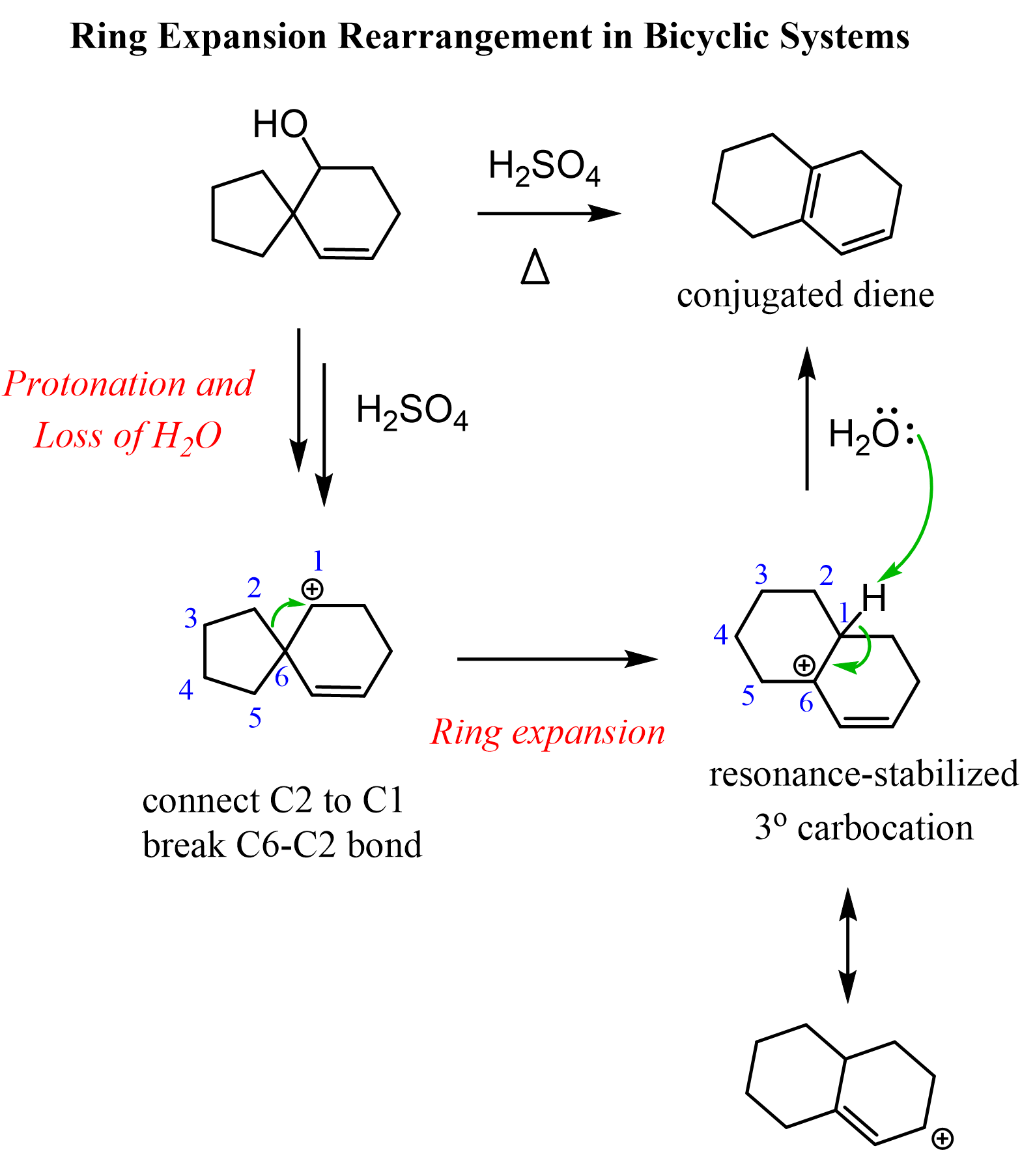
Crucially, the relief of ring strain can be such a powerful driving force that a rearrangement may occur even if it leads to a carbocation of equal or slightly lower substitution (e.g., tertiary to secondary), as seen in the video below.
Lec 22: Wagner-Meerwein rearrangment, Pinacol rearrangment, Benzilic acid rearrangment
Let's examine how ring strain drives rearrangements, using the classic Wagner-Meerwein rearrangement as a framework.
Watch the segment from 01:45 to 06:20. The instructor discusses the Wagner-Meerwein rearrangement, highlighting the two competing driving forces: carbocation stability and relief of ring strain. Pay special attention to the α-pinene example (around 02:40), where a tertiary carbocation rearranges to a secondary one specifically to relieve the strain of a four-membered ring.
3. Migratory Aptitude: Which Group Moves?
What happens if there are multiple groups on an adjacent carbon that could migrate? For example, a hydrogen, a methyl group, and a phenyl group. This is governed by migratory aptitude, which is the relative ability of a group to migrate.
The general order of migratory aptitude is:
Aryl (Phenyl) > Hydride (H) > 3° Alkyl > 2° Alkyl > 1° Alkyl
(Note: H vs. Aryl can sometimes be debated and depend on conditions, but both are highly mobile).
The "why" for this trend again relates to the stability of the bridged transition state. The migrating group must bear a partial positive charge.
- Aryl groups are excellent at this because they can form a resonance-stabilized phenonium ion intermediate. This participation by a neighboring group is called anchimeric assistance and can significantly accelerate the reaction.
- Hydride is a very small, mobile group.
- More substituted alkyl groups are better electron donors and can better stabilize the partial positive charge.
This resource provides an excellent discussion of Wagner-Meerwein rearrangements and digs into the concept of anchimeric assistance by phenyl groups.
First, read section 1. Wagner-Meerwein Rearrangements, focusing on the neopentyl bromide example to see a clear case of a 1,2-methyl shift. Then, read section 4. Anchimeric Assistance. This will explain how a neighboring phenyl group can actively participate in the ionization step, accelerating the reaction and controlling the stereochemical outcome.
Test your understanding!
Consider the following carbocation. Predict the major rearranged product after a single 1,2-shift. Which group migrates and why?
Show answer
The most likely rearrangement involves a 1,2-hydride shift.
The initial carbocation is secondary. The adjacent carbon has three potential migrating groups: two methyl groups and one hydrogen.
According to migratory aptitude (H > alkyl), the hydride is the most mobile group. A 1,2-hydride shift moves the hydrogen and its bonding electrons to the secondary carbocation center.
This shift results in a tertiary carbocation, which is significantly more stable than the starting secondary carbocation. Migration of a methyl group would also lead to a tertiary carbocation, but the hydride shift is kinetically faster.
4. Proposing Full Mechanisms
Now, let's put it all together. A carbocation rearrangement is not a reaction in itself, but a single step within a larger mechanism (like Sₙ1, E1, or electrophilic addition).
Example: Dehydration of 3,3-dimethyl-2-butanol
Let's predict the major alkene product when this alcohol is treated with hot concentrated H₂SO₄.
-
Protonation & Loss of Water (Carbocation Formation): The acid protonates the alcohol, turning -OH into a good leaving group, -OH₂⁺. This leaves, forming a secondary carbocation.
-
Rearrangement (1,2-Methyl Shift): The secondary carbocation is adjacent to a quaternary carbon. There are no hydrogens to shift, but there are methyl groups. A 1,2-methyl shift occurs. This transforms the secondary carbocation into a much more stable tertiary carbocation.
-
Deprotonation (Alkene Formation): A weak base (like H₂O or HSO₄⁻) removes a proton from a carbon adjacent to the new carbocation center. Following Zaitsev's rule, the proton is removed from the more substituted carbon (C2 in this case) to form the most stable (tetrasubstituted) alkene.
The full mechanism:
The final product, 2,3-dimethyl-2-butene, has a different carbon skeleton than the starting material—a clear sign that a rearrangement has occurred.
Conclusion
You have now explored the world of carbocation rearrangements, a key process driven by the relentless pursuit of stability. You can now not only predict that a rearrangement will happen but also explain why it is so favorable from a molecular orbital perspective.
Key Takeaways:
- Carbocation rearrangements are typically 1,2-shifts of hydride or alkyl groups to an adjacent electron-deficient carbon.
- The primary driving forces are the formation of a more stable carbocation (higher substitution or resonance) and the relief of ring strain.
- The high propensity for carbocation rearrangement is explained by the aromatic character of the 2-electron transition state, in contrast to the antiaromatic transition state for carbanions.
- Migratory aptitude (Aryl > H > 3° > 2° > 1° alkyl) determines which group moves when there is a choice, based on the ability to stabilize the transition state.
- Rearrangements are key steps within broader mechanisms like Sₙ1, E1, and electrophilic additions.
Preview of the Next Lesson:
We are now approaching the culmination of this course. In our final lesson, we will focus on constructing a complete retrosynthetic plan for a simple, bifunctional target molecule. You will bring together everything you've learned—from functional group interconversions to sequential mechanisms and now, the crucial possibility of carbocation rearrangements—to design elegant and plausible synthetic routes from start to finish.