Hello! Welcome to the next lesson in our final module on synthesizing organic molecules.
In our last session, we explored Functional Group Interconversion (FGI) as a powerful retrosynthetic tool. We saw how a multi-step sequence like Alcohol Alkene Alkyne could be planned to achieve a synthetic goal. Today, we shift our focus from planning the sequence of reactions to detailing the sequence of mechanisms. Many transformations that appear as a single step in a synthesis are, in fact, composed of two or more distinct mechanistic processes.
Our learning outcome for this lesson is to propose a plausible mechanism for a given reaction involving a sequence of two distinct mechanistic steps (e.g., substitution followed by elimination). By the end of this lesson, you will be able to dissect a complex transformation into its fundamental mechanistic components—addition, elimination, substitution—and draw the complete, arrow-pushing mechanism for the entire sequence.
1. From Retrosynthesis to Mechanistic Analysis
Previously, you learned to think backward, identifying patterns to disconnect molecules. A common strategy involves moving a functional group, which we plan retrosynthetically. Now, let's analyze the forward synthesis and its mechanism. Consider the task of converting 1-bromopropane to 2-bromopropane. There is no single reaction for this. Instead, we use a sequence.
The strategic sequence is:
- Elimination: Remove HBr to form an alkene.
- Addition: Add HBr back to form the more substituted alkyl halide.
This is a perfect example of a transformation involving two distinct, sequential mechanistic steps.
Synthesis & Multi-Step Reactions Finals Practice [LIVE Recording] Organic Chemistry Review
Let's watch an expert walk through a similar problem: moving a chlorine atom across a carbon chain. This provides an excellent overview of the elimination-then-addition strategy.
Watch the segment from 30:05 to 34:51. The instructor tackles a problem where a chlorine atom is moved from one carbon to another. Focus on the core pattern she identifies: a series of elimination and addition reactions. Notice how the overall transformation is broken down into individual, mechanistically distinct steps.
Let's break down the mechanism for a simpler version of this, converting 1-bromopropane to 2-bromopropane.
Step 1: E2 Elimination
To create the alkene intermediate (propene), we perform an elimination reaction. Using a strong base like sodium ethoxide (NaOCH₂CH₃) in ethanol with heat ensures an E2 mechanism.
Mechanism:
The ethoxide ion acts as a base, abstracting a proton from the -carbon (C2), while simultaneously the C-Br bond breaks and the -bond forms.
The E2 elimination of 1-bromopropane to form propene.
Step 2: Electrophilic Addition
Now, we add HBr across the double bond of propene. From your knowledge of addition reactions, you'll recall this follows Markovnikov's rule.
Mechanism:
The -bond of the alkene acts as a nucleophile, attacking the proton of HBr. This forms the most stable carbocation intermediate (the secondary carbocation at C2). The bromide ion then acts as a nucleophile, attacking the carbocation to form the final product, 2-bromopropane.
The electrophilic addition of HBr to propene, proceeding via the more stable secondary carbocation to yield the Markovnikov product.
Together, these two distinct mechanisms—E2 elimination and electrophilic addition—achieve the overall transformation.
2. Substitution Followed by Elimination: The Hofmann Elimination
Another classic example of a sequential mechanism is the Hofmann elimination, which converts an amine into an alkene. The challenge is that the amino group (-NH₂) is a terrible leaving group. The reaction sequence is designed to solve this problem.
The sequence involves:
- Substitution: Convert the amine into a good leaving group via exhaustive methylation.
- Elimination: Remove the newly formed leaving group via an E2 reaction.
This article from Master Organic Chemistry provides a superb explanation of the Hofmann elimination. It clearly presents the two-part process.
Read sections 3 ('The “Hofmann Degradation”') and the first part of section 4. Focus on how the reaction is broken into two distinct steps: exhaustive methylation with methyl iodide, followed by elimination with a base like silver oxide.
Step 1: Exhaustive Methylation (Sₙ2 Substitution)
The amine is treated with an excess of methyl iodide (CH₃I). The nitrogen atom acts as a nucleophile and repeatedly attacks the methyl iodide in a series of Sₙ2 reactions. This process converts the neutral amine into a positively charged quaternary ammonium salt, which is an excellent leaving group (similar to how protonating an alcohol turns -OH into -OH₂⁺).
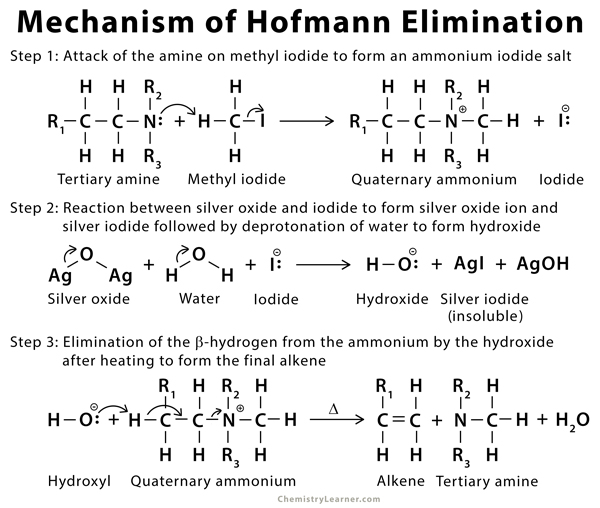
Step 2: E2 Elimination
Once the good leaving group is in place, heating with a strong base (like hydroxide, often generated from Ag₂O and water) initiates an E2 elimination.
A key feature of the Hofmann elimination is its regioselectivity: it forms the least substituted alkene (the "Hofmann product"). Given your interest in the fundamental "why," this is a fascinating puzzle. Why does this reaction favor the thermodynamically less stable alkene?
Let's return to the Master Organic Chemistry article for a deep dive into the mechanistic reason for Hofmann's rule.
Read the rest of section 4, 'The Hofmann Elimination Has An Extremely Bulky Leaving Group...'. Pay close attention to the Newman projection analysis. This is where your appreciation for 3D spatial reasoning and energetics comes into play. Understand how steric hindrance in the transition state leading to the Zaitsev product makes that pathway higher in energy.
The reason for Hofmann selectivity is the steric bulk of the trialkylamine leaving group (-NR₃⁺). For the E2 mechanism's required anti-periplanar geometry, the transition state leading to the more substituted (Zaitsev) alkene involves significant steric clashes (gauche interactions) between the bulky leaving group and the alkyl groups on the substrate. The transition state leading to the less substituted (Hofmann) alkene is sterically less hindered and therefore lower in energy, making it the major pathway.
3. Sequential Mechanisms in Aromatic Chemistry
Nucleophilic substitution on an aromatic ring (SNAr) is impossible via standard Sₙ1 or Sₙ2 pathways. Instead, it proceeds through unique sequential mechanisms.
Case 1: The Addition-Elimination Mechanism
This occurs on aromatic rings that have a good leaving group (like a halogen) and are activated by strong electron-withdrawing groups (EWGs) at the ortho or para position.

Mechanism:
- Addition: The nucleophile attacks the carbon bearing the leaving group. This is the slow, rate-determining step because it breaks the ring's aromaticity. The resulting anionic intermediate, called a Meisenheimer complex, is stabilized by resonance, with the negative charge delocalized onto the EWG.
- Elimination: The leaving group is expelled, and the aromaticity of the ring is restored.
The overall reaction is a substitution, but its mechanism is a clear addition-elimination sequence.
Case 2: The Elimination-Addition (Benzyne) Mechanism
This pathway occurs on unactivated aryl halides, but requires an extremely strong base (like sodium amide, NaNH₂).
Mechanism:
- Elimination: The strong base abstracts a proton from the position ortho to the leaving group. The resulting carbanion then expels the leaving group to form a highly reactive, strained intermediate called benzyne, which contains a formal triple bond within the six-membered ring.
- Addition: The nucleophile (e.g., another amide ion) attacks one of the carbons of the benzyne triple bond. A subsequent protonation step gives the final product.
This substitution is achieved via an elimination-addition sequence.
Nucleophilic Aromatic Substitution
For a deeper look into both of these fascinating aromatic mechanisms, this article from Chemistry Steps is excellent. It addresses the 'why' behind the reactivity trends and even provides experimental evidence.
First, read the sections on 'The Mechanism of Nucleophilic Aromatic Substitution' and 'Why must the electron-withdrawing group be in the ortho/para position?'. This covers the Addition-Elimination pathway. Then, read the sections on 'The Benzyne Mechanism' and 'How do we prove the formation of the benzyne intermediate?'. This covers the Elimination-Addition pathway and provides the kind of rigorous proof you enjoy.
Test your understanding!
Propose a plausible, step-by-step mechanism for the following reaction. Be sure to show all intermediates and use curved arrows to represent electron flow.
Show answer
This reaction is a classic Hofmann elimination. The overall transformation from an amine to an alkene proceeds via a two-part sequence: substitution followed by elimination.
Part 1: Exhaustive Methylation (Sₙ2 Substitutions)
The starting material, piperidine, is a secondary amine. It reacts with excess methyl iodide. The nitrogen's lone pair acts as a nucleophile, attacking the electrophilic methyl group of CH₃I and displacing iodide. This Sₙ2 reaction happens twice to form a quaternary ammonium iodide salt.
Part 2: E2 Elimination
The quaternary ammonium salt is heated with a source of hydroxide (Ag₂O, H₂O). The hydroxide acts as a strong base, abstracting a -proton. This induces an E2 elimination where the C-N bond breaks, forming the alkene product and trimethylamine as a leaving group. Both -positions are equivalent, so only one alkene product is formed.
Conclusion
Today, we have delved into the mechanisms of reactions that are composed of distinct, sequential steps. You have learned that what might look like a single transformation on paper is often a sophisticated dance of fundamental mechanistic processes.
Key Takeaways:
- Many complex organic reactions can be broken down into sequences of the four fundamental reaction types: addition, elimination, substitution, and rearrangement.
- Elimination-Addition: This sequence is a powerful strategy for moving functional groups, as seen in the conversion of 1-bromopropane to 2-bromopropane via an alkene intermediate.
- Substitution-Elimination: The Hofmann elimination exemplifies this sequence. It uses Sₙ2 substitutions to turn a poor leaving group (-NH₂) into an excellent one (-NR₃⁺) before an E2 elimination can occur.
- SNAr Mechanisms: Nucleophilic aromatic substitution proceeds via two main sequences: Addition-Elimination for activated rings and Elimination-Addition (via a benzyne intermediate) for unactivated rings with very strong bases.
Preview of the Next Lesson:
We have now seen how fundamental mechanisms can be chained together. In our next lesson, we will focus on another crucial element that often occurs within these sequences: carbocation rearrangements. You will learn to propose plausible mechanisms for reactions where the migration of a hydride or alkyl group is a key, stability-driven step.