Hello! Welcome to the final lesson of our course. We have journeyed from the quantum mechanical origins of chemical bonds to the intricate dance of electrons in reaction mechanisms. Today, we bring all of that knowledge to bear on the art and logic of organic synthesis. This is where your deep understanding of the "why" enables you to master the "how."
In our previous lessons, we've filled our toolbox with powerful concepts: disconnection, synthons, synthetic equivalents, and functional group interconversions (FGI). Most recently, we explored carbocation rearrangements, seeing them not as complications, but as predictable steps in a reaction pathway.
Our final learning outcome is to construct a complete retrosynthetic plan and corresponding forward synthesis for a simple, bifunctional target molecule. You will act as a molecular architect, designing a logical and efficient route to a target by deconstructing it into simple, available starting materials.
1. The Retrosynthetic Mindset: Thinking in Reverse
Before we build, we must learn to deconstruct. Retrosynthetic analysis, developed by Nobel laureate E.J. Corey, is a formal problem-solving method for planning syntheses. It involves breaking down the complex target molecule (TM) into progressively simpler precursors until we arrive at readily available starting materials.
To ground ourselves in the formal language and logic of this process, let's review the core principles.
This document from Prof. J.W. Bode's course at ETH Zurich provides a concise and rigorous introduction to the key concepts and guidelines of retrosynthetic analysis. It will formalize the terminology we've been using.
Please read the sections titled '2. Key Concepts' and '3. How to Select a Disconnection'. Pay close attention to the definitions of 'Synthon' and 'Synthetic Equivalent', the general guidelines for analysis, and the distinction between donor (dN) and acceptor (aN) synthons.
As you've read, the process is governed by a clear set of rules:
- Disconnection: A 'paper' cleavage of a bond, representing the reverse of a known chemical reaction. We use the retrosynthetic arrow (=>) for this.
- Synthon: An idealized, often charged, fragment resulting from a disconnection. It may not be a stable, real species.
- Synthetic Equivalent: A real chemical reagent that provides the synthon in a reaction.
The core challenge is to identify strategic disconnections that lead to reliable reactions. For simple molecules, C-X (carbon-heteroatom) bonds are often the easiest to disconnect.
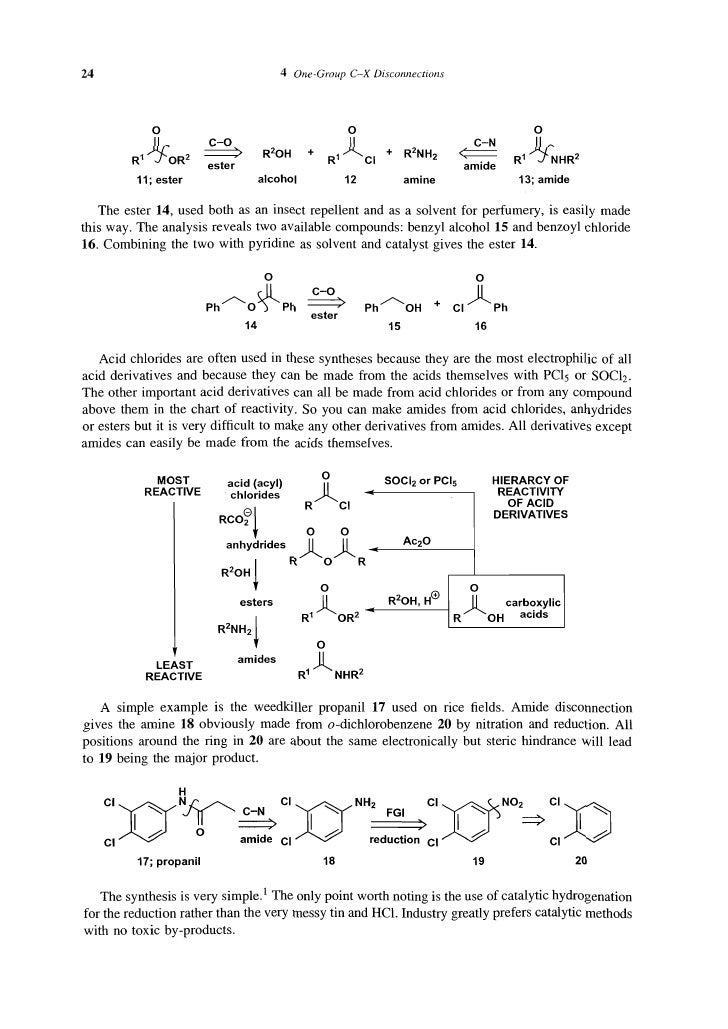
However, the real power of synthesis lies in forming the carbon skeleton, which requires strategic C-C bond disconnections. This is where bifunctional molecules provide us with crucial clues.
2. Strategy for Bifunctional Molecules: Reading the Map
The relationship between two functional groups in a target molecule is the most important clue for identifying a powerful C-C disconnection. By numbering the carbon chain, we can classify these relationships as 1,2-, 1,3-, 1,4-, etc., with each pattern suggesting a specific type of bond-forming reaction.
This video introduces the concept of two-group disconnections, categorizing them based on the relative positions of the functional groups. It provides a good overview of the patterns we'll be looking for.
Watch the video from 03:11 to 09:58. The speaker will discuss 1,2-, 1,1-, and 1,3-disconnection approaches. Focus on how the spatial relationship between the functional groups directly points to a particular class of starting materials (e.g., epoxides for 1,2-systems, carbonyls for 1,1- and 1,3-systems).
The video outlines a systematic approach. Let's delve deeper into two of the most common and powerful patterns: the 1,3 and 1,5 relationships. These correspond to two of the most fundamental C-C bond-forming reactions in organic chemistry: the Aldol and Michael reactions.
3. Case Study 1: The 1,3-Relationship and the Aldol Reaction
Consider a molecule with a 1,3-dioxygenated relationship, such as a β-hydroxy carbonyl. This pattern is the hallmark of an Aldol addition reaction. The disconnection, therefore, is a retro-Aldol.
Let's analyze a real-world example.
Examples of 1,3 difunctionalized and 1,5 disubstituted compounds II Disconnection Approach Part 3
The following video segment analyzes the synthesis of Gingerol, the molecule responsible for the pungent taste of ginger. It's a perfect example of a 1,3-bifunctional compound.
Watch from the beginning to 05:11. Observe how the instructor identifies the 1,3-relationship, performs the disconnection, and proposes the forward synthesis.
Let's break down the logic for Gingerol:
1. Analysis of the Target Molecule (TM):
- The TM contains a ketone and a secondary alcohol.
- Numbering from the ketone carbonyl (C1), the alcohol's hydroxyl group is on C3. This is a classic 1,3-relationship. This pattern immediately suggests an Aldol reaction was used to form the C2-C3 bond.
Retrosynthetic analysis of Gingerol, showing the key 1,3-relationship and disconnection.
2. Retrosynthetic Plan:
- Disconnection: We disconnect the C2-C3 bond. This is a
C-C disconnection. - Synthons: The disconnection generates two synthons. Since this is the reverse of an Aldol reaction, we envision an enolate nucleophile and a carbonyl electrophile.
- The fragment containing the ketone (C1-C2) becomes the nucleophilic enolate synthon (a
d2synthon). - The fragment containing the alcohol (C3 onwards) becomes the electrophilic aldehyde synthon (an
a0synthon, as the charge is on the carbonyl carbon itself).
- The fragment containing the ketone (C1-C2) becomes the nucleophilic enolate synthon (a
- Synthetic Equivalents: We translate the synthons into real reagents.
- The enolate synthon comes from the corresponding ketone: 1-(4-hydroxy-3-methoxyphenyl)propan-2-one.
- The aldehyde synthon is simply the corresponding aldehyde: hexanal.
3. Forward Synthesis:
- To synthesize Gingerol, we simply execute the Aldol reaction. We treat the ketone with a base (like NaOH or LDA) to generate the enolate, which then attacks the aldehyde. An acidic or aqueous workup protonates the resulting alkoxide to give the final β-hydroxy ketone product.
This example shows the elegance of retrosynthesis. By recognizing a single pattern, we can deconstruct a complex natural product into two much simpler building blocks.
4. Case Study 2: A Multi-Step Plan with FGI
Real-world synthesis is rarely a single step. Often, we must strategically modify functional groups using Functional Group Interconversion (FGI) to reveal a more useful pattern for disconnection.
Let's examine a more complex target, the drug Doxapram.
Examples of 1,3 difunctionalized and 1,5 disubstituted compounds II Disconnection Approach Part 3
The same video now analyzes Doxapram. This is a fantastic example that showcases a sequence of disconnections, including FGI, to create a multi-step plan. This goes beyond the typical JEE level and demonstrates the power of strategic thinking.
Watch the segment from 05:11 to 14:24. Don't worry about memorizing every detail. Instead, focus on the strategy: How does each disconnection or FGI simplify the molecule and lead to a known reaction type?
This synthesis is more intricate, so let's trace the logic backwards:
Simplified retrosynthetic analysis of Doxapram.
1. Analysis and Initial Disconnections:
- The most obvious feature is the cyclic acetal. Acetal formation is a reliable reaction. Disconnecting it (
C-O disconnections) reveals a diol and a ketone (formaldehyde in this case). - The diol itself is a complex structure. How do we make a diol? A common way is by reduction of a diester. This is an FGI step (
diol <= diester). FGI is a powerful tool to change the problem into an easier one.
2. Unveiling the Core Reaction:
- After the FGI, we have an amino-diester. The C-N bond can be disconnected (
C-N disconnection), leading to dimethylamine and a diester with a double bond. - This molecule, an α,β-unsaturated diester, has a 1,5-dicarbonyl relationship (if you consider the double bond as a precursor to a carbonyl). This is the signature of a Michael addition. Disconnecting the C-C bond formed by the Michael addition reveals our starting materials: diethyl malonate and a substituted pyridinyl-acrolein. The pyridinyl-acrolein itself can be made from a simpler aldehyde and diethyl malonate via Knoevenagel condensation.
3. The Complete Plan:
- Retrosynthesis: Doxapram => diol => diester => α,β-unsaturated diester => diethyl malonate + pyridinyl aldehyde.
- Forward Synthesis: The forward synthesis simply reverses these steps.
- Knoevenagel Condensation: React the pyridine-aldehyde with diethyl malonate to form the Michael acceptor.
- Michael Addition: React the product with dimethylamine.
- Reduction (FGI): Reduce the diester to a diol using a strong reducing agent like LiAlH₄.
- Acetal Formation: React the diol with formaldehyde and an acid catalyst to form the final Doxapram molecule.
This example highlights that a retrosynthetic plan is a chain of logical deductions, where each step (disconnection or FGI) is the reverse of a reliable reaction you have learned.
Test your understanding!
Now, it's your turn to be the architect. Propose a full retrosynthetic plan and the corresponding forward synthesis for the following 1,5-diketone target molecule.
Target: heptane-2,6-dione
Hint: Analyze the relationship between the two carbonyl groups. What famous reaction creates a 1,5-dicarbonyl relationship?
Show answer
1. Analysis:
The target molecule is heptane-2,6-dione. The two ketone functional groups are in a 1,5-relationship. This pattern is the classic outcome of a Michael Addition followed by hydrolysis of an intermediate ester (a sequence known as the Stork enamine synthesis or related variants). The most direct Michael addition disconnection involves an enolate attacking an α,β-unsaturated ketone.
2. Retrosynthetic Plan:
- Disconnection: The most logical C-C disconnection is between C4 and C5. This is the bond that would have been formed during the Michael addition.
- Synthons: This disconnection yields an enolate nucleophile synthon at C4 and an α,β-unsaturated ketone electrophile synthon.
- Synthetic Equivalents:
- The nucleophilic enolate synthon comes from acetone.
- The electrophilic synthon is methyl vinyl ketone (MVK).
The retrosynthesis is therefore:
Heptane-2,6-dione => Acetone + Methyl Vinyl Ketone
3. Forward Synthesis:
The synthesis is a base-catalyzed Michael addition.
- Generate the enolate of acetone by treating it with a base (e.g., sodium ethoxide, NaOEt).
- Add methyl vinyl ketone (MVK) to the reaction mixture. The enolate of acetone will attack the β-carbon of MVK in a conjugate addition.
- A final workup step (e.g., addition of H₃O⁺) neutralizes the reaction and ensures the product is the neutral diketone.
The overall reaction is:
Conclusion and Course Reflection
Congratulations! You have reached the end of our journey through advanced organic chemistry. Today, you've learned to think like a synthetic chemist, leveraging your deep knowledge of reaction mechanisms to design logical and elegant pathways to complex molecules.
Key Takeaways from this Lesson:
- Retrosynthesis is the logical process of breaking down a target molecule into simpler, available starting materials by proposing disconnections that correspond to known, reliable reactions.
- The relationship between functional groups (e.g., 1,3- or 1,5-) is the most powerful clue for identifying strategic C-C bond disconnections.
- Recognizing patterns is key: 1,3-relationships suggest retro-Aldol disconnections, while 1,5-relationships suggest retro-Michael disconnections.
- Functional Group Interconversion (FGI) is a critical strategic tool used to transform one functional group into another to facilitate a more effective disconnection.
- A complete plan includes both the retrosynthetic analysis (the "blueprint") and the forward synthesis (the "construction").
When we began this course, your goal was to move beyond superficial memorization and understand the fundamental "why" behind organic chemistry. We have connected reaction pathways to the aromaticity of transition states, carbocation stability to hyperconjugation and rearrangements, and now, complex synthesis to a few logical, powerful patterns. You have built a framework of thinking that will serve you well in your JEE preparation and any future scientific endeavors. Well done.