Hello! Welcome to the final module of our course. Over the past several weeks, we've built a sophisticated toolkit for understanding and describing organic molecules. We've delved into quantum models of bonding, analyzed electronic effects, unraveled stereochemistry, and decoded spectroscopic data. In essence, you've learned how to answer the question: "Given this data, what is the structure of this molecule?"
Now, we pivot to a fundamentally different and more creative question: "Given this molecular structure, how can we build it?"
This lesson introduces you to the elegant and powerful methodology developed for this purpose: retrosynthetic analysis. Pioneered by E.J. Corey, who received the 1990 Nobel Prize in Chemistry for this work, retrosynthesis is a problem-solving technique that involves mentally deconstructing a complex molecule into simpler, readily available starting materials. It is the architectural blueprint of organic synthesis.
Our learning outcome for today is to explain the core principles of retrosynthesis, including disconnection, synthon, and synthetic equivalent. We will learn the language and the logic of this backward-thinking approach, setting the stage for designing complex syntheses.
1. The Philosophy: Strategy vs. Tactics in Synthesis
Imagine you're trying to solve a complex maze. You could start from the beginning and try every possible path, but a more efficient strategy is often to work backward from the exit. Retrosynthesis applies the same philosophy to chemistry. We start with the final product—the Target Molecule (TGT)—and work backward step-by-step.
This process involves a crucial distinction between strategy and tactics, which is an excellent way to frame the entire discipline of organic synthesis.
Advanced Organic Chemistry: Retrosynthesis with Dr. Steven Crossley
To begin, let's watch a segment from a graduate-level tutorial by Dr. Steven Crossley from Synthesis Workshop. He provides a concise and formal definition of retrosynthetic analysis and introduces the crucial distinction between strategy and tactics.
Watch from 02:02 to 03:36. Focus on the definitions of strategy (identifying where to disconnect) and tactics (how to form the bonds in the forward synthesis).
As Dr. Crossley explains:
- Strategy is the high-level plan: identifying the key bonds to break that will most efficiently simplify the molecule's structure.
- Tactics are the specific reactions used to form those bonds in the forward direction.
Our focus today is on the strategic language and logic of this planning phase.
2. The Vocabulary of Retrosynthesis
To effectively plan a synthesis, chemists use a specialized vocabulary. These terms allow us to discuss the deconstruction process with clarity and precision.
Advanced Organic Chemistry: Retrosynthesis with Dr. Steven Crossley
Dr. Crossley's introduction also formally defines the essential vocabulary we'll be using. This segment is the foundation for our entire lesson.
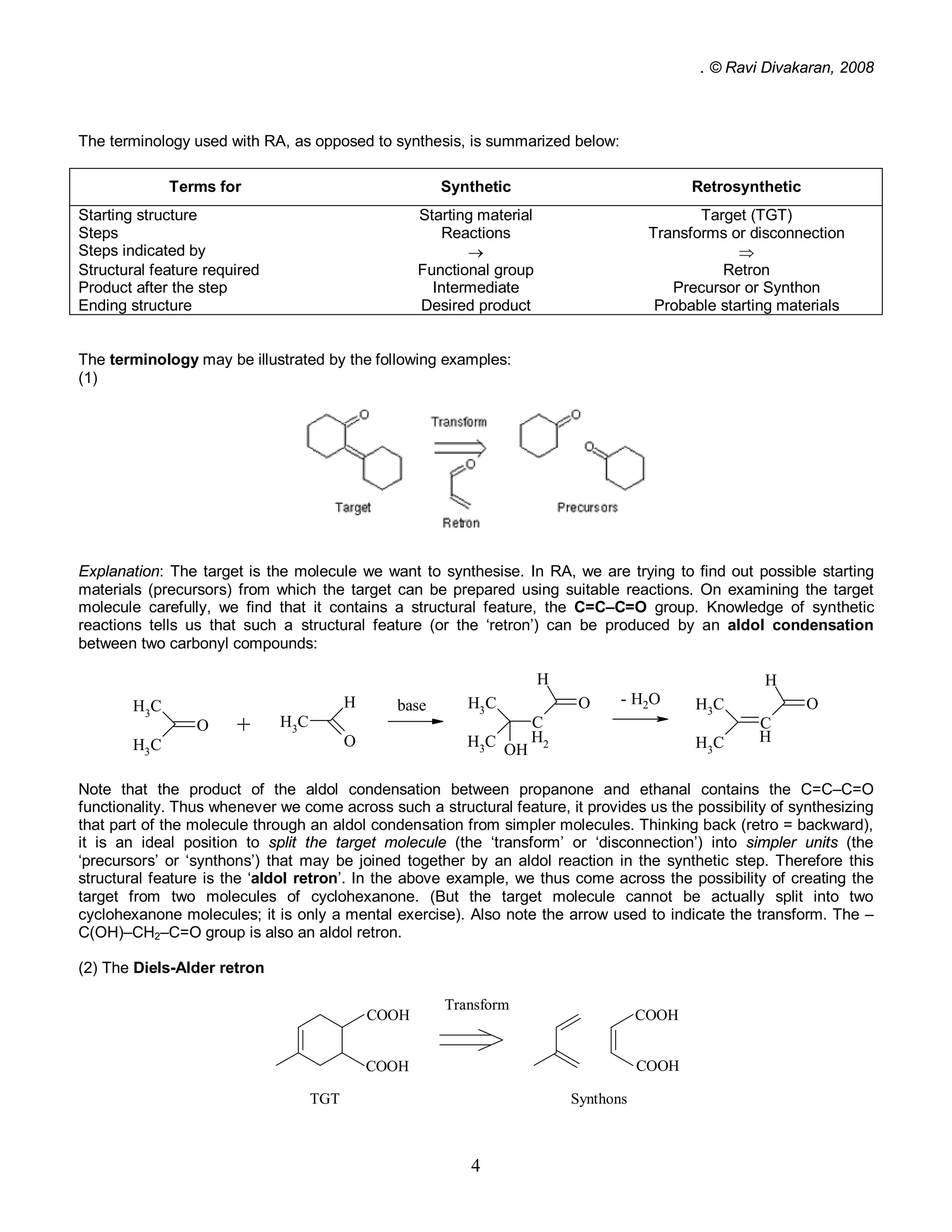
Please watch from 00:40 to 04:58. Pay close attention to the definitions and visual examples of: Target Molecule (TGT), Disconnection, Synthon, Synthetic Equivalent, Transform, and Retron. You may want to take notes on these definitions.
Let's break down these key terms:
- Target Molecule (TGT): The molecule you want to synthesize.
- Disconnection: A retrosynthetic operation where a bond is broken to generate simpler precursor structures. It is the reverse of a real chemical reaction and is symbolized by a double-line arrow (⇒).
- Transform: The reverse operation of a specific synthetic reaction. A disconnection is the application of a transform (e.g., an "ester transform" is the reverse of esterification).
- Retron: A minimal structural feature within the target molecule that allows for a specific transform to be applied. For example, a six-membered ring containing a double bond is a retron for the Diels-Alder transform. Identifying retrons is key to strategic planning.
- Synthon: An idealized, conceptual fragment resulting from a disconnection. These are often ionic and are not actual, stable reagents. They are conceptual building blocks.
- Synthetic Equivalent: A real chemical reagent that serves the function of the conceptual synthon. This is the bridge from the abstract plan to the practical laboratory synthesis.
3. From Concept to Reagent: Synthons and Synthetic Equivalents
The most crucial and perhaps most abstract part of retrosynthesis is the relationship between the imaginary synthon and its real-world synthetic equivalent. A disconnection often generates charged fragments (synthons) that are too unstable to exist in a flask. We must therefore identify a stable, neutral reagent (the synthetic equivalent) that can deliver that fragment's reactivity.
Your knowledge of reactive intermediates is key here. An alkyl carbocation synthon (R⁺) is a conceptual electrophile; its synthetic equivalent is an alkyl halide (R-X). An alkyl carbanion synthon (R⁻) is a conceptual nucleophile; its synthetic equivalent is a Grignard reagent (R-MgBr) or an organolithium (R-Li).
Disconnection Approach (Retrosynthetic Analysis), L-02, Synthon and Synthetic Equivalents
The link between the conceptual synthon and the real-world synthetic equivalent is crucial. This video provides a rich catalog of common synthons and the reagents that act as their equivalents.
Watch from 00:22 to 09:54. You don't need to memorize every single example. The goal is to understand the pattern: how an ionic fragment (synthon) is realized as a stable, neutral molecule (synthetic equivalent). Focus on the classic examples like alkyl cations/anions, acyl cations, and the enolate anion.
Here is a table summarizing some of the most fundamental synthon/equivalent pairs:
| Synthon (Conceptual Fragment) | Reactivity | Synthetic Equivalent (Real Reagent) |
|---|---|---|
| R⁺ (Alkyl cation) | Electrophile | R-X (Alkyl halide), R-OTs (Alkyl tosylate) |
| R⁻ (Alkyl carbanion) | Nucleophile | R-MgBr (Grignard reagent), R-Li |
| RC⁺=O (Acyl cation) | Electrophile | RCOCl (Acyl chloride), (RCO)₂O (Anhydride) |
| ⁻CH₂COR (Enolate anion) | Nucleophile | CH₃COR + Base (e.g., LDA, NaH) |
| ⁺CH₂OH | Electrophile | CH₂=O (Formaldehyde) |
| ⁻C≡CR (Alkynide anion) | Nucleophile | HC≡CR + Base (e.g., NaNH₂) |
Test your understanding!
Imagine a disconnection yields a benzoyl cation synthon (Ph-C⁺=O). What is a common and practical synthetic equivalent for this synthon?
Show answer
A common synthetic equivalent for the electrophilic benzoyl cation synthon is benzoyl chloride (Ph-COCl). In a Friedel-Crafts acylation, for example, benzoyl chloride reacts with a Lewis acid (like AlCl₃) to behave as if it were delivering a Ph-C⁺=O fragment to an aromatic ring.
4. The Logic of a "Good" Disconnection
The power of retrosynthesis lies not just in breaking bonds, but in breaking the right bonds. A "good" disconnection is one that is strategically sound. Here are three criteria:
- It must correspond to a known, reliable chemical reaction. There is no point in imagining a disconnection if there isn't a high-yielding, trustworthy reaction to form that bond in the forward direction.
- It should lead to a significant simplification of the molecule. The goal is to break a complex molecule into much simpler, preferably commercially available or easily synthesized, starting materials.
- It should generate synthons whose synthetic equivalents are stable and accessible. This often means disconnecting to form more stable carbocations or carbanions, leveraging your knowledge of intermediate stability.
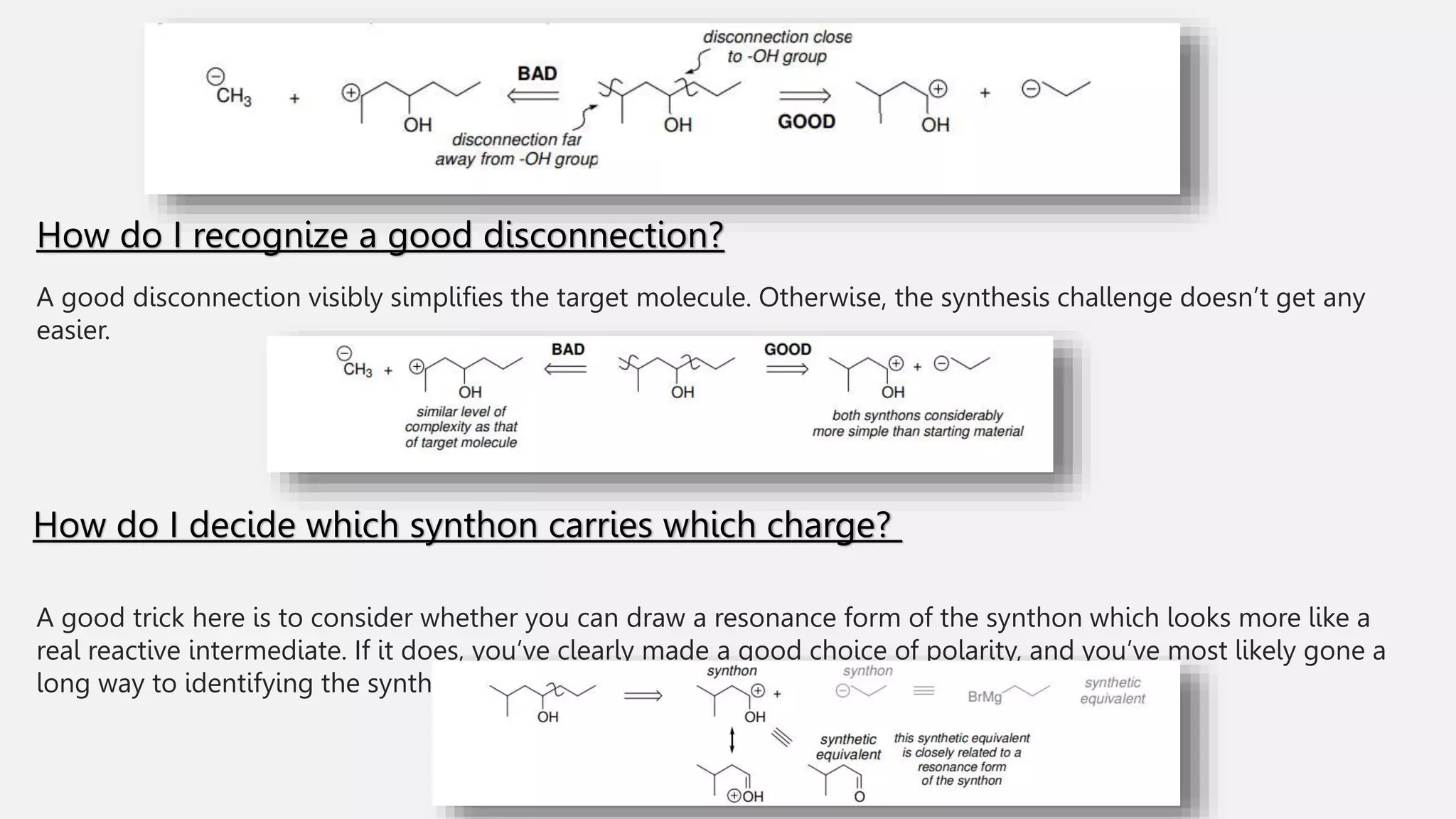
Let's apply this logic to a classic example: the synthesis of a tertiary alcohol.
The classic textbook 'Designing Organic Syntheses' by Stuart Warren provides excellent, step-by-step examples. Let's study a section that applies these principles to the disconnection of simple alcohols.
Read the section titled '1. DISCONNECTIONS OF SIMPLE ALCOHOLS', from frame 10 to frame 17. Pay attention to how a tertiary alcohol is disconnected, how the synthons (like Et⁻) are identified, and how they are translated into their synthetic equivalents (like EtMgBr).
As the text shows, making a tertiary alcohol like Ph(Me)C(OH)Et can be analyzed by disconnecting any of the three C-C bonds to the central carbon. Each disconnection corresponds to a Grignard reaction. Disconnecting the ethyl group, for example, gives the synthons Et⁻ and a Ph(Me)C⁺OH cation. The synthetic equivalent for Et⁻ is EtMgBr, and the equivalent for the cation is the ketone acetophenone (PhC(=O)Me). The forward reaction is simply the addition of ethylmagnesium bromide to acetophenone.
5. A Glimpse of Advanced Strategy: Illogical Synthons
So far, we have disconnected bonds to produce synthons with "natural" polarity (e.g., carbon attached to oxygen is electrophilic). However, the most powerful synthetic strategies often arise from a "polarity inversion" (Umpolung in German). This involves cleverly creating a reagent that reacts as if it had the opposite charge to what is natural.
To push our understanding further, let's briefly look at the concept of 'illogical' synthons. Sometimes the most elegant disconnection leads to a conceptual fragment with reversed polarity, requiring clever synthetic equivalents. This is a glimpse into the creative problem-solving at the heart of synthesis design.
Read the section 'THE 1,2-DIOXYGENATION PATTERN' from frame 131 to 132. Focus on the idea that the 'absurd synthon' –CO₂H can be represented by the very real reagent, cyanide ion (CN⁻). This is a foundational example of 'Umpolung' or polarity inversion.
In this example, to make an α-hydroxy acid, we disconnect to an aldehyde and a ⁻COOH synthon. This synthon is "illogical" because the carbonyl carbon is typically electrophilic, not nucleophilic. However, the cyanide ion, CN⁻, is a perfect synthetic equivalent. It can attack an aldehyde, and the resulting nitrile (-CN group) can be hydrolyzed to a carboxylic acid (-COOH). This kind of thinking elevates synthesis from a simple application of rules to a creative art.
Conclusion
Today, we have laid the logical foundation for designing organic syntheses. We have shifted our perspective from analysis to creation, adopting a backward-thinking approach to deconstruct complex molecules.
Key Takeaways:
- Retrosynthetic analysis is a logical process for planning a synthesis by working backward from a Target Molecule (TGT).
- The key operation is the disconnection (⇒), the reverse of a known reaction, which breaks bonds to simplify the structure.
- Disconnections generate conceptual, idealized fragments called synthons.
- Real, stable reagents called synthetic equivalents are used in the lab to provide the reactivity of the corresponding synthons (e.g., R-MgBr is the synthetic equivalent of an R⁻ synthon).
- A good disconnection simplifies the molecule significantly and corresponds to a reliable, high-yielding reaction.
You are now equipped with the fundamental language of synthetic design. This is not just a method for passing exams; it is the thought process that drives the creation of new medicines, materials, and molecular machines.
Preview of the Next Lesson:
With the core principles established, our next step is to learn how to identify strategic bond disconnections. We will move from defining the terms to applying them. In the next lesson, we will focus on the learning outcome: Identify strategic bond disconnections in a target molecule that correspond to reliable chemical reactions. We will begin to look at molecules and ask the crucial question: "Where is the best place to break this molecule apart?"