Hello! In our previous lessons, we've decoded three essential features of a ¹H NMR spectrum: the number of signals (chemical equivalence), the integration (proton ratios), and the chemical shift (electronic environment). Today, we tackle the final and perhaps most informative feature: the shape of the signals, a phenomenon known as spin-spin splitting or multiplicity.
Last time, we saw how a proton's electronic environment determines its position on the chemical shift axis. But if you look closely at high-resolution spectra, signals are rarely just single sharp lines. They are often split into doublets, triplets, or more complex patterns. This splitting isn't random; it's a direct message about the molecular structure, revealing which protons are neighbors on the carbon skeleton.
Our learning outcome for this lesson is to use spin-spin splitting (multiplicity) in a ¹H NMR spectrum to determine the connectivity of atoms. We will explore the physical origin of this effect, learn the rules that govern simple splitting patterns, and then see how to decipher more complex patterns to map out the molecule's structure.
1. The Origin of Spin-Spin Splitting: J-Coupling
The splitting of an NMR signal is caused by the magnetic influence of neighboring, non-equivalent protons. This interaction, transmitted through the bonding electrons, is called scalar coupling or, more commonly, J-coupling.
To understand this, let's start with the simplest case: two non-equivalent protons, Hₐ and Hᵦ, on adjacent carbons.
Spin-spin splitting (coupling) | Spectroscopy | Organic chemistry | Khan Academy
The video 'Spin-spin splitting (coupling)' from Khan Academy Organic Chemistry offers an excellent and intuitive visual introduction to why a proton's signal is affected by its neighbor's spin.
Please watch from the beginning to 06:13. Focus on how the magnetic moment of one proton can either add to or subtract from the external magnetic field experienced by its neighbor, effectively creating two slightly different magnetic environments.
As the video illustrates, the nucleus of a neighboring proton (say, Hᵦ) is itself a tiny magnet. Its spin can be aligned with the external magnetic field (the α spin state) or against it (the β spin state).
- In about half of the molecules in the sample, Hᵦ will be in the α state. Its local magnetic field adds to , so Hₐ feels a slightly stronger effective field, .
- In the other half of the molecules, Hᵦ will be in the β state. Its local field opposes , so Hₐ feels a slightly weaker effective field, .
Because Hₐ experiences two different effective magnetic fields, its signal is split from a single peak into two peaks of equal intensity. This pattern is called a doublet.

The Quantum Mechanical View
Your interest in quantum chemistry provides an opportunity to look at this more deeply. J-coupling modifies the energy levels of the entire spin system.
The video 'J- coupling' from the 'Principles and Applications of NMR Spectroscopy' channel provides a quantitative explanation of this phenomenon using energy level diagrams. This connects the observed splitting directly to quantum mechanics.
Please watch from 00:29 to 14:41. Pay close attention to how the interaction between two spins (Hₐ and Hᵦ) adds an energy term, m_A m_B J, to the system's Hamiltonian. This term lifts the degeneracy of the energy transitions, causing a single peak to split into a doublet.
Key points from this quantum view:
- The interaction energy is proportional to the coupling constant, J, which is a measure of the strength of the interaction. It is reported in Hertz (Hz).
- J-coupling is mutual. If proton Hₐ splits Hᵦ into a doublet with a coupling constant , then Hᵦ must also split Hₐ into a doublet with the exact same coupling constant, . This is a powerful tool for identifying which protons are coupled to each other.
- The value of J is independent of the external magnetic field strength, unlike chemical shift differences (when measured in Hz).
2. The N+1 Rule and Pascal's Triangle
We can generalize from one neighbor to multiple neighbors. When a proton is coupled to n chemically equivalent neighboring protons, its signal is split into n+1 peaks. This is the famous n+1 rule.
The relative intensities of the peaks in these simple multiplets follow a predictable pattern defined by Pascal's Triangle. This pattern arises from the statistical probabilities of the different spin combinations of the neighboring protons.
Let's continue with the same 'J- coupling' video to see how the n+1 rule and Pascal's Triangle emerge from the principles we've just discussed.
Watch from 14:41 to 30:55. This segment first introduces the n+1 rule with examples, then uses a splitting tree to derive the intensity patterns (1:1 for a doublet, 1:2:1 for a triplet, 1:3:3:1 for a quartet, etc.) that form Pascal's Triangle.
Here's a summary of common patterns:
| n (Number of equivalent neighbors) | n+1 (Multiplicity) | Multiplet Name | Intensity Ratio |
|---|---|---|---|
| 0 | 1 | Singlet (s) | 1 |
| 1 | 2 | Doublet (d) | 1:1 |
| 2 | 3 | Triplet (t) | 1:2:1 |
| 3 | 4 | Quartet (q) | 1:3:3:1 |
| 4 | 5 | Pentet (or Quintet) | 1:4:6:4:1 |
| 6 | 7 | Septet (or Heptet) | 1:6:15:20:15:6:1 |
Example: In the spectrum of 1,1,2-trichloroethane (Cl₂CH-CH₂Cl):
- The CH proton has 2 equivalent neighbors on the adjacent carbon. According to the n+1 rule (n=2), its signal will be a triplet.
- The CH₂ protons have 1 neighbor. According to the n+1 rule (n=1), their signal will be a doublet.
Test your understanding!
Predict the splitting pattern (multiplicity) for each unique proton signal in the ¹H NMR spectrum of diethyl ether (CH₃CH₂-O-CH₂CH₃).
Show answer
Diethyl ether has two sets of equivalent protons due to symmetry: the methyl (-CH₃) protons and the methylene (-CH₂) protons.
- -CH₃ signal: The methyl protons have 2 equivalent neighbors (the -CH₂ protons). Applying the n+1 rule, where n=2, the signal will be split into 2+1 = 3 peaks (a triplet).
- -CH₂ signal: The methylene protons have 3 equivalent neighbors (the -CH₃ protons). Applying the n+1 rule, where n=3, the signal will be split into 3+1 = 4 peaks (a quartet).
This "triplet and quartet" pattern is a classic signature of an ethyl group (-CH₂CH₃).
3. Complex Splitting: Beyond the N+1 Rule
The n+1 rule works beautifully when a proton is coupled to only one set of equivalent neighbors. But what if a proton is coupled to two or more different sets of non-equivalent neighbors, with different coupling constants? This leads to complex splitting.
In this scenario, the n+1 rule does not apply directly. Instead, we must consider the splitting effects sequentially using a splitting tree diagram.
13.7: More Complex Spin-Spin Splitting Patterns
The LibreTexts page 'More Complex Spin-Spin Splitting Patterns' provides a clear introduction to complex coupling and the use of splitting tree diagrams.
Please read the section 'Complex Coupling'. Focus on the example of methyl acrylate and understand how the signal for Hc is split first by Ha (with a large J) and then each of those peaks is split again by Hb (with a small J), resulting in a 'doublet of doublets' (dd).
The Process:
- Start with the unsplit signal.
- Split the signal by the neighbor with the largest coupling constant (J).
- Then, split each of the resulting peaks by the neighbor with the next largest J.
- Repeat for all coupling partners.
The resulting pattern is named based on the sequential splittings. For example:
- A proton coupled to two different single protons gives a doublet of doublets (dd).
- A proton coupled to a CH₂ group and a different single CH group could give a triplet of doublets (td) or a doublet of triplets (dt), depending on which J value is larger.
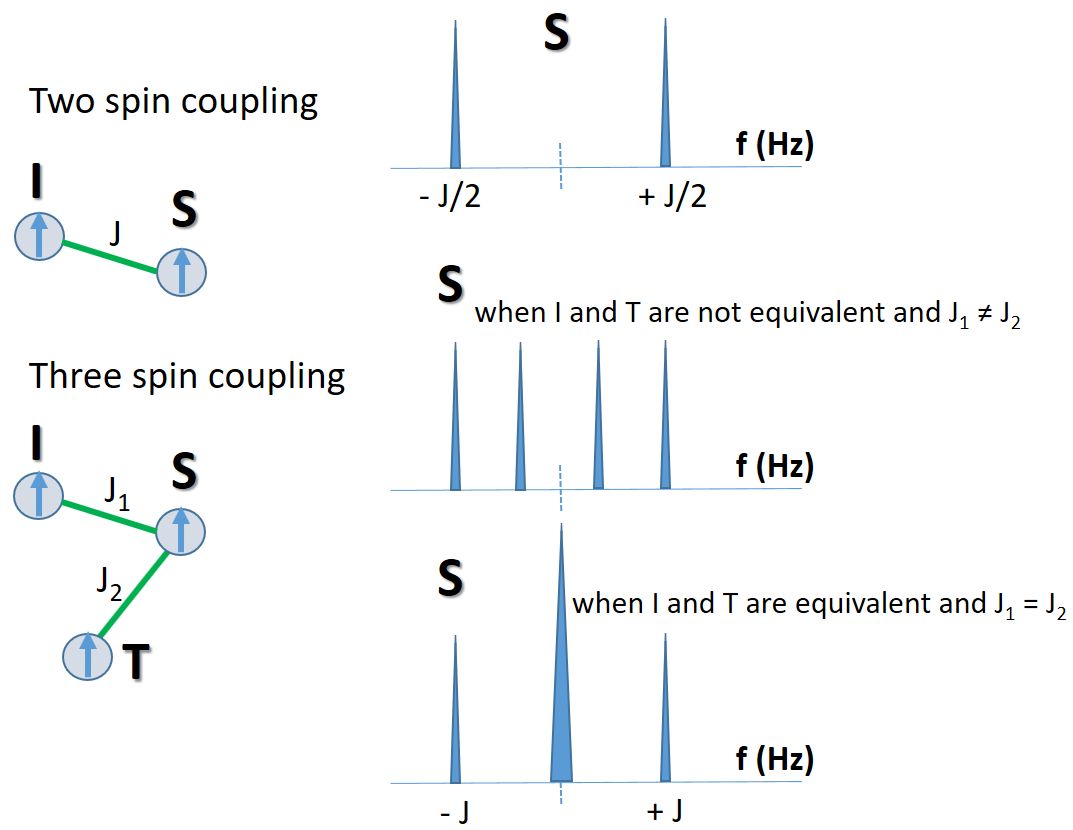
Accidental Equivalence
Sometimes, different coupling constants can be very similar in magnitude (J₁ ≈ J₂). When this happens, the inner peaks of a complex multiplet can overlap, making the pattern appear to follow the simpler n+1 rule. For example, a "triplet of doublets" where the J values are close might look like a simple quartet. This is known as accidental equivalence. Being aware of this is crucial for interpreting real-world spectra.
4. Advanced Analysis: Deconstructing Multiplets
For a rigorous approach, you can reverse the process of building a splitting tree to analyze a complex multiplet and extract the coupling constants. This is a powerful technique that goes beyond simple pattern recognition.
5.3 Spin-Spin Splitting: J-Coupling
The document '5.3 Spin-Spin Splitting: J-Coupling' from Hans Reich's valuable collection of NMR notes provides a systematic method for this analysis.
Please read the sections titled 'Analyzing a First Order Multiplet' and 'Practice Multiplets'. Focus on the concept of constructing a 'reverse coupling tree' by 'taking out' the smallest coupling first. This method allows you to systematically deconstruct any first-order multiplet to find all J values.
This analytical skill is precisely the kind of deep, systematic approach that distinguishes a cursory understanding from a masterful one. It allows you to prove connectivity and extract detailed geometric information from the spectrum.
Conclusion
Today, we have added the final fundamental tool to our ¹H NMR interpretation toolkit. By analyzing the multiplicity of signals, we can directly map the connectivity between different sets of protons.
Key Takeaways:
- Spin-spin splitting is caused by J-coupling, the through-bond magnetic interaction between non-equivalent neighboring nuclei.
- The n+1 rule allows us to predict the multiplicity of a signal coupled to n equivalent neighbors. The intensity pattern of these simple multiplets is described by Pascal's Triangle.
- When a proton is coupled to multiple, non-equivalent sets of neighbors, complex splitting occurs. These patterns, like a doublet of doublets (dd), must be analyzed using splitting tree diagrams.
- The coupling constant (J), measured in Hz, represents the magnitude of the interaction. Mutually coupled protons share the same J value, which is a key to confirming their neighborly relationship.
You are now equipped with the four pillars of ¹H NMR analysis:
- Number of Signals → Number of unique proton environments
- Integration → Relative number of protons in each environment
- Chemical Shift → Electronic nature of each environment
- Splitting → Connectivity between protons (neighboring atoms)
Preview of the Next Lesson:
Having completed our foundational study of structure determination with NMR, we will now pivot to a topic that is essential for navigating the complex world of organic reactions: advanced nomenclature. In the next lesson, we will tackle the learning outcome: Apply IUPAC rules to name complex polyfunctional organic molecules with multiple functional groups and stereocenters. This will equip us with the precise language needed to describe the sophisticated molecules we will encounter in our study of reaction mechanisms.