Hello! Welcome back to our final module on organic synthesis.
In our last lesson, we learned the fundamental vocabulary of retrosynthesis: the concepts of disconnection, synthons, and synthetic equivalents. We established that this is a mental exercise in working backward, allowing us to create a blueprint for a complex synthesis.
Today, we transition from vocabulary to strategy. The learning outcome is to identify strategic bond disconnections in a target molecule that correspond to reliable chemical reactions. This is the creative core of retrosynthesis. While it is an art, it is an art guided by rigorous, logical principles. We will explore these principles and even see how they can be organized into a systematic, almost algorithmic, framework for making strategic choices.
1. The Guiding Principles of a "Good" Disconnection
Before we can break a molecule apart, we need a set of rules to guide our choices. A random disconnection is useless; a strategic one is the key to an elegant synthesis.
A "good" disconnection must satisfy three main criteria:
- It must correspond to a known, reliable chemical reaction.
- It must lead to a significant simplification of the molecule.
- The synthons generated must have stable and accessible synthetic equivalents.
Let's explore these ideas with some clear examples.
Synthetic Strategy – Lecture 2
To start, let's review these foundational guidelines. This lecture slide from Imperial College London provides concise, visual examples of what makes a disconnection 'good' versus 'bad'.
Please read the section titled 'Retrosynthetic analysis FAQs' (page 2). Focus on the two key questions: 'Where should I choose to disconnect?' and 'How do I recognise a good disconnection?'. Pay close attention to the visual examples contrasting GOOD and BAD disconnections.
As the notes illustrate, disconnections are made near functional groups because that's where reactivity lies, and they must break the target into substantially simpler pieces.
The "Why Not": Avoiding Unstable Intermediates
Just as important as knowing where to disconnect is knowing where not to. A common mistake is proposing a disconnection that leads to a highly unstable or inaccessible intermediate.
Retrosynthesis (Part 1): Choosing a Disconnection
This video from Molecular Memory provides an excellent explanation for why certain seemingly logical disconnections are strategically poor.
Watch the segment from 04:14 to 06:24. The speaker analyzes two 'bad' disconnections. Focus on the chemical reasoning provided for why generating an aryl cation (disconnection A) or simply replacing one leaving group with another (disconnection B) are not productive strategies.
This analysis reinforces a critical point: your deep knowledge of reaction mechanisms and intermediate stability is your primary guide. An sp²-hybridized aryl cation is extremely high in energy and difficult to form, making it a poor synthetic target. The disconnection must be chemically reasonable in the forward direction.
2. A Systematic Framework: "Disconnect by the Numbers"
While intuition guided by experience is powerful, the logic of disconnection can be formalized. For a mind that appreciates rigor and systems, as yours does, this approach can be particularly insightful. In 1990, Michael B. Smith published a paper outlining a protocol to assign numerical priorities to bonds, effectively creating an algorithm for identifying the most strategic disconnection.
The core idea is to assign a priority number (0, 3, 7, or 10) to each bond based on the ease of forming it with common, reliable reactions. The higher the number, the more strategic the disconnection.
Let's examine the protocol from the original paper, 'Disconnect by the Numbers'. This provides a structured method for evaluating potential disconnections.
First, read the two paragraphs on page 848 starting with 'All disconnection approaches assign priorities...'. This introduces the concept. Then, read the protocol outlined in points (a) through (f) on page 849. This gives you the step-by-step procedure.
The protocol examines four regions of the molecule relative to a functional group (X):
- Region 1: The bond connected directly to the functional group (C—//—X)
- Region 2: The bond alpha to the functional group (C—//—C—X)
- Region 3: The bond beta to the functional group (C—//—C—C—X)
- Region 4: Bonds connected to chiral centers.
The priority numbers are not arbitrary; they are derived from fundamental principles of reactivity you've already studied. Let's look at the logic for the two most important regions.
The 'why' behind the numbers is rooted in reaction mechanisms like Sₙ2, Sₙ1, and nucleophilic acyl substitution. This reading explains the justification for the priority scores.
Read the sections 'Region 1 (The Bond Connected to the Functional Group)' on page 850 and 'Region 2 (Second Bond from the Functional Group)' on page 851. As you read, focus on how factors like steric hindrance (1° vs 3° carbons), substrate type (alkyl vs. aryl), and reaction type (Sₙ2 vs. Sₙ1) influence the priority numbers.
For example, a high priority of 10 is given to disconnecting a primary carbon from a heteroatom (Region 1, C¹°—//—X) because this bond is easily formed by an Sₙ2 reaction. In contrast, a tertiary carbon gets a low priority because Sₙ2 is disfavored. This system elegantly encodes chemical principles into a simple numerical score.
3. Common Disconnection Strategies
The numerical system helps us identify promising bonds. These high-priority bonds typically fall into a few major categories of strategic disconnections, which correspond to some of the most powerful C-C and C-X bond-forming reactions in organic chemistry.
Let's watch clips from a detailed lecture that illustrates these common strategies.
Chapter 30: Retrosynthetic Analysis | Organic Chemistry by Clayden - Greeves - Warren
This video, based on the textbook 'Organic Chemistry' by Clayden, Greeves, and Warren, provides a wealth of examples. We will use it to visualize the most common and powerful disconnection strategies.
We will be watching several short, targeted clips from this video.
Strategy 1: Disconnect Next to a Heteroatom (C-X Bonds)
This is often the most obvious and effective first step. It corresponds to Region 1 in our numerical system.
Chapter 30: Retrosynthetic Analysis | Organic Chemistry by Clayden - Greeves - Warren
Let's see the C-X disconnection in action. Notice how breaking the C-S bond leads to synthons whose polarity is based on electronegativity, and how these directly translate to simple reagents.
Watch from 02:22 to 04:00. This demonstrates the disconnection of a thioether.
Strategy 2: C-C Disconnections for Alcohols (Grignard & Organometallic Reactions)
This is a cornerstone of synthesis. Disconnecting a C-C bond adjacent to an alcohol's carbon corresponds to a Grignard or organolithium addition to a carbonyl in the forward direction. This is a high-priority Region 2 disconnection.
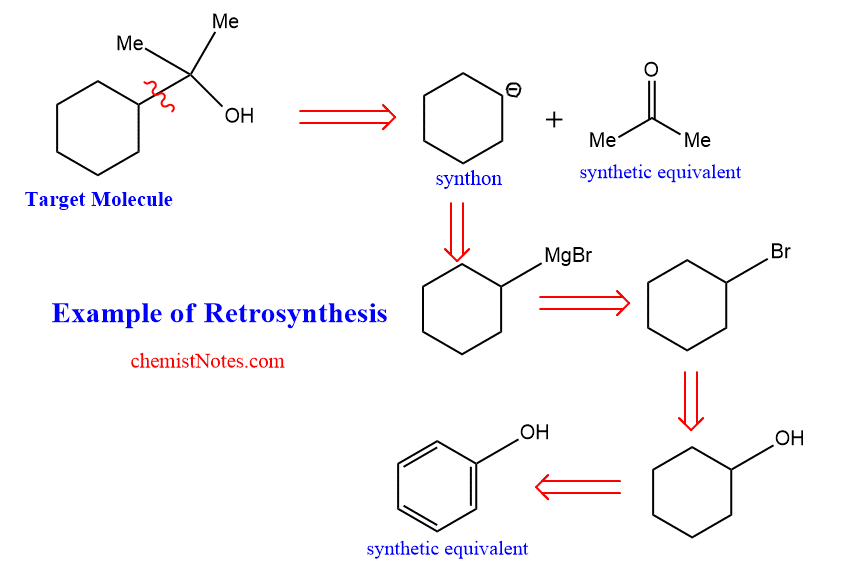
Chapter 30: Retrosynthetic Analysis | Organic Chemistry by Clayden - Greeves - Warren
The synthesis of alcohols is a classic application of retrosynthesis. Watch how different types of alcohols (primary, secondary, tertiary) can be disconnected back to carbonyl compounds and Grignard reagents.
Watch from 00:37:36 to 00:39:15. This segment shows the disconnection of a tertiary alcohol, exploring the different possible C-C bond breaks around the central carbon.
Strategy 3: Two-Group C-C Disconnections
Sometimes, the relationship between two functional groups is the key. The distance between them (1,2-, 1,3-, 1,4-, etc.) is a powerful "retron" that suggests a specific type of disconnection.
1,3-Difunctional Compounds (Aldol & Michael Reactions)
If you see a β-hydroxy carbonyl or an α,β-unsaturated carbonyl, think "Aldol condensation". If you see a 1,3-dicarbonyl, think "Claisen condensation". If you see a functional group at the β-position of a carbonyl, think "Michael addition". These correspond to Region 2 and Region 3 disconnections.
Chapter 30: Retrosynthetic Analysis | Organic Chemistry by Clayden - Greeves - Warren
Let's look at a 1,3-disconnection, which corresponds to a Michael addition in the forward synthesis.
Watch from 00:24:17 to 00:25:30. This example shows a ketone with a nucleophile at the 3-position. The disconnection breaks the molecule into a simple nucleophile (thiol) and an α,β-unsaturated ketone (a Michael acceptor).
1,5-Difunctional Compounds (Michael Addition + Alkylation)
A 1,5-relationship between two carbonyls (or their equivalents) often suggests a sequence involving a Michael addition followed by an enolate alkylation.
Chapter 30: Retrosynthetic Analysis | Organic Chemistry by Clayden - Greeves - Warren
The logic extends to other relationships. A 1,5-dicarbonyl suggests a specific combination of powerful reactions.
Watch from 00:57:56 to 00:59:00. This example of a 1,5-dicarbonyl compound is disconnected via a 'Michael-type' disconnection, breaking it down into an enolate and an α,β-unsaturated system.
Test your understanding!
Consider the molecule 4-phenylbutan-2-one. It has a carbonyl group. The phenyl group is at the 4-position relative to the carbonyl oxygen (or the 3-position relative to the carbonyl carbon). What strategic disconnection does this 1,4-relationship suggest? What would the synthons and corresponding synthetic equivalents be?
Show answer
The 1,4-relationship suggests a disconnection of the bond between C-3 and C-4. This is a Region 3 disconnection (beta to the carbonyl).
- Disconnection: Break the C₃-C₄ bond.
- Synthons: This generates a nucleophilic enolate synthon at C-3 (⁻CH₂COCH₃) and an electrophilic benzyl cation synthon at C-4 (⁺CH₂Ph).
- Synthetic Equivalents:
- The synthetic equivalent of the enolate is acetone (CH₃COCH₃) plus a strong base like LDA.
- The synthetic equivalent of the benzyl cation is benzyl bromide (PhCH₂Br).
The forward reaction would be the alkylation of the acetone enolate with benzyl bromide.
Conclusion
Today we moved from the 'what' to the 'how' of retrosynthesis. You learned to think like a synthetic chemist, evaluating a target molecule not for what it is, but for how it could have been made.
Key Takeaways:
- Strategic disconnections are guided by principles: they must correspond to reliable reactions, simplify the structure, and lead to stable equivalents.
- The "Disconnect by the Numbers" method provides a formal, logical framework for prioritizing potential bond disconnections based on established principles of chemical reactivity.
- High-priority disconnections often fall into common patterns:
- C-Heteroatom bonds (e.g., Williamson ether synthesis).
- C-C bonds alpha to an alcohol (e.g., Grignard reactions).
- C-C bonds involving carbonyls to form 1,3- or 1,5-difunctional systems (e.g., Aldol, Michael reactions).
- Recognizing the relationship between two functional groups (e.g., 1,3-, 1,5-) is a powerful way to identify strategic retrons.
You now have the fundamental strategic tools to deconstruct a target molecule. However, sometimes the most strategic disconnection is hidden. The target molecule must first be modified to reveal the key bond break.
Preview of the Next Lesson:
Our next and final lesson will address this challenge. We will cover the learning outcome: Utilize functional group interconversion (FGI) as a strategic tool to enable more effective disconnections. You will learn how changing one functional group to another can unlock a powerful and simplifying disconnection that was not initially obvious, adding a final layer of sophistication to your synthetic planning.