Hello! Let's continue our exploration of nucleophilic substitution reactions.
In the last lesson, we focused on the electrophile, analyzing how its structure (steric hindrance) and the quality of its leaving group dictate the SN2 reaction rate. We established that the reaction proceeds fastest with unhindered substrates and weak-base leaving groups, all explained by the stability of the pentacoordinate transition state.
Today, we complete our analysis of the factors governing the SN2 reaction by turning to the environment in which it occurs: the solvent. The rate law, rate = k[Substrate][Nucleophile], doesn't explicitly mention the solvent, yet its choice can change the reaction rate by orders of magnitude. This lesson will dissect how the solvent interacts with the reactants at a molecular level and, ultimately, how you can choose the optimal solvent to facilitate an SN2 reaction.
1. Classifying Solvents: The Critical Distinction
For reactions involving charged species, the solvent's primary role is solvation—stabilizing charges through favorable intermolecular forces. The ability to do this varies dramatically between two major classes of polar solvents.
-
Polar Protic Solvents: These solvents have a significant dipole moment and, crucially, contain a hydrogen atom bonded to a highly electronegative atom (typically oxygen or nitrogen). This allows them to act as hydrogen bond donors.
- Examples: Water (H₂O), methanol (CH₃OH), ethanol (CH₃CH₂OH), formic acid (HCOOH).
-
Polar Aprotic Solvents: These solvents also have a significant dipole moment, but they lack a hydrogen atom that can be donated for hydrogen bonding. Their positive dipole is generally buried within the molecule, while the negative dipole is exposed.
- Examples: Dimethyl sulfoxide (DMSO), Dimethylformamide (DMF), Acetonitrile (CH₃CN), Acetone ((CH₃)₂CO).
(Non-polar solvents like hexane or benzene are generally unsuitable for SN2 reactions with ionic nucleophiles, as the reactants simply won't dissolve.)
The presence or absence of a hydrogen bond donor is the single most important factor determining a solvent's effect on an SN2 reaction.
2. The Effect of Solvation on SN2 Rates
Let's consider a typical SN2 reaction, such as the reaction of sodium iodide with chloromethane:
The key interaction to analyze is between the solvent and the anionic nucleophile, I⁻.
In a Polar Protic Solvent (e.g., Methanol)
A protic solvent like methanol solvates both the cation (Na⁺) and the anion (I⁻). The solvation of the anion is particularly strong and occurs via hydrogen bonding. The partially positive hydrogens of the methanol molecules form a tight "cage" or solvation shell around the iodide anion.
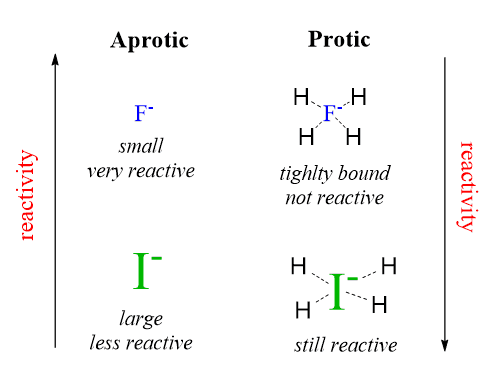
This solvation has two critical consequences for the reaction kinetics:
- Ground State Stabilization: The solvation shell strongly stabilizes the nucleophile, lowering its potential energy in the ground state.
- Increased Activation Energy: For the solvated nucleophile to attack the electrophile, it must break free, at least partially, from its solvent cage. This desolvation process requires energy.
The net effect is a significant increase in the activation energy ($\Delta G^\ddagger$), which dramatically slows down the reaction.
Furthermore, the strength of this protic solvation depends on the nucleophile's charge density. Smaller anions with more concentrated charge (e.g., F⁻) are solvated more tightly than larger anions with diffuse charge (e.g., I⁻). This explains the observed nucleophilicity trend for halides in protic solvents:
Nucleophilicity in Polar Protic Solvents:
Fluoride is so heavily solvated that it becomes a very poor nucleophile, while iodide, being large and less tightly solvated, remains the most reactive.
In a Polar Aprotic Solvent (e.g., DMSO)
The situation is completely different in a polar aprotic solvent.
- The solvent (like DMSO) still effectively solvates the cation (Na⁺) using its exposed negative dipole (the oxygen atom).
- However, it cannot form hydrogen bonds to solvate the anion (I⁻). The positive end of the solvent's dipole is sterically shielded, leading to very weak interaction with the nucleophile.
This leaves the anion relatively unsolvated, or "naked." A naked anion is a high-energy, highly reactive species. Its ground state energy is not significantly lowered by the solvent. Because there is no strong solvation shell to break, the activation energy for the reaction is much lower, and the reaction proceeds much faster.
In the absence of the differentiating effect of hydrogen bonding, the intrinsic reactivity of the nucleophiles, which often correlates with basicity, becomes the dominant factor. The C-F bond is the strongest C-X bond, implying a more stable product and, by Hammond's postulate in this context, a more stable transition state. This leads to a complete reversal of the halide nucleophilicity trend:
Nucleophilicity in Polar Aprotic Solvents:
The result is that SN2 reactions are almost always performed in polar aprotic solvents if possible, as the rate enhancements can be enormous (factors of 1000 or more).
Test your understanding!
You wish to synthesize ethyl cyanide (CH₃CH₂CN) from ethyl bromide (CH₃CH₂Br) using sodium cyanide (NaCN). Which solvent would give a faster reaction: ethanol (CH₃CH₂OH) or acetonitrile (CH₃CN)? Explain your reasoning.
Show answer
Acetonitrile (CH₃CN) would give a much faster reaction.
- Ethanol is a polar protic solvent. It would form strong hydrogen bonds with the cyanide anion (CN⁻), creating a tight solvation shell. This stabilizes the nucleophile, lowering its ground state energy and increasing the activation energy of the reaction.
- Acetonitrile is a polar aprotic solvent. It cannot hydrogen bond with the cyanide anion. The CN⁻ nucleophile will be "naked" and highly reactive, leading to a much lower activation energy and a faster reaction rate.
3. A Deeper Look: Orbitals, Thermodynamics, and Quantum Chemistry
Your interest lies in the fundamental "why," so let's move beyond the solvation shell model and into the realm of molecular orbitals and thermodynamics. The reversal of halide nucleophilicity in aprotic solvents presents a fascinating puzzle that can't be explained by simple polarizability arguments alone.
Explanation for the trends in nucleophilicity—Orbital interactions or electrostatic attraction
This discussion on Chemistry Stack Exchange provides an intellectually stimulating analysis of this exact problem. The question itself articulates the apparent contradiction with Frontier Molecular Orbital (FMO) theory, and the top-voted answer provides a sophisticated resolution.
First, read the question section (the first part of the page) to understand the core paradox. Then, read the first and most upvoted answer (by user Tan Yong Boon). Focus on two key ideas in the answer: The introduction of the Klopman-Salem equation, which separates electrostatic and orbital interaction terms. The critical argument about the thermodynamic stability of the forming C-X bond influencing the kinetic barrier (activation energy).
As you've just read, two main ideas resolve the paradox:
-
Intrinsic Reactivity (Thermodynamics): In the gas phase or in an aprotic solvent (where solvation effects are minimized), the reaction rate correlates with the strength of the new bond being formed in the transition state. The C-F bond is significantly stronger than the C-I bond. According to Hammond's Postulate, a more stable product implies a more stable, lower-energy transition state leading to it. This thermodynamic factor favors the formation of the stronger bond, making the "naked" fluoride ion intrinsically more nucleophilic towards a carbon center than iodide.
-
Solvation and Orbital Energy (Quantum Mechanics): The simplified "caged" model can be described more rigorously. Solvation is fundamentally an acid-base interaction where the solvent acts as a Lewis acid and the nucleophile as a Lewis base.
- This interaction involves the donation of electron density from the nucleophile's HOMO to the solvent's LUMO (e.g., the σ* of an O-H bond).
- This interaction, combined with electrostatic attraction, lowers the energy of the nucleophile's HOMO.
- A lower-energy HOMO results in a larger energy gap between the nucleophile's HOMO and the substrate's LUMO (the σ* C-LG orbital).
- According to FMO theory, a larger HOMO-LUMO gap leads to a weaker orbital interaction, a less-stabilized transition state, and thus a higher activation barrier.
A highly advanced computational study (F. M. Bickelhaupt et al., J. Org. Chem. 2022) confirms this quantum-chemical picture using Activation Strain and Kohn-Sham MO analyses. It quantifies how a protic solvent like water stabilizes the HOMO of F⁻ much more effectively than a polar aprotic solvent like dichloromethane. This stabilization weakens the Lewis base (nucleophile), making it less able to overcome the activation barrier. In essence, the solvent "detunes" the nucleophile.
This provides the deepest "why": Protic solvents slow SN2 reactions by quantum mechanically lowering the energy of the nucleophile's frontier orbital, which in turn weakens the bond-forming orbital interaction that drives the reaction.
Conclusion
Today we've seen the dramatic and decisive role a solvent plays in an SN2 reaction. By understanding how different solvent classes interact with the nucleophile, you can not only predict reaction rates but also rationally design reaction conditions.
Key Takeaways:
- Polar aprotic solvents (DMSO, DMF, acetone) are ideal for SN2 reactions. They solvate the cation but leave the anion "naked" and highly reactive, leading to low activation energies and fast rates.
- Polar protic solvents (water, alcohols) are generally poor choices for SN2 reactions. They form strong hydrogen-bonding solvation shells around the nucleophile, stabilizing its ground state and significantly increasing the activation energy.
- This differential solvation explains the reversal of halide nucleophilicity:
- In protic solvents: I⁻ > Br⁻ > Cl⁻ > F⁻ (less solvation = more reactive).
- In aprotic solvents: F⁻ > Cl⁻ > Br⁻ > I⁻ (intrinsic reactivity/bond strength dominates).
- From a quantum mechanical perspective, protic solvation lowers the energy of the nucleophile's HOMO, increasing the HOMO-LUMO gap with the substrate and weakening the stabilizing orbital interaction in the transition state.
Preview of the Next Lesson:
We have now fully analyzed the SN2 reaction. Our next topic is the other major substitution pathway: the SN1 reaction. You will see that the solvent is also critically important for SN1, but for a completely different reason: its ability to stabilize the key carbocation intermediate. This will provide a fantastic point of comparison for the concepts we've learned today.