Hello! Welcome back to your deep dive into organic reaction mechanisms.
In our previous lesson, we established a cornerstone of the SN2 reaction: its stereospecificity. We saw how the mandatory backside attack, a consequence of HOMO-LUMO orbital overlap, leads to a complete inversion of configuration at the chiral center via a pentacoordinate transition state.
Today, we shift our focus from what happens to how fast it happens. All SN2 reactions are not created equal; some are blindingly fast, while others are impractically slow. The key to predicting these rates lies in understanding the stability of the transition state. This lesson will analyze how two crucial factors related to the electrophile—its substrate structure and the nature of its leaving group—influence the energy of this transition state and, consequently, the overall reaction rate.
1. The Effect of Substrate Structure: Steric Hindrance
The most dramatic factor affecting the rate of an SN2 reaction is the substitution pattern at the electrophilic carbon. The empirical observation is stark and unambiguous:
Rate of SN2 Reaction:
A methyl halide reacts orders of magnitude faster than a secondary halide, and a tertiary halide is effectively inert to the SN2 mechanism. The reason for this is steric hindrance.
To understand this from the first principles you appreciate, let's analyze how the substrate's structure impacts the energy of the pentacoordinate transition state.
Substitution Reactions (on Saturated Carbons) and Chapter 8: Nucleophilic substitutions
The following resources provide an excellent, multi-faceted explanation of how substrate structure governs SN2 reactivity. Pay close attention not just to the idea of physical 'blocking', but also to the more subtle arguments about transition state strain.
In the first resource, 'Substitution Reactions', read the subsection titled '1. Substrate structure (ignoring leaving group)'. Focus on the paragraphs and diagrams explaining why SN2 is disfavored for sterically hindered substrates. Note the advanced point about the change in bond angles and strain.
Chapter 8: Nucleophilic substitutions
Now, let's look at a textbook explanation that reinforces these concepts with another clear diagram.
Read the section '8.3A: Steric hindrance at the electrophile'. The diagrams here provide a clear visual of how backside attack is progressively blocked as substitution increases from methyl to tertiary.
As you've just read, we can deconstruct the effect of steric hindrance into two key components, both of which raise the activation energy ($\Delta G^\ddagger$) of the reaction:
-
Orbital Overlap and Accessibility: At its most fundamental level, the SN2 reaction requires the nucleophile's HOMO to effectively overlap with the σ* LUMO of the C-LG bond. Bulky alkyl groups (like methyl or ethyl groups) attached to the electrophilic carbon act as physical barriers. They occupy space on the "backside" of the carbon, preventing the nucleophile from achieving the close proximity and precise 180° trajectory needed for optimal orbital overlap. The more substituted the carbon, the more obstructed this path becomes.
-
Transition State Destabilization (Steric Strain): As the nucleophile approaches and the pentacoordinate transition state forms, the three non-reacting substituents are forced from a tetrahedral arrangement (~109.5° bond angles) into a planar configuration. In this trigonal bipyramidal geometry, these groups are only 90° away from both the incoming nucleophile and the outgoing leaving group. For small hydrogen atoms, this compression is minor. But for bulky alkyl groups, this proximity leads to significant van der Waals repulsion (steric strain), dramatically increasing the potential energy of the transition state and thus slowing the reaction.

In summary, increasing alkyl substitution at the electrophilic carbon raises the energy of the SN2 transition state, which increases the activation energy and drastically decreases the reaction rate.
Test your understanding!
Arrange the following compounds in order of decreasing reactivity towards sodium cyanide (NaCN) in an SN2 reaction:
a) 1-bromopentane
b) 2-bromopentane
c) 1-bromo-2,2-dimethylpropane (neopentyl bromide)
Explain your reasoning based on steric hindrance.
Show answer
The order of decreasing reactivity is: a > b > c.
- a) 1-bromopentane: This is a primary (1°) alkyl halide. The electrophilic carbon is only attached to one other carbon, so it is relatively unhindered. It will react the fastest.
- b) 2-bromopentane: This is a secondary (2°) alkyl halide. The electrophilic carbon is attached to two other carbons. This presents more steric hindrance to backside attack than the primary halide, so it will react slower than (a).
- c) 1-bromo-2,2-dimethylpropane: This is also a primary (1°) alkyl halide. However, the adjacent carbon (the β-carbon) is a quaternary center, loaded with three bulky methyl groups. While the attack is on a primary carbon, these large groups are held close to the reaction site, creating significant steric hindrance that blocks the nucleophile's approach. This effect, known as neopentyl hindrance, makes the reaction extremely slow, even slower than the reaction at the secondary carbon in (b).
2. The Effect of the Leaving Group
For the C-LG bond to break, the leaving group must depart with the electron pair from the bond. The ease with which it can do this has a major impact on the reaction rate. The governing principle is simple yet profound:
A good leaving group is a weak base.
Why? A weak base is, by definition, a species that is stable and happy to hold a negative charge (or be neutral). Let's connect this to the transition state.
Substitution Reactions (on Saturated Carbons)
The following reading explores this principle in detail. It connects leaving group ability directly to the pKa of the conjugate acid and explains why some common functional groups are poor leaving groups unless 'activated'.
Read the section titled '2. Substrate structure - the leaving group'. Focus on the relationship between leaving group ability, base strength, and the pKaH of the conjugate acid. Also, note the important strategies for converting an alcohol into a good leaving group.
In the SN2 transition state, the C-LG bond is partially broken, and the leaving group is accumulating a partial negative charge.
The more stable the leaving group (LG) is as an anion, the better it can accommodate this developing negative charge. This stabilization lowers the overall energy of the transition state, reducing the activation energy and speeding up the reaction.
Since the stability of an anion is inversely related to its strength as a base, we can use pKa values as a quantitative guide. A good leaving group is the conjugate base of a strong acid (which has a low or negative pKa).
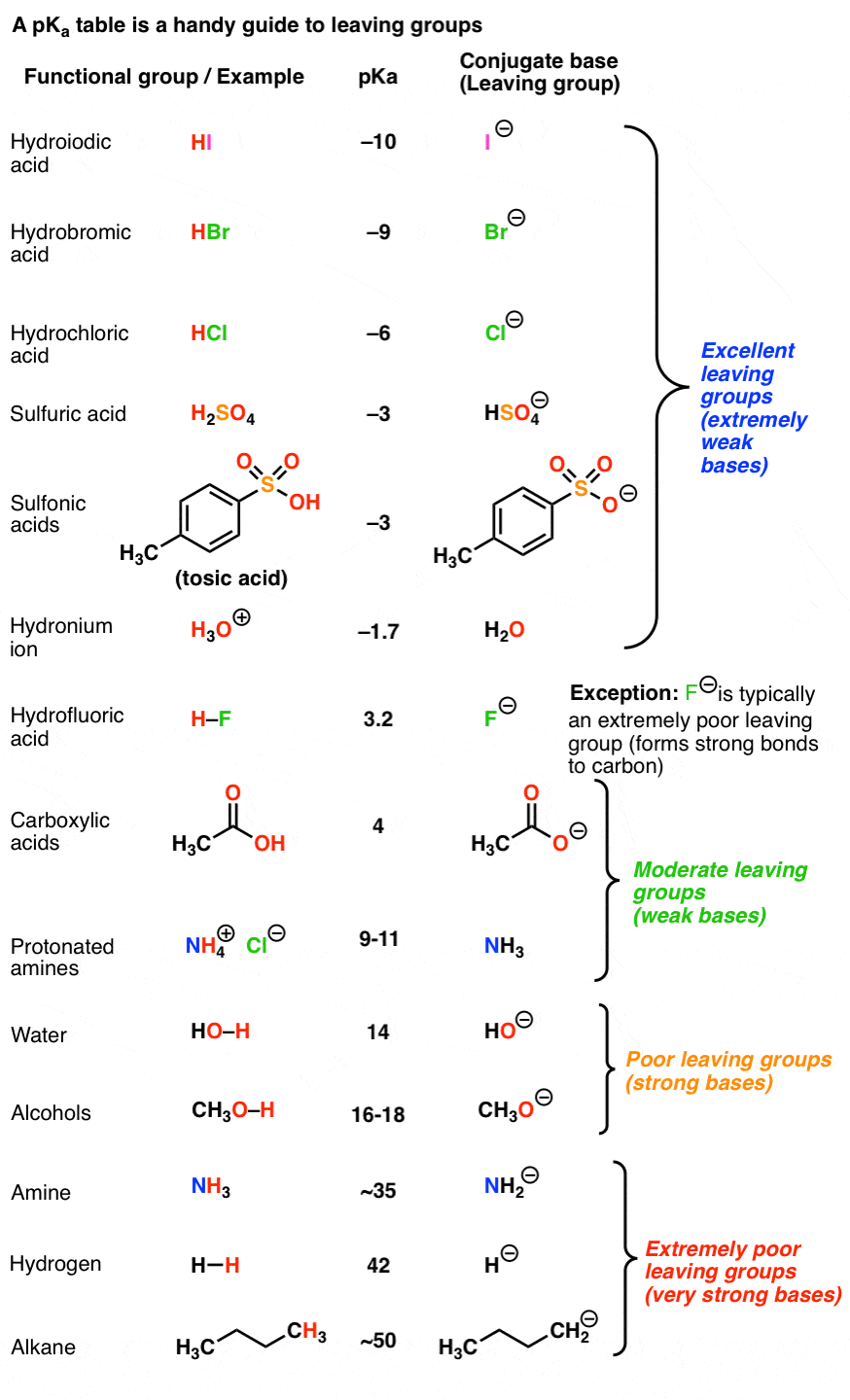
This principle explains several key trends:
-
Halides: The acidity of hydrogen halides increases down the group: HF < HCl < HBr < HI. Consequently, the basicity of their conjugate bases decreases: F⁻ > Cl⁻ > Br⁻ > I⁻. This makes iodide the best halide leaving group and fluoride the worst.
Leaving Group Ability: I⁻ > Br⁻ > Cl⁻ ≫ F⁻ -
Activating Poor Leaving Groups: Groups like hydroxide (HO⁻) and alkoxide (RO⁻) are strong bases and thus terrible leaving groups. To make them reactive in substitution reactions, they must first be converted into weak bases. Two common strategies are:
- Protonation: In the presence of a strong acid, an alcohol's -OH group is protonated to form an oxonium ion, -OH₂⁺. The leaving group is now a neutral water molecule (H₂O), which is an excellent leaving group (it's the conjugate base of H₃O⁺, pKa ≈ -1.7).
- Conversion to Sulfonate Esters: Alcohols can be converted into tosylates (-OTs), mesylates (-OMs), or triflates (-OTf). These are the conjugate bases of extremely strong sulfonic acids, making them superb leaving groups whose stability is enhanced by resonance.
Test your understanding!
You want to synthesize methyl ethyl ether (CH₃OCH₂CH₃). Which of the following two reactions would be more successful? Explain why.
- CH₃O⁻Na⁺ + CH₃CH₂-Br → CH₃OCH₂CH₃ + NaBr
- CH₃CH₂O⁻Na⁺ + CH₃-OH → CH₃OCH₂CH₃ + NaOH
Show answer
Reaction 1 would be far more successful.
The key is to compare the leaving groups. In reaction 1, the leaving group is the bromide ion (Br⁻). Bromide is the conjugate base of a strong acid (HBr, pKa ≈ -9), making it a weak base and an excellent leaving group.
In reaction 2, the leaving group would have to be the hydroxide ion (HO⁻). Hydroxide is the conjugate base of water (pKa ≈ 14), a very weak acid. This makes hydroxide a strong base and an extremely poor leaving group. In fact, the reaction is more likely to be a simple acid-base reaction where the ethoxide (CH₃CH₂O⁻) deprotonates the methanol (CH₃OH), with no substitution occurring.
Conclusion
Today, we have dissected how the structure of the substrate critically determines the rate of SN2 reactions. By focusing on the energetics of the transition state, you can now rationally predict how changes to the electrophile will impact reactivity.
Key Takeaways:
- The SN2 reaction rate is highly sensitive to steric hindrance at the electrophilic carbon, following the trend: methyl > 1° > 2° ≫ 3°.
- Bulky substituents raise the energy of the pentacoordinate transition state through steric strain and by preventing optimal orbital overlap for the backside attack.
- A good leaving group is a weak base, as it must be able to stabilize the negative charge it acquires in the transition state.
- The ability of a leaving group can be quantitatively estimated by the pKa of its conjugate acid; the stronger the acid, the better the leaving group.
- Poor leaving groups like alcohols (-OH) must be "activated" by converting them into better leaving groups, such as water (-OH₂⁺) or a sulfonate ester (-OTs).
Preview of the Next Lesson:
We have now examined the electrophile's role in detail (structure and leaving group). But the SN2 rate law—rate = k[Substrate][Nucleophile]—tells us two other players are involved. In the next lesson, we will turn our attention to the reaction environment, specifically analyzing the profound effect that the solvent has on the SN2 reaction rate.