Hello! Welcome back to our course on organic chemistry.
In our previous lessons, we conducted a thorough investigation of the SN2 reaction. We saw that it is a single, concerted step where bond-breaking and bond-making occur simultaneously, governed by factors like steric hindrance, leaving group ability, nucleophile strength, and, as we saw last time, the type of solvent.
Today, we shift our focus to the other major pathway for nucleophilic substitution: the SN1 reaction. You'll discover that this mechanism is fundamentally different. Instead of a concerted process, it is a stepwise reaction that proceeds through a fascinating and critically important species: the carbocation intermediate. As previewed, the solvent is also crucial here, but its role is to stabilize this very intermediate.
Our goal for this lesson is to describe the detailed, stepwise mechanism of SN1 reactions, with a particular focus on the formation, structure, and stability of the carbocation that lies at its heart.
1. The SN1 Mechanism: A Stepwise Pathway
The designation SN1 stands for Substitution, Nucleophilic, Unimolecular. The "unimolecular" part is key—it refers to the nature of the slowest, rate-determining step of the reaction, which involves only one molecule: the substrate.
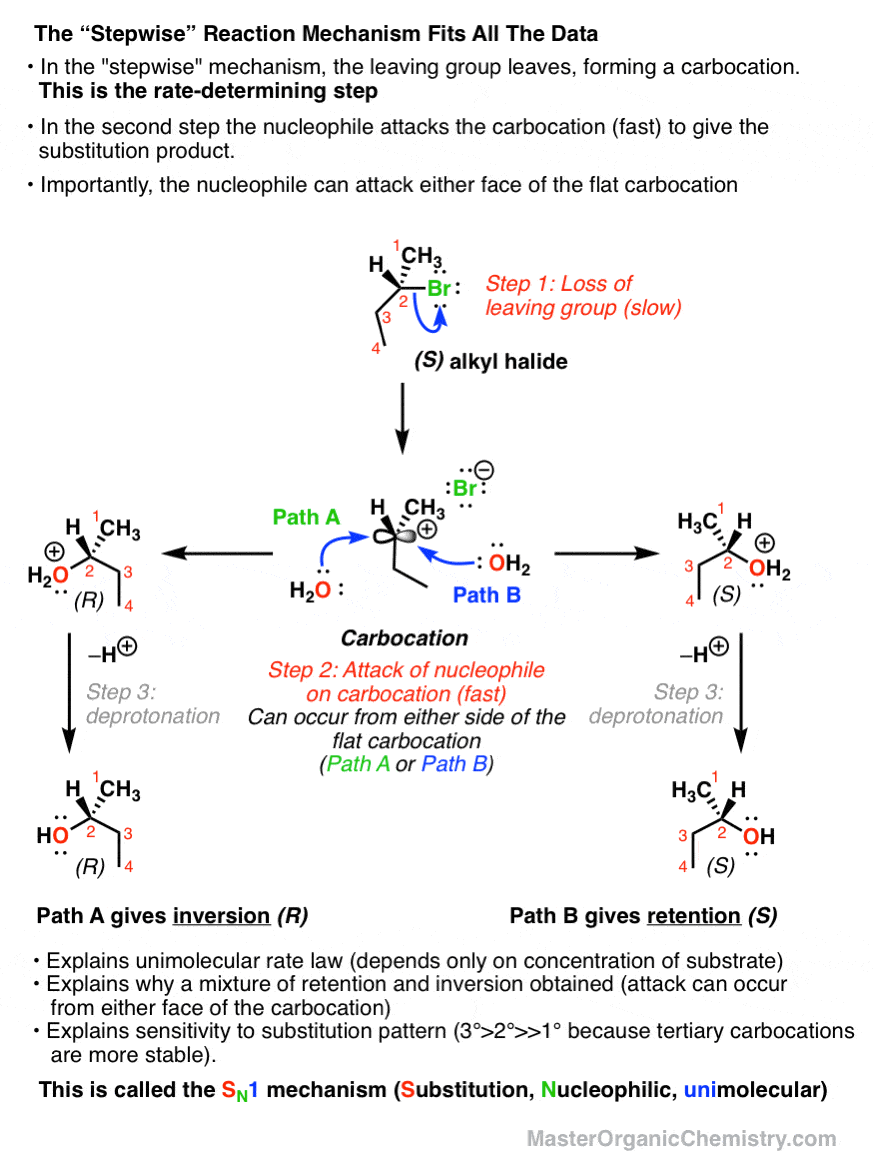
The SN1 mechanism is generally a two-step process (sometimes three, as we'll see) involving a carbocation intermediate.
To begin, let's get a formal introduction to the SN1 mechanism. This section from the online textbook 'Organic Chemistry' by Robert C. Neuman, Jr. outlines the fundamental steps.
Read the section titled 'The SN1 Mechanism'. Focus on how it's defined as a two-step process and identify what happens in each of those two steps. Pay attention to the meaning of the '1' in SN1.
As you've just read, the mechanism unfolds as follows:
- Step 1 (Slow): Ionization to form a carbocation. The C-LG (carbon-leaving group) bond breaks heterolytically, with the leaving group taking both electrons. This is a high-energy step and is therefore the slow, rate-determining step (RDS).
- Step 2 (Fast): Nucleophilic attack. The nucleophile, a Lewis base, donates an electron pair to the electron-deficient carbocation (a Lewis acid) to form a new bond.
Let's visualize this with a concrete example. The reaction of tert-butyl bromide with water is a classic SN1 reaction. Notice here that the nucleophile (water) is neutral. This introduces a third, final step.
Let's examine a real-world example: the conversion of t-butyl bromide to t-butyl alcohol. The same chapter from Neuman's text details this reaction.
Read the section 't-Butyl Alcohol ((CH3)3C-OH) from t-Butyl Bromide ((CH3)3C-Br) (SN1)'. Follow the three numbered reactions (7, 8, and 9) that illustrate the full mechanism. Note the role of the water solvent as both a nucleophile and a base.
To summarize the three steps for this reaction:
- Ionization: The C-Br bond breaks to form a stable tert-butyl carbocation and a bromide ion. This is the slow, rate-determining step.
- Nucleophilic Attack: A water molecule attacks the carbocation. Since water is neutral, the product of this step is a protonated alcohol (an oxonium ion).
- Deprotonation: Another water molecule acts as a base, removing a proton from the oxonium ion to yield the final, neutral alcohol product. This is a fast acid-base reaction.
The entire process is beautifully illustrated in the following animation.
2. Kinetics and the Energy Profile
The stepwise nature of the SN1 reaction directly dictates its kinetics. Because the slow step involves only the substrate molecule breaking apart, the reaction rate depends solely on the concentration of the substrate.
Rate = k[Substrate]
This is a first-order rate law, which contrasts sharply with the second-order rate law of the SN2 reaction (Rate = k[Substrate][Nucleophile]). The nucleophile's concentration has no effect on the SN1 rate because it only participates after the slow step is complete.
The reaction's energy profile reflects this.

The diagram above shows the energy cost of forming the carbocation. The full reaction has two "humps" corresponding to the two main steps (ionization and attack).
To understand the kinetics fully, let's examine the rate law and the complete energy diagram for an SN1 reaction. This will connect the mechanism to the experimentally observed reaction rate.
First, read the subsection 'SN1 Reaction Rates' to see the rate law and understand why the nucleophile is absent from it. Then, look at the diagram in the subsection 'Energy Diagram for an SN1 Reaction' (Figure [graphic 7.26a]) to see the full two-humped energy profile.
The first activation energy barrier (for carbocation formation) is much larger than the second (for nucleophilic attack). This is why the first step is rate-determining. Any factor that lowers this first barrier will speed up the reaction. The most important of these factors is the stability of the carbocation intermediate itself.
3. The Carbocation: Structure and Stability
The existence and stability of the carbocation are the defining features of the SN1 mechanism. A reaction will only proceed via this pathway if a relatively stable carbocation can be formed.
Structure and Hybridization
A carbocation is a carbon atom with a positive formal charge, bonded to three other atoms.
3 Factors That Stabilize Carbocations
Let's take a closer look at the carbocation itself. This article from Master Organic Chemistry provides an excellent, clear description of its fundamental properties.
Read section 1, 'What is A Carbocation?', to understand its geometry and electronic structure. Then, read the first three paragraphs of the untitled section that follows it (starting with 'Why bring this up?'). This crucial part explicitly connects the stability of the carbocation to the reaction rate via Hammond's Postulate.
As you've read, the key features are:
- sp² hybridization at the central carbon.
- Trigonal planar geometry with bond angles of ~120°.
- A vacant, unhybridized p-orbital perpendicular to the plane of the bonds.
- Electron deficient, with only 6 valence electrons, making it a powerful electrophile and Lewis acid.
According to Hammond's Postulate, the transition state leading to the carbocation will resemble the carbocation in structure and energy. Therefore, factors that stabilize the carbocation also stabilize the transition state, lower the activation energy, and increase the reaction rate.
Factors Affecting Carbocation Stability
The central question is: what makes a carbocation stable? There are three primary electronic effects, all of which involve donating electron density to the electron-deficient p-orbital.
The observed order of stability is:
Tertiary (3°) > Secondary (2°) > Primary (1°) > Methyl
This directly translates to SN1 reactivity. Tertiary halides react readily, secondary halides react slowly, and primary/methyl halides effectively do not react via the SN1 mechanism at all.
Let's delve into the "why" behind this trend.
1. Hyperconjugation: This is the most important effect for simple alkyl carbocations. It is a stabilizing interaction that involves the overlap of a filled, adjacent C-H or C-C σ-bonding orbital with the empty p-orbital of the carbocation. This delocalizes the positive charge over a larger volume, which is stabilizing.
For a deep dive into hyperconjugation, let's turn back to Neuman's text, which offers a rigorous, orbital-based explanation.
Read the entire section titled 'Alkyl Group Stabilization of Carbocations (7.2D)'. Focus on the explanation and associated figures for 'Hyperconjugation'. This is the quantum mechanical basis for why more substituted carbocations are more stable.
A tertiary carbocation has many adjacent σ-bonds (e.g., nine C-H bonds in the tert-butyl cation) that can participate in hyperconjugation, making it very stable. A primary carbocation has far fewer, making it much less stable.
Test your understanding!
The ethyl cation, CH₃CH₂⁺, is a primary carbocation. How many C-H bonds are properly aligned to stabilize the positive charge via hyperconjugation at any given moment (assuming free rotation)?
Show answer
There are three C-H bonds on the adjacent methyl group (the β-carbon). These three σ-bonds can overlap with the empty p-orbital on the positively charged carbon (the α-carbon), stabilizing it through hyperconjugation.
2. Resonance: If a carbocation is adjacent to a π-bond (like in an alkene or a benzene ring), it can be stabilized by resonance. This delocalizes the positive charge across the π-system, which is an even more powerful stabilizing effect than hyperconjugation.
3. Adjacent Lone Pairs: If an atom with a lone pair (like O or N) is attached to the carbocation, it can donate that lone pair to form a π-bond. This gives every atom a full octet, which is an extremely powerful stabilizing effect, even if it places a positive formal charge on an electronegative atom like oxygen.
3 Factors That Stabilize Carbocations
The Master Organic Chemistry article provides a very clear summary of all three stabilizing effects, with excellent examples for resonance and lone-pair donation.
Read sections 4 ('Factors That Stabilize Carbocations – Resonance'), 5 ('The Importance of Carbocation Stability In Reactions'), and 6 ('Factors That Stabilize Carbocations – Adjacent Lone Pairs'). These sections explain why benzylic and allylic carbocations are so stable and how lone pairs can provide stabilization.
The benzyl carbocation (C₆H₅CH₂⁺) and the allyl carbocation (CH₂=CH-CH₂⁺) are both primary, but their resonance stabilization makes them as stable as, or even more stable than, a typical secondary or tertiary alkyl carbocation.
4. Stereochemical Outcome of the SN1 Reaction
Since the carbocation intermediate is trigonal planar, the nucleophile can attack from either the top face or the bottom face of the empty p-orbital.
- If the attack occurs on the same side from which the leaving group departed, the product has retention of configuration.
- If the attack occurs on the opposite side, the product has inversion of configuration.
In an ideal scenario, attack from either side would be equally probable, leading to a 50:50 mixture of the two enantiomers. This is called racemization.
However, in reality, the leaving group doesn't always diffuse away completely before the nucleophile attacks. It can linger, forming an ion pair that partially shields one face of the carbocation. This often results in a slight excess of the inversion product. We will explore this fascinating detail in our next lesson.
Conclusion
Today, we have dissected the SN1 mechanism, contrasting its stepwise nature with the concerted SN2 pathway. We have seen how its progress hinges entirely on the formation of a carbocation intermediate.
Key Takeaways:
- The SN1 reaction is a stepwise process involving a carbocation intermediate.
- The first step, ionization, is slow, unimolecular, and rate-determining. The reaction rate is first-order: Rate = k[Substrate].
- Carbocation stability is paramount. The stability order is 3° > 2° >> 1°. This is explained by hyperconjugation and inductive effects.
- Resonance and adjacent lone pairs provide powerful additional stabilization, making allylic, benzylic, and α-heteroatom carbocations readily accessible.
- The mechanism proceeds through a trigonal planar, sp²-hybridized intermediate, which leads to attack from both faces.
Preview of the Next Lesson:
We have briefly touched on the stereochemical outcome of the SN1 reaction—racemization. In the next lesson, we will fully explore this topic, explaining what leads to complete versus incomplete racemization by examining the concept of ion pairs in greater detail. This will complete our picture of the SN1 pathway and set the stage for comparing and predicting SN1 versus SN2 reactivity.