Hello! Welcome to the first lesson in our new module, "Acids, Bases, and Reactivity Principles."
In our previous module, we completed our exploration of molecular structure and stereochemistry, culminating in the analysis of cyclohexane conformations. You've built a robust understanding of how molecules exist in three-dimensional space. Now, we shift our focus from structure to reactivity—from what molecules are to what they do. This module is the gateway to understanding the mechanisms of organic reactions, which is central to your goal of mastering organic chemistry.
Today's lesson addresses the most fundamental question of reactivity: why do molecules react? We will explore two key theoretical frameworks that describe the vast majority of chemical interactions. Our learning outcome is to apply Brønsted-Lowry and Lewis definitions to identify acids, bases, nucleophiles, and electrophiles. These concepts form the language we will use to describe how and why chemical reactions occur, providing the "why" behind electron movement that you're seeking.
1. The Brønsted-Lowry Definition: A Focus on the Proton
The first and most common framework for acids and bases in organic chemistry is the Brønsted-Lowry theory. It's elegantly simple and focuses entirely on the transfer of a single particle: the proton ().
- A Brønsted-Lowry Acid is a species that donates a proton.
- A Brønsted-Lowry Base is a species that accepts a proton.
When an acid donates a proton, the species that remains is called its conjugate base. When a base accepts a proton, the species it becomes is its conjugate acid. Every Brønsted-Lowry acid-base reaction involves two such conjugate pairs.
For example, in the reaction of acetic acid with ammonia:
The pair CH₃COOH/CH₃COO⁻ is one conjugate acid-base pair, and NH₄⁺/NH₃ is the other.
Conjugate Acid Base Pairs, Arrhenius, Bronsted Lowry and Lewis Definition - Chemistry
To see this theory in action with clear examples, watch this segment from The Organic Chemistry Tutor. It begins with the older Arrhenius definition for context and then thoroughly explains the Brønsted-Lowry concept of proton donors/acceptors and conjugate pairs.
Watch from the beginning to 9:15. Pay close attention to how to identify the acid, the base, and their respective conjugate pairs in a reaction.
The Brønsted-Lowry theory is powerful, but it's limited to reactions involving proton transfer. To understand a wider array of organic reactions, we need a more general theory.
2. The Lewis Definition: A Focus on Electron Pairs
In 1923, the same year as Brønsted and Lowry, G.N. Lewis proposed a more fundamental and encompassing definition based on electron pairs, which is at the heart of how we draw reaction mechanisms.
- A Lewis Acid is a species that accepts a pair of electrons.
- A Lewis Base is a species that donates a pair of electrons.
Under this definition, a proton () is a Lewis acid because it can accept an electron pair. A Brønsted-Lowry base (like or ) is also a Lewis base because it uses its lone pair to accept the proton. Thus, all Brønsted-Lowry acid-base reactions are also Lewis acid-base reactions.
However, the Lewis theory goes further. Consider the reaction between borane () and ammonia ():
Here, no proton is transferred. Instead, the nitrogen atom of ammonia donates its lone pair of electrons to the electron-deficient boron atom, which accepts the pair. This forms a new covalent bond called a coordinate covalent bond or an adduct.
Conjugate Acid Base Pairs, Arrhenius, Bronsted Lowry and Lewis Definition - Chemistry
Let's continue with the same video, which now explains the Lewis definition.
Watch from 9:15 to the end (11:33). Notice how the focus shifts from protons to the movement of electron pairs.
3. Nucleophiles and Electrophiles: The Language of Organic Reactions
The Lewis definition provides the direct foundation for the key players in organic reaction mechanisms. In organic chemistry, we use more descriptive terms:
- A Nucleophile ("nucleus-loving") is a Lewis base. It is electron-rich and seeks a region of positive charge (a nucleus) to donate its electrons to.
- An Electrophile ("electron-loving") is a Lewis acid. It is electron-poor and seeks a pair of electrons to accept.
Therefore, a chemical reaction can be viewed as the interaction between a nucleophile and an electrophile. The flow of a reaction mechanism is depicted with curved arrows that always start from the nucleophile (the source of electrons) and point to the electrophile (the electron sink).

4. The Quantum Mechanical View: HOMO-LUMO Interactions
Here we connect these ideas to the quantum mechanical principles you're interested in. Why does a nucleophile donate electrons and an electrophile accept them? The answer lies in Frontier Molecular Orbital (FMO) theory.
A chemical reaction between a nucleophile and an electrophile is fundamentally an interaction between molecular orbitals. Specifically, it involves the donation of electrons from the Highest Occupied Molecular Orbital (HOMO) of the nucleophile into the Lowest Unoccupied Molecular Orbital (LUMO) of the electrophile.
- Nucleophile (Lewis Base): Its most available, highest-energy electrons are in its HOMO. These are the electrons it will use to form a new bond.
- Electrophile (Lewis Acid): Its most accessible, lowest-energy empty orbital is its LUMO. This is where it will accept the incoming electrons.
This HOMO-LUMO interaction is the quantum mechanical description of a Lewis acid-base reaction. The shapes and energies of these orbitals determine the reactivity and selectivity of molecules.
22.2 Principles of Reactivity - Lewis Theory and HOMO-LUMO
This video by Michael Evans provides an excellent, in-depth explanation of how Lewis acid-base theory is simply a manifestation of HOMO-LUMO interactions. This connects the abstract concept of electron donation to concrete molecular orbitals.
Please watch these three segments: 3:14 - 5:56: This part recaps the Lewis definition and introduces the HOMO-LUMO paradigm, explaining how electron donation from the nucleophile's HOMO to the electrophile's LUMO leads to stabilization. 9:46 - 11:57: This segment introduces the terms 'nucleophile' and 'electrophile' in the context of a HOMO-LUMO interaction between ammonia and borane. 11:57 - 13:31: This is a crucial section. It explains how the shape and location of the HOMO and LUMO lobes allow us to identify the specific atoms that will act as the nucleophilic and electrophilic centers.
As the video shows, analyzing the HOMO of a potential nucleophile reveals which atom has the highest electron density and is most likely to donate electrons. Conversely, analyzing the LUMO of an electrophile shows which atom is most electron-deficient and ready to accept electrons. This is a powerful predictive tool that moves beyond simple formal charges.
5. How to Identify Nucleophiles and Electrophiles
While FMO theory provides the deep reason, we can use some general structural features to quickly identify nucleophiles and electrophiles.
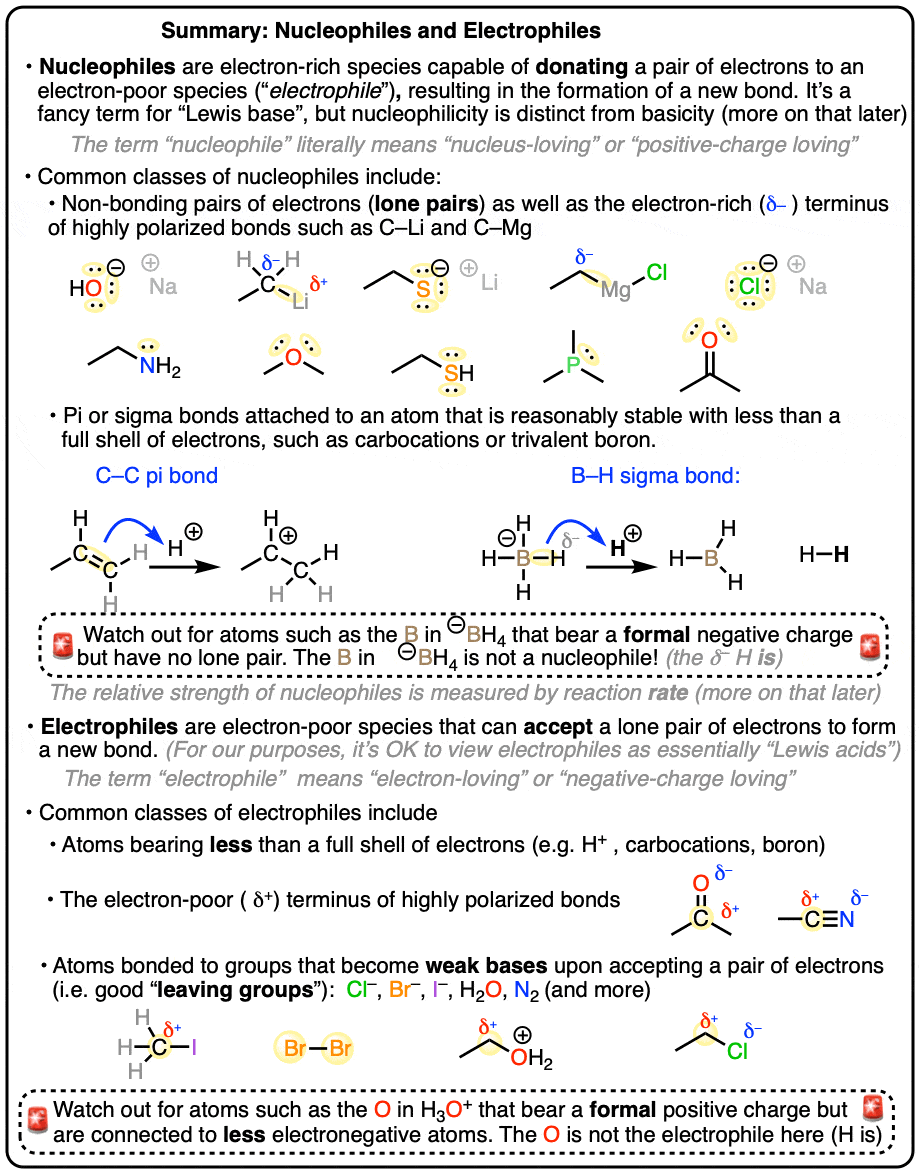
As summarized in the chart, here are the key characteristics:
Common Features of Nucleophiles (Lewis Bases):
- Presence of a lone pair: Atoms like Oxygen (in H₂O, ROH), Nitrogen (in NH₃, RNH₂), and Sulfur (in H₂S, RSH) are common nucleophilic centers.
- Presence of a net negative charge: Anions are generally strong nucleophiles (e.g., , , ).
- Presence of a bond: The electrons in double and triple bonds are in higher-energy orbitals than electrons and can act as nucleophiles (e.g., alkenes, alkynes, benzene).
Common Features of Electrophiles (Lewis Acids):
- Presence of a net positive charge: Cations like carbocations () or the hydronium ion () are potent electrophiles.
- An atom with an incomplete octet: Species like and have an empty p-orbital that can readily accept an electron pair.
- An atom in a polar bond with a partial positive charge (): The carbon atom in a carbonyl group () or an alkyl halide () is a very common electrophilic site.
Notice the "Watch Out!" section in the chart. It highlights subtle but important points, such as why the boron in is not nucleophilic, even with a formal negative charge. This is because the boron is electron-poor, and the nucleophilic character resides in the H atoms (as hydride, ). This is the kind of deep, non-superficial understanding we are aiming for.
Test your understanding!
For the following reaction between methoxide ion and methyl iodide, identify the:
a) Brønsted-Lowry acid/base (if any)
b) Lewis acid and Lewis base
c) Nucleophile and Electrophile
d) Draw a curved arrow to show the electron movement that forms the new C-O bond.
Show answer
a) Brønsted-Lowry: There are no Brønsted-Lowry acids or bases in this reaction, as no proton is being transferred.
b) Lewis Acid/Base:
* Lewis Base: The methoxide ion () donates a pair of electrons from its oxygen atom.
* Lewis Acid: Methyl iodide () accepts the electron pair at its carbon atom.
c) Nucleophile/Electrophile:
* Nucleophile: The electron-rich methoxide ion ().
* Electrophile: The electron-poor carbon atom in methyl iodide. The C-I bond is polarized () because iodine is more electronegative than carbon, making the carbon atom electrophilic.
d) Curved Arrow: The arrow starts at one of the lone pairs on the oxygen atom of and points directly to the carbon atom of . (A second arrow would typically show the C-I bond breaking, with the arrow pointing from the bond to the iodine atom, but the question only asks for the bond-forming step).
Conclusion
Today, we laid the groundwork for understanding all of organic reactivity. We've seen how chemical interactions can be described through the lens of proton transfer (Brønsted-Lowry) or, more generally, electron-pair transfer (Lewis).
Key Takeaways:
- Brønsted-Lowry theory defines acids as proton donors and bases as proton acceptors.
- Lewis theory provides a broader definition: acids are electron-pair acceptors, and bases are electron-pair donors.
- In organic chemistry, we use the terms electrophile for a Lewis acid and nucleophile for a Lewis base.
- Reactions are fundamentally interactions between an electron-rich nucleophile and an electron-poor electrophile.
- From a quantum mechanical perspective, this corresponds to the interaction between the HOMO of the nucleophile and the LUMO of the electrophile.
Preview of the Next Lesson:
Now that you can identify acids and bases, the next logical question is: how do we compare their strengths? In the next lesson, we will analyze the stability of conjugate bases to predict the relative acidity of organic compounds. You will learn how structural features influence pKa values, allowing you to quantitatively predict the outcome of acid-base reactions.