Hello! Welcome back to our journey through organic chemistry.
In the last lesson, we established the fundamental language of reactivity, defining acids and bases through the Brønsted-Lowry (proton transfer) and Lewis (electron-pair transfer) models. We saw that organic reactions can be universally described as an interaction between an electron-rich nucleophile (Lewis base) and an electron-poor electrophile (Lewis acid), driven by the overlap of the nucleophile's HOMO and the electrophile's LUMO.
Today, we move from identifying acids to comparing their strengths. The learning outcome for this lesson is to analyze the stability of conjugate bases to predict the relative acidity of organic compounds. This is one of the most powerful predictive tools in organic chemistry, and mastering it will allow you to understand, not just memorize, why different molecules exhibit vastly different acidities.
1. The Guiding Principle: Stable Conjugate Base = Stronger Acid
Let's begin with the dissociation of a generic Brønsted-Lowry acid, , in water:
The strength of the acid is quantified by its acid dissociation constant, , where a larger (and thus a smaller ) indicates a stronger acid. The position of this equilibrium is governed by the relative stability of the species on either side.
The core principle is this: Any factor that stabilizes the conjugate base, , relative to the acid, , will shift the equilibrium to the right, making a stronger acid.
From a thermodynamic perspective, a more stable conjugate base means the products are at a lower free energy () relative to the reactants. This leads to a more favorable (larger) equilibrium constant . Therefore, the question "Which acid is stronger?" becomes "Which acid has the more stable conjugate base?"
Our task, then, is to learn how to systematically evaluate the stability of the conjugate base, . We will use a hierarchical set of factors, often remembered by the mnemonic ARIO or CARDIO.
2. A Framework for Analysis: CARDIO
To compare the stability of two or more conjugate bases, we evaluate a series of structural features in order of importance. A common and effective mnemonic for this is CARDIO:
- C - Charge: Compare the charges of the bases. We'll touch on this, but most of our comparisons will involve bases with the same charge.
- A - Atom: What atom bears the negative charge?
- R - Resonance: Can the charge be delocalized through resonance (the mesomeric effect)?
- I - Induction: Are there electronegative atoms nearby that can pull electron density away, stabilizing the charge?
- O - Orbital: In what type of hybridized orbital does the negative charge reside?
You apply these rules in order. If the 'Atom' factor reveals a clear difference, you generally don't need to proceed to 'Resonance'.
3.2 Ranking Acids and Bases | Organic Chemistry
To begin, watch this introductory segment from a video by Chad's Prep. It lays out this exact framework and explains the fundamental logic behind it.
Watch from the beginning to 3:27. Focus on the relationship between conjugate base stability and acid strength, and familiarize yourself with the 'CARDIO' mnemonic.
Now, let's dissect each factor in detail.
3. Factor 1: The Atom Effect
This is the most important factor after charge. When comparing conjugate bases, the identity of the atom bearing the negative charge has a profound effect on its stability. We must consider two different scenarios.
A. Within the Same Period (Row)
When comparing atoms in the same row of the periodic table, electronegativity is the dominant factor. A more electronegative atom is better able to accommodate a negative charge.
Consider the acidity of ethane (), methylamine (), and ethanol ().
- Acids: , ,
- Conjugate Bases: , ,
The negative charge resides on C, N, and O, respectively. Since electronegativity increases from C to N to O, the stability of the conjugate bases follows the same trend: . Therefore, the acidity trend is: Ethanol > Methylamine > Ethane.
B. Within the Same Group (Column)
When comparing atoms in the same column, atomic size is the dominant factor. This is a crucial point that often overrides electronegativity. A negative charge is more stable when it is spread out over a larger volume.
Consider the acidity of the hydrogen halides: .
- Conjugate Bases:
Although fluorine is the most electronegative halogen, the iodide ion () is much larger than the fluoride ion (). The negative charge on is dispersed over a significantly larger volume, making it the most stable conjugate base in the series. Thus, the stability trend is , and the acidity trend is: HI > HBr > HCl > HF.
3.2 Ranking Acids and Bases | Organic Chemistry
Now, let's watch the segment from Chad's Prep that details the Atom rule. Pay close attention to the distinction between the periodic trend (electronegativity) and the group trend (size).
Watch from 6:14 to 12:29. The video clearly explains how to decide whether electronegativity or size is the key factor and shows how to use this to rank both acids and bases.
4. Factor 2: Resonance (The Mesomeric Effect)
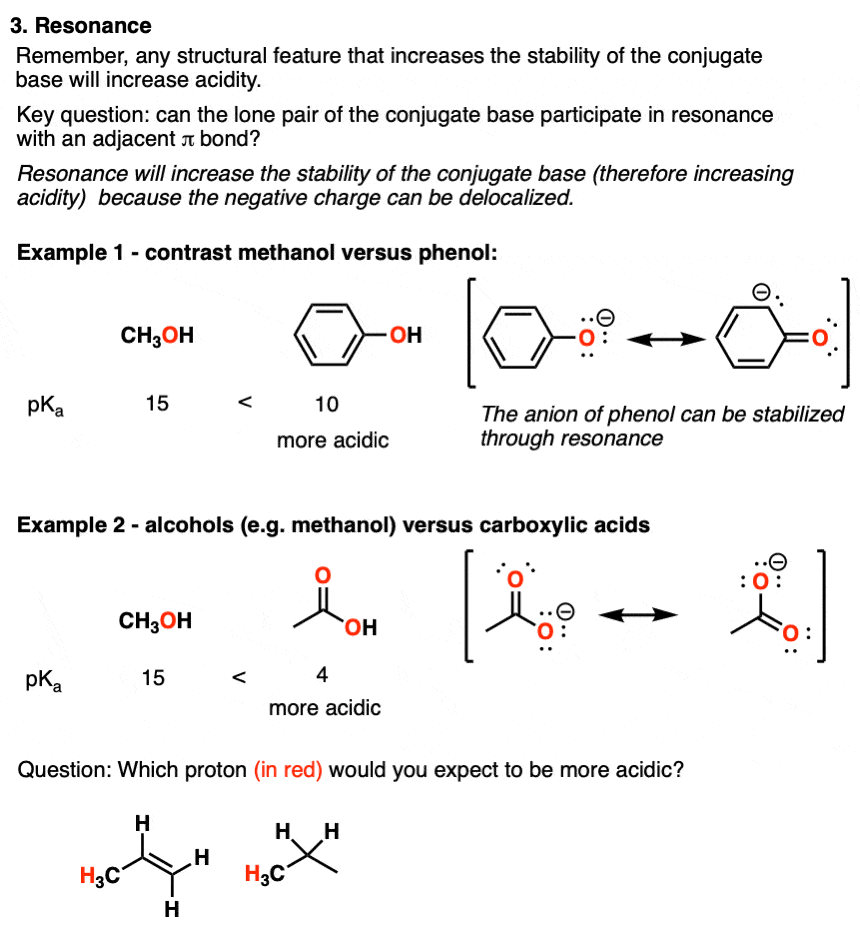
You expressed a particular interest in this topic, and for good reason. The ability to delocalize a charge via resonance is a powerful stabilizing effect that can dramatically increase acidity.
If a negative charge in a conjugate base can be spread over two or more atoms through resonance structures, the base is significantly more stable than a similar base where the charge is localized on a single atom.
3.4: Structural Effects on Acidity and Basicity
For a deeper look, let's read about this phenomenon from the article 'Structural Effects on Acidity and Basicity' on Chem LibreTexts. It provides excellent examples, including the one you see in the image.
Read section 3.4.2 Resonance Effect. Focus on how the delocalization of charge in acetate and phenoxide ions makes them more stable than ethoxide.
3.2 Ranking Acids and Bases | Organic Chemistry
Let's reinforce this with the video explanation.
Watch from 12:29 to 16:13. This segment explains how to apply the resonance rule and also introduces the important idea that the quality of resonance structures matters (e.g., charge on two oxygens is better than on one oxygen and three carbons).
5. Factor 3: The Inductive Effect
The inductive effect is the polarization of a bond due to a difference in electronegativity between the atoms. Electronegative atoms can pull electron density towards themselves through a chain of sigma bonds, which can help stabilize a nearby negative charge.
Key aspects of the inductive effect:
- Strength: The more electronegative the atom/group, the stronger the electron-withdrawing effect. (F > Cl > Br > I)
- Number: The more electron-withdrawing groups, the greater the stabilizing effect.
- Distance: The effect weakens rapidly with distance. A group two carbons away has a much smaller effect than one that is adjacent to the charge.
Consider the acidity of acetic acid and its chlorinated derivatives:
- Acids: , , ,
In their conjugate bases, the highly electronegative chlorine atoms pull electron density away from the carboxylate group, further delocalizing the negative charge and stabilizing the anion. Trichloroacetate is the most stable base, making trichloroacetic acid the strongest acid in the series.
Inductive and Resonance (Mesomeric) Effects
The article 'Inductive and Resonance (Mesomeric) Effects' from Chemistry Steps provides a detailed explanation of this effect.
Read the section titled Inductive Effect and Acid Strength. It clearly shows how electronegativity and distance impact acidity through the inductive stabilization of the conjugate base.
3.2 Ranking Acids and Bases | Organic Chemistry
Now watch the corresponding video segment from Chad's Prep.
Watch from 16:13 to 25:07. This section provides an excellent walkthrough of how to compare inductive effects based on strength, distance, and number of withdrawing groups.
6. Factor 4: The Orbital Effect (Hybridization)
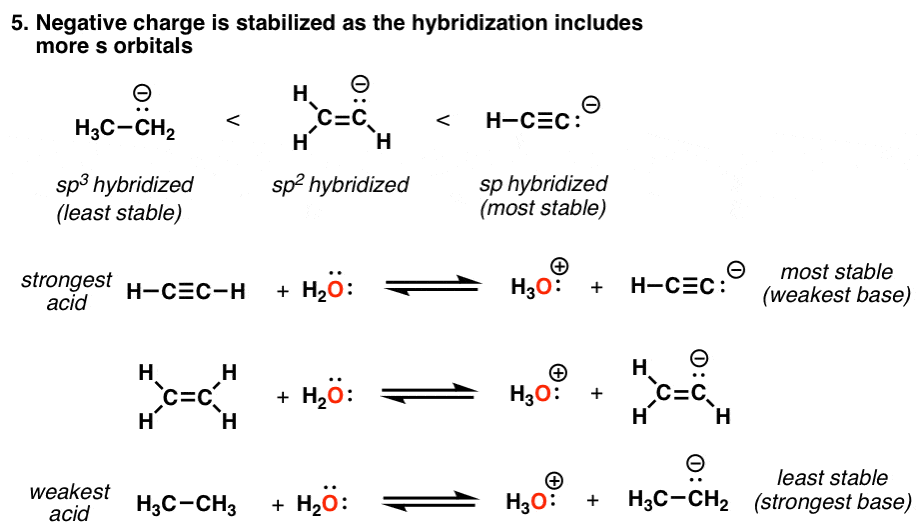
The final factor connects directly back to the quantum mechanical structure of the atom. The type of orbital holding the lone pair of the conjugate base affects its energy and stability.
The key idea is s-character. Electrons in s orbitals are, on average, held closer to the positively charged nucleus than electrons in p orbitals. Therefore, a lone pair in an orbital with higher s-character will be at a lower energy and more stable.
- sp³ orbital: 25% s-character
- sp² orbital: 33.3% s-character
- sp orbital: 50% s-character
Stability of charge: sp > sp² > sp³
3.2 Ranking Acids and Bases | Organic Chemistry
Let's complete our tour of the CARDIO rules with the video segment on the orbital effect.
Watch from 25:07 to 28:50. This explains how the higher s-character of sp orbitals stabilizes the negative charge in the conjugate base.
Test your understanding!
Using the CARDIO rules, rank the following compounds from most acidic (1) to least acidic (3). Explain your reasoning by analyzing their conjugate bases.
A) (Ethanethiol)
B) (Ethanol)
C) (2-Chloroethanol)
Show answer
The correct ranking is A > C > B.
-
Compare all three: First, draw the conjugate bases:
- A':
- B':
- C':
-
Apply Rule A (Atom): Compare A' and B'. The negative charge is on Sulfur vs. Oxygen. These are in the same group. For atoms in the same group, size dominates. Sulfur is larger than oxygen, so it stabilizes the negative charge better. Therefore, is more stable than , making ethanethiol (A) more acidic than ethanol (B). This immediately tells us A is the most acidic.
-
Apply Rule I (Induction): Now compare B' and C'.
- Atom: Both have the charge on an oxygen. Tie.
- Resonance: Neither has resonance. Tie.
- Induction: Compound C' has an electronegative chlorine atom. This chlorine exerts an electron-withdrawing inductive effect, pulling electron density away from the and stabilizing the negative charge. B' has no such effect. Therefore, is more stable than . This makes 2-chloroethanol (C) more acidic than ethanol (B).
-
Final Ranking:
- (A) Ethanethiol is the most acidic due to the 'Atom' effect (size).
- (C) 2-Chloroethanol is next, as its conjugate base is stabilized by induction.
- (B) Ethanol is the least acidic.
7. When the Rules Collide: The Importance of Hierarchy
The CARDIO framework is hierarchical. However, there are famous edge cases where a powerful effect lower on the list can compete with a weaker effect higher on the list. Knowing these exceptions is key to a deeper understanding.
A classic example is comparing the acidity of acetylene () and ammonia ().
- Acetylene: . Conjugate base: . Charge is on an sp-hybridized carbon.
- Ammonia: . Conjugate base: . Charge is on an sp³-hybridized nitrogen.
If you strictly followed the rules, 'Atom' (Nitrogen is more electronegative than Carbon) would suggest is more stable. But the experimental values show acetylene is a much stronger acid. Why? In this case, the Orbital effect is so pronounced (sp vs. sp³) that it overcomes the difference in electronegativity between the atoms. The 50% s-character of the sp orbital provides immense stability to the acetylide anion.
3.2 Ranking Acids and Bases | Organic Chemistry
The final segment of the video discusses exactly these kinds of tricky examples, including the one above. This is crucial for developing a nuanced, 'hyper deep' understanding beyond simple rule-following.
Watch from 28:50 to the end. Pay close attention to how knowing pKa values can help resolve cases where the simple rules might lead you astray, like the acetylene vs. ammonia comparison.
Conclusion
You have now learned the essential framework for predicting relative acidity, a skill that is foundational to understanding organic reactivity. By analyzing the stability of the conjugate base, you can explain the vast differences in values across different functional groups.
Key Takeaways:
- The strength of an acid is directly related to the stability of its conjugate base.
- We can analyze conjugate base stability using the hierarchical CARDIO factors:
- Atom: Within a period, electronegativity wins. Within a group, size wins.
- Resonance: Delocalization of charge is a powerful stabilizing effect.
- Induction: Electron-withdrawing groups stabilize negative charge through bonds. The effect is dependent on strength, number, and distance.
- Orbital: Higher s-character in the hybrid orbital holding the charge leads to greater stability ().
- While the hierarchy is a strong guide, powerful lower-level effects can sometimes override weaker higher-level ones, requiring a more nuanced analysis.
Preview of the Next Lesson:
We have focused on acidity. In the next lesson, we will leverage the direct relationship between acidity and basicity (stronger acid weaker conjugate base) to fully explore how these same structural effects—inductive, resonance, and hybridization—influence the strength of organic bases. We will also learn how to apply these concepts to more complex molecules.