Hello! Welcome to the final lesson in our module on Stereoisomerism and Conformational Analysis.
In the last lesson, we explored the dynamic nature of acyclic molecules like butane. We saw how rotation around single bonds leads to different conformers, and how their relative stability is governed by a balance of torsional strain and steric strain, particularly the destabilizing gauche interaction.
Today, we will apply these principles to a cyclic system: cyclohexane. The constraints of a ring introduce fascinating stereochemical consequences. Our goal is to analyze chair conformations of cyclohexane and predict the most stable conformer for substituted derivatives using A-values. This is a cornerstone of stereochemical analysis in organic chemistry.
1. The Chair Conformation: A Strain-Free Haven
If cyclohexane were a flat hexagon, its C-C-C bond angles would have to be 120°. This would create significant angle strain, as the hybridized carbons prefer a tetrahedral angle of 109.5°. Furthermore, a planar structure would force all adjacent C-H bonds into an eclipsed arrangement, creating immense torsional strain.
To relieve both angle and torsional strain, the cyclohexane ring puckers out of the plane into its most stable conformation: the chair conformation.
The chair conformation is remarkable because it achieves:
- No angle strain: All C-C-C bond angles are approximately 109.5°.
- No torsional strain: Looking down any C-C bond in a Newman projection reveals a perfectly staggered arrangement.
In the chair conformation, the twelve hydrogen atoms (or substituents) occupy two distinct types of positions:
- Axial (a): Six positions that are parallel to a vertical axis passing through the center of the ring. Three point "up" and three point "down".
- Equatorial (e): Six positions that point out from the "equator" of the ring, angled slightly up or down.
Each carbon atom has one axial bond and one equatorial bond.
2. The Ring Flip and Conformational Energy
Cyclohexane is not static. It can undergo a "ring flip", where one chair conformation interconverts into another.
A brief introduction to 1,3-diaxial interactions
Let's start with a short video from ChemSurvival. It provides a quick review of the chair conformation, defines the axial and equatorial positions, and introduces the ring flip process.
Watch the first 1 minute and 30 seconds. Focus on visualizing the two types of positions and what happens to them during a ring flip.
During a ring flip, every axial position becomes equatorial, and every equatorial position becomes axial. However, substituents that point "up" remain pointing "up", and those pointing "down" remain "down". For an unsubstituted cyclohexane, the two chair conformers are identical and have the same energy.
The situation changes dramatically when we add a substituent.
3. Monosubstituted Cyclohexane and 1,3-Diaxial Interactions
Consider methylcyclohexane. The methyl group can be either axial or equatorial. These two conformers are no longer equal in energy.
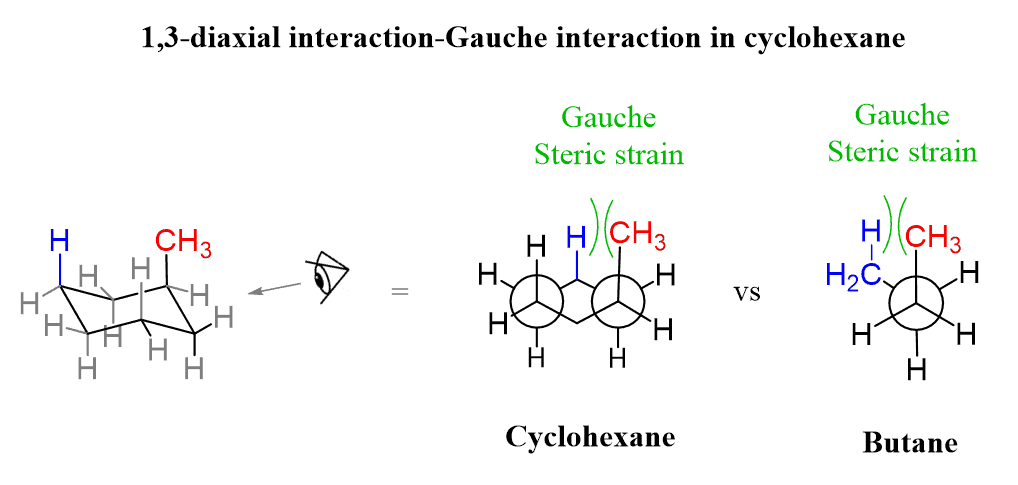
When a substituent is in the axial position, it is brought into close proximity with the other two axial substituents on the same face of the ring (at positions 3 and 5 relative to the substituent). This unfavorable steric crowding is called a 1,3-diaxial interaction.
As the image above masterfully shows, this is nothing new! A 1,3-diaxial interaction is simply a gauche-butane interaction embedded within the ring structure. In contrast, a substituent in the spacious equatorial position points away from the rest of the ring and experiences no such interactions.
Consequently:
The conformation that places the substituent in the equatorial position is more stable (lower in energy) than the conformation that places it in the axial position.
Ring Flips in Substituted Cyclohexanes - 1,3-Diaxial Interactions
This video segment vividly demonstrates the steric clash that arises from 1,3-diaxial interactions and explains why bulky groups strongly prefer the equatorial position.
Watch from 0:20 to 0:51 and from 1:48 to 3:18. Observe how the model shows the spatial crowding of the axial position compared to the spaciousness of the equatorial position.
4. Quantifying Steric Preference: A-Values
To predict the most stable conformer, we need to quantify the energetic cost of placing a substituent in the axial position. This is done using the A-value, also known as the conformational free energy.
The A-value is the difference in Gibbs free energy () between the axial and equatorial conformers.
A larger A-value signifies a greater steric bulk and a stronger preference for the equatorial position. The A-value for a substituent is the energetic cost of its two 1,3-diaxial interactions.

The A-value can be directly related to the equilibrium constant between the two conformers using the equation you know from thermodynamics:
where . A larger A-value leads to a larger , meaning the equilibrium lies heavily in favor of the equatorial conformer.
Test your understanding!
The A-value for a methyl group is 1.7 kcal/mol. At 298 K, what percentage of methylcyclohexane molecules exist in the equatorial conformation? (R ≈ 1.987 cal/mol·K)Hint: First calculate , then use it to find the percentage.
Show answer
- Rearrange the free energy equation to solve for :
- Plug in the values (ensure units are consistent):
- Calculate the percentage:
Let . Then .
So, about 95% of methylcyclohexane molecules have the methyl group in the equatorial position at room temperature.
5. Analyzing Disubstituted Cyclohexanes
For molecules with multiple substituents, we can predict the most stable conformer by assuming that A-values are additive. The total strain of a conformer is the sum of the A-values of all its axial substituents. The conformer with the lower total axial strain is the more stable one.
To do this, we follow a simple procedure:
- Draw one chair conformer for the molecule.
- Draw the other chair conformer by performing a ring flip.
- For each conformer, identify all axial substituents and sum their A-values.
- The conformer with the smaller sum of A-values is the more stable one.
Let's study the application of this method to differently substituted cyclohexanes.
Conformational Analysis of Substituted Cyclohexane
The following resource from the textbook 'Advanced Organic Chemistry I' details the conformational analysis of substituted cyclohexanes. It introduces A-values and shows their application to 1,4-, 1,3-, and 1,2-disubstituted systems.
Please read the section titled 'Conformational Analysis Substituted Cyclohexane', which starts after the energy profile of cyclohexane and continues for several pages. Focus on the examples for 1,4-, 1,3-, and 1,2-disubstitution. Pay attention to how the relative stereochemistry (cis/trans) determines the possible axial/equatorial arrangements.
Let's summarize and reinforce the key patterns for a disubstituted cyclohexane with two identical groups (e.g., dimethylcyclohexane):
-
1,4-disubstituted:
- trans: Can be diequatorial (e,e) or diaxial (a,a). The (e,e) conformer is overwhelmingly more stable (Strain = 0 vs. 2A).
- cis: Must be axial/equatorial (a,e). The ring flip gives another (a,e) conformer of equal energy.
-
1,3-disubstituted:
- cis: Can be diequatorial (e,e) or diaxial (a,a). The (e,e) conformer is much more stable. However, in the diaxial conformer, the two axial groups create a new, highly destabilizing 1,3-diaxial interaction with each other, in addition to their interactions with axial hydrogens.
- trans: Must be (a,e). The two conformers are of equal energy.
-
1,2-disubstituted:
- trans: Can be diequatorial (e,e) or diaxial (a,a). The (e,e) conformer is more stable.
- cis: Must be (a,e). The two conformers are of equal energy.
The overarching principle is that the equilibrium will favor the conformer that places the largest possible number of bulky groups in equatorial positions.
The Tert-Butyl Group: A Conformational Lock
The tert-butyl group has an extremely large A-value (~5 kcal/mol). The energetic penalty for placing it in an axial position is so high that any cyclohexane ring with a t-butyl group will be effectively "locked" in the conformation that places the t-butyl group equatorially. This is a powerful tool used in organic chemistry to control the conformation of a molecule.
For example, in trans-1-tert-butyl-4-chlorocyclohexane, the t-butyl group will lock itself into the equatorial position. This forces the chlorine atom to also be equatorial. In the cis isomer, the equatorial t-butyl group forces the chlorine to be axial. We don't even need to consider the conformer with an axial t-butyl group; its population is negligible.
Conclusion
Today we moved from the free rotation of acyclic chains to the constrained, puckered world of cyclic alkanes. We found that cyclohexane avoids strain by adopting a chair conformation, which provides two distinct environments for substituents: axial and equatorial.
Key Takeaways:
- Cyclohexane's most stable conformation is the chair, which is free of both angle and torsional strain.
- Substituents can occupy axial (crowded) or equatorial (spacious) positions.
- Steric hindrance in the form of 1,3-diaxial interactions makes the equatorial position energetically favorable for most substituents. This is analogous to a gauche-butane interaction.
- A-values quantify the free energy cost of a substituent being axial and are used to predict the position of the conformational equilibrium.
- For polysubstituted cyclohexanes, the most stable conformer is generally the one that places the largest groups in equatorial positions, minimizing the total axial strain.
Preview of the Next Module:
This concludes our deep dive into stereoisomerism. You now have a sophisticated understanding of both static (configurational) and dynamic (conformational) isomerism. In our next module, "Acids, Bases, and Reactivity Principles", we will begin exploring chemical reactions. You will see that the principles we've just learned are not merely structural curiosities; the preferred conformation of a molecule often dictates its reactivity, determining which bonds are accessible and how reactions proceed in three-dimensional space.