Hello! Welcome to the sixth lesson of our module on Stereoisomerism and Conformational Analysis.
In our previous lessons, we explored stereoisomers as molecules with the same connectivity but different, fixed arrangements in 3D space. We treated these structures as relatively static. Today, we shift our focus to the dynamic nature of molecules. Our goal is to analyze conformational isomerism in acyclic systems (e.g., butane) using potential energy diagrams. This topic bridges the gap between a molecule's 2D Lewis structure and its true, ever-changing 3D existence.
1. Conformational Isomers and Newman Projections
Single bonds (sigma bonds) are not rigid sticks; they can rotate. This rotation generates different three-dimensional arrangements of the atoms. These arrangements, which can interconvert simply by bond rotation without breaking any bonds, are called conformational isomers or conformers.
To visualize and analyze these conformers, we use a tool called the Newman projection. This projection looks directly down a specific carbon-carbon bond axis.
- The front carbon is represented by a dot (the junction of three bonds).
- The back carbon is represented by a circle.
- The bonds attached to the front and back carbons are drawn as lines originating from the dot and the circle, respectively.
Let's begin by understanding these concepts with the simplest alkane that has a C-C bond: ethane ().
This video from The Organic Chemistry Tutor provides a clear introduction to drawing Newman projections using ethane as the model. It explains the two fundamental conformations: staggered and eclipsed.
Watch the first 2 minutes and 26 seconds of the video. Focus on how a 3D structure is translated into a Newman projection and the visual difference between the staggered and eclipsed forms.
As the video showed, there are two key conformations for ethane:
- Staggered: The C-H bonds on the front carbon are positioned exactly between the C-H bonds on the back carbon. The dihedral angle (the angle between a specific C-H bond on the front carbon and one on the back carbon) is 60°.
- Eclipsed: The C-H bonds on the front and back carbons are aligned. The dihedral angle is 0°.
The staggered conformation is more stable (lower in energy) than the eclipsed conformation. The energy difference, about 12 kJ/mol (or ~2.9 kcal/mol), is known as torsional strain.
2. The Quantum Mechanical Origin of Torsional Strain
Why is the staggered conformation more stable? The simple explanation is that the eclipsed conformation forces the electron clouds of the C-H bonds on adjacent carbons into close proximity, leading to electrostatic repulsion. This is a good first approximation.
However, a deeper, more accurate explanation lies in a stabilizing quantum mechanical effect that is maximized in the staggered conformation. This effect is hyperconjugation.
In the staggered conformation, a filled C-H bonding orbital () on one carbon is perfectly aligned with an empty C-H anti-bonding orbital () on the adjacent carbon. This alignment allows for a small but significant delocalization of electron density from the filled orbital to the empty orbital, which stabilizes the molecule.
In the eclipsed conformation, this ideal alignment is lost, so the stabilizing hyperconjugation effect is absent. Therefore, the energy difference between staggered and eclipsed conformations is not just due to repulsion in the eclipsed form, but also due to a lack of stabilization.
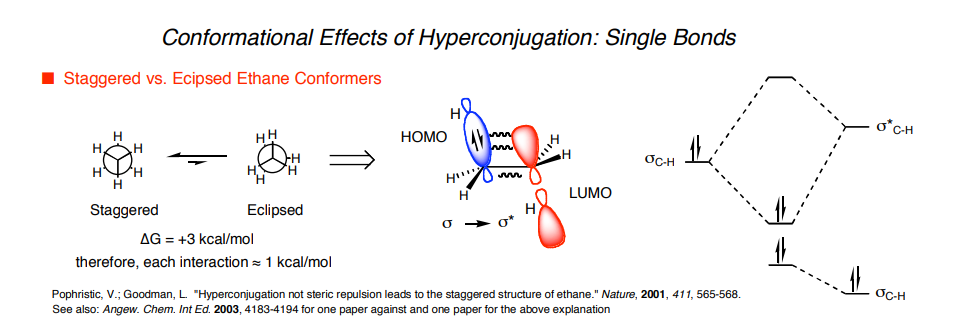
This concept of orbital overlap is a fundamental theme in organic chemistry that you will see again when we discuss the stability of carbocations and other reactive intermediates.
3. Conformational Analysis of Butane
The situation becomes more interesting with butane (). Let's analyze the rotation around the central C2-C3 bond. Now, the groups on our carbons are not just hydrogens; we have two bulkier methyl () groups to consider.
This complexity gives rise to four distinct conformations.
Let's return to the video from The Organic Chemistry Tutor. This section provides a detailed analysis of the different conformations of butane and introduces the associated terminology.
Watch from 02:26 to 05:42. Pay close attention to the names of the four key conformations—anti, gauche, and the two different eclipsed forms—and the reasoning behind their relative stabilities.
To summarize the conformations arising from rotation around the C2-C3 bond of butane:
- Anti-periplanar (Anti): A staggered conformation where the two methyl groups are 180° apart. This is the most stable conformer because the large methyl groups are as far apart as possible, minimizing repulsion.
- Gauche (Synclinal): A staggered conformation where the two methyl groups are 60° apart. While it is staggered (good!), the proximity of the two methyl groups introduces a new type of strain called steric strain (or van der Waals strain). This makes the gauche conformer slightly less stable than the anti conformer.
- Eclipsed: A high-energy conformation where the front and back groups are aligned. One methyl group is eclipsed with a hydrogen. This has both torsional strain and some steric strain.
- Totally Eclipsed (Syn-periplanar): An eclipsed conformation where the two methyl groups are aligned (0° dihedral angle). This is the least stable conformer due to maximized torsional strain and severe steric strain between the two bulky methyl groups.
4. The Potential Energy Diagram of Butane
We can plot the potential energy of butane as a function of the dihedral angle of the C2-C3 bond. This creates a potential energy diagram that maps the energetic landscape of the molecule's rotation.

Let's watch two final video segments that walk through this diagram, quantifying the energy costs of the different types of strain.
Conformational analysis of butane | Organic chemistry | Khan Academy
The first video, from Khan Academy, uses a physical model to illustrate the rotation and then maps it onto the potential energy diagram, breaking down the energy costs of each interaction.
Watch from 01:17 to 10:11. This provides an excellent visualization and quantifies the energy costs associated with H-H, H-CH3, and CH3-CH3 eclipsing interactions, as well as the gauche interaction.
The second video, from The Organic Chemistry Tutor, also constructs the energy diagram and then uses the energy values to calculate the energy barrier for rotation.
Watch from 06:32 to 09:52 and from 18:13 to the end. This reinforces the shape of the potential energy diagram and shows a practical application of the energy values.
Summary of Strain Energy Costs
From the videos and other sources, we can compile a "price list" for the different strain interactions in simple alkanes (values are approximate and may vary slightly between sources).
| Interaction Type | Conformation | Strain | Energy Cost (kJ/mol) | Energy Cost (kcal/mol) |
|---|---|---|---|---|
| H eclipsed with H | Eclipsed | Torsional | ~4.0 | ~1.0 |
| H eclipsed with CH₃ | Eclipsed | Torsional + Steric | ~6.0 | ~1.4 |
| CH₃ eclipsed with CH₃ | Totally Eclipsed | Torsional + Steric | ~11.0 | ~2.5 - 3.0 |
| CH₃ gauche to CH₃ | Staggered (Gauche) | Steric | ~3.8 | ~0.9 |
At room temperature, there is enough thermal energy for butane molecules to rapidly interconvert between all these conformations. However, they don't spend equal time in each one. According to the Boltzmann distribution, the population of molecules will be highest in the lowest energy state. Thus, at any given moment, most butane molecules will be in the more stable anti and gauche conformations, with the anti conformer being the most abundant.
Test your understanding!
Consider pentane, . Let's analyze the rotation around the C2-C3 bond. The groups on C2 are a methyl group and two hydrogens. The groups on C3 are an ethyl group and two hydrogens.
- Draw the Newman projections for the three possible staggered conformations.
- Identify the single most stable conformation among them. Justify your answer by considering the types of interactions present.
Show answer
Let's represent the front carbon (C2) with its methyl group (Me) and two hydrogens (H). The back carbon (C3) has an ethyl group (Et) and two hydrogens (H).
The three staggered conformations are:
-
Conformation A: The methyl group and the ethyl group are anti to each other (180°). This is the most stable conformation. It has no gauche interactions involving the two largest alkyl groups.
-
Conformation B: The methyl group is gauche to the ethyl group (60°). This conformation is less stable than A due to the steric strain of the gauche interaction between the Me and Et groups.
-
Conformation C: The ethyl group is gauche to the methyl group. This is identical in energy to conformation B; it's just the other possible gauche interaction.
Conclusion: Conformation A is the most stable because it places the two bulkiest substituents (methyl and ethyl) in an anti-periplanar arrangement, which completely avoids the destabilizing steric strain of a gauche interaction between them.
Conclusion
In this lesson, we transitioned from viewing molecules as static objects to understanding them as dynamic systems. By analyzing the rotation around single bonds, we can predict the relative stabilities of different spatial arrangements.
Key Takeaways:
- Rotation around sigma bonds leads to different conformational isomers (conformers).
- Newman projections are a critical tool for visualizing conformers by looking down a C-C bond.
- The stability of conformers is determined by a combination of factors:
- Torsional Strain: Destabilization from eclipsing bonds (an electronic effect).
- Steric Strain: Repulsion between bulky groups that are close in space.
- Hyperconjugation: A stabilizing electronic effect present in staggered conformations.
- For butane, the stability order is: anti > gauche > eclipsed > totally eclipsed.
- Potential energy diagrams provide a quantitative map of a molecule's energy as its bonds rotate.
Preview of the Next Lesson:
We will now apply these fundamental principles of conformational analysis to cyclic systems. While acyclic molecules can rotate freely, the atoms in a ring are more constrained. In our next lesson, we will analyze the chair conformations of cyclohexane and see how the concepts of staggered, eclipsed, and gauche interactions are crucial for predicting the most stable conformer for substituted derivatives.