Hello! Welcome to the fifth lesson in our module on stereoisomerism.
In our last lesson, we established that enantiomers have identical physical properties, with one crucial exception: their interaction with plane-polarized light. We noted that one enantiomer rotates light in one direction, while its mirror image rotates it by the exact same amount in the opposite direction. We also established that meso compounds, being achiral, are optically inactive.
Today, we will dive into the "why" and "how" of this phenomenon. Your interest in the intersection of physics and chemistry will be particularly relevant here. Our learning goals are to explain the physical basis of optical activity and then learn how to calculate specific rotation and enantiomeric excess. This lesson will bridge the conceptual understanding of chirality with its quantitative, experimental measurement.
1. The Physical Basis of Optical Activity: A Deeper Look
At first glance, it seems paradoxical. How can a solution of randomly tumbling chiral molecules cause a net, directional rotation of a light beam? Surely, for every molecule oriented one way, another should be oriented in a way that cancels its effect. The resolution to this paradox lies in the nature of light itself and its interaction with a chiral medium.
1.1 Linearly Polarized Light as a Superposition
Normal light consists of electromagnetic waves whose electric fields oscillate in all possible planes perpendicular to the direction of travel. A polarizing filter blocks all planes of oscillation except one, creating linearly polarized (or plane-polarized) light.
The key insight, first proposed by Augustin-Jean Fresnel, is that linearly polarized light can be mathematically described as the superposition of two equal-amplitude circularly polarized components rotating in opposite directions: one clockwise (right-handed) and one counter-clockwise (left-handed).
This is a beautiful and non-obvious piece of physics. The video below provides an exceptionally clear, intuitive explanation of this concept, and then uses it to demystify optical rotation.
Why Sugar Always Twists Light To The Right - Optical Rotation
The video 'Why Sugar Always Twists Light To The Right' from the Steve Mould channel offers one of the best explanations of the physical origin of optical activity. It directly addresses the puzzle of how random molecules produce a net effect.
Watch the video from 00:31 to 08:09. The first part (to 03:47) sets up the phenomenon. The crucial section (from 03:47 to 08:09) explains how linearly polarized light can be viewed as a superposition of two circularly polarized states. Pay close attention to the diagrams showing how these circular components add up.
1.2 Circular Birefringence: The Chiral Interaction
Now, consider what happens when this light, composed of its left- and right-handed circular components, passes through a solution of chiral molecules (which also have a specific "handedness").
- The left-handed circularly polarized component interacts differently with the chiral molecules than the right-handed component does.
- This differential interaction means the medium has a slightly different refractive index for each component: . This phenomenon is called circular birefringence.
- Because the refractive indices are different, the two circular components travel through the sample at slightly different velocities.
- Upon exiting the sample, one component has been delayed (or phase-shifted) relative to the other.
- When these out-of-phase circular components recombine, they still form linearly polarized light, but its plane of polarization has been rotated.

Let's continue with the Steve Mould video, which uses a fantastic analogy to explain this differential interaction and the resulting rotation.
Why Sugar Always Twists Light To The Right - Optical Rotation
This next segment of the video explains how the handedness of a molecule (represented by a pasta spiral) leads to the differential interaction with circularly polarized light, causing one component to slow down more than the other and resulting in a net rotation.
Watch from 08:09 to 16:30. This part explains why the random orientation of molecules doesn't cancel out the effect—a key part of the puzzle. It connects the macroscopic rotation to the microscopic property of molecular handedness (chirality).
For a more formal, mathematical treatment of this theory, the Wikipedia article on Optical Rotation is excellent.
The following text provides the rigorous theoretical and mathematical framework for optical rotation, which should align well with your background.
Read the 'Theory' section. It formally defines circular birefringence using refractive indices (n_L and n_R) and uses phasor notation to show mathematically how a phase difference between the circular components leads to a rotation of the linear polarization axis. This directly connects the physics to the observed chemical phenomenon.
2. Quantifying Optical Activity
Now that we understand the physical basis, let's turn to its measurement and quantification.
The instrument used to measure optical rotation is a polarimeter. It consists of a light source, a fixed polarizer, a sample tube, and a rotating polarizer called the analyzer. The observed angle of rotation, , is measured by rotating the analyzer until the light is blocked again.
- If the rotation is clockwise, the compound is dextrorotatory (from the Latin dexter, "right"), denoted by (+) or (d).
- If the rotation is counter-clockwise, the compound is levorotatory (from the Latin laevus, "left"), denoted by (-) or (l).
A critical point: There is no general correlation between the R/S configuration and the direction of rotation (+/-). (R)-alanine is dextrorotatory, but (R)-glyceraldehyde is levorotatory. R/S is a system of nomenclature based on priority rules; +/- is an experimentally measured physical property. The only rule is that if an (R) enantiomer is (+), its (S) enantiomer will be (-), and by the same magnitude.
5.7 Optical Activity | Organic Chemistry
This short video from Chad's Prep clarifies the distinction between absolute configuration (R/S) and relative configuration (d/l or +/-).
Watch from 02:57 to 06:28. The key takeaway is that you cannot predict the sign of rotation from the structure alone; it must be measured experimentally.
2.1 Specific Rotation,
The observed rotation, , depends on the path length of the sample tube and the concentration of the chiral compound. To have a standardized, intrinsic property of a substance, we define specific rotation, .
For a solution, it is calculated as:
where:
- = observed rotation in degrees.
- = temperature in degrees Celsius.
- = wavelength of light (usually the sodium D-line, 589.3 nm).
- = path length of the sample tube in decimeters (dm). (Note: 1 dm = 10 cm).
- = concentration of the sample in g/mL.
The units are unconventional but standard. Specific rotation is a physical constant for a pure enantiomer, just like melting point or boiling point.
Let's watch a worked example of this calculation.
5.7 Optical Activity | Organic Chemistry
This video segment clearly explains the formula for specific rotation and walks through a sample calculation, paying special attention to the unusual units.
Watch from 06:28 to 10:43. Follow the calculation, noting the necessary conversions for concentration (g/L to g/mL) and path length (cm to dm).
2.2 Enantiomeric Excess (ee)
A racemic mixture (50:50 mix of enantiomers) is optically inactive because the (+) and (-) rotations cancel perfectly. But what if a sample is, say, 75% (R)-enantiomer and 25% (S)-enantiomer? This sample will be optically active.
The enantiomeric excess (ee), also known as optical purity, quantifies the "excess" of one enantiomer over the other. It is defined as:
The ee is also related to the composition of the mixture:
Since % major + % minor = 100%, we have a system of two equations that allows us to determine the exact composition of the mixture from its measured rotation.
Let's look at the logic behind this. A 75:25 mixture can be thought of as a 50% racemic portion (25% R + 25% S) and a 50% excess of the R enantiomer. The racemic portion contributes 0 to the rotation, so the observed rotation is due entirely to the 50% excess of the R enantiomer.
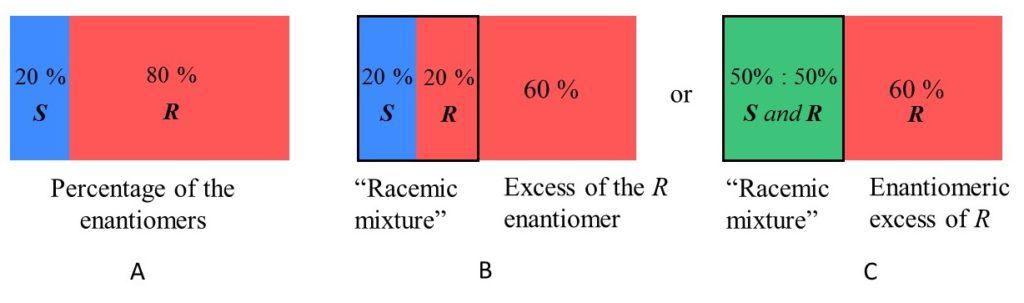
The final segment of the Chad's Prep video provides an excellent worked example for calculating ee and the composition of a mixture.
5.7 Optical Activity | Organic Chemistry
This final video segment explains optical purity and enantiomeric excess, and demonstrates how to calculate the composition of a mixture from its observed rotation.
Watch from 10:43 to 16:23. Pay close attention to the logic: first, calculate the ee% from the rotations. Second, set up the two simultaneous equations to solve for the percentage of each enantiomer.
Test your understanding!
Pure (S)-limonene, a natural product found in orange peels, has a specific rotation of +123°. A chemist prepares a mixture of limonene enantiomers. A 0.5 g sample of this mixture is dissolved in 10 mL of ethanol and placed in a 20 cm polarimeter tube. The observed rotation is +3.69°.
- What is the specific rotation, , of the mixture?
- What is the enantiomeric excess (ee) of the mixture?
- What are the percentages of the (S) and (R) enantiomers in the mixture?
Show answer
-
Calculate the specific rotation of the mixture.
First, get the units right:- Concentration,
- Path length,
- Observed rotation,
Now, use the formula:
-
Calculate the enantiomeric excess (ee).
The pure (S)-enantiomer is dextrorotatory (+). Since our mixture is also dextrorotatory, the (S)-enantiomer is in excess.- (for the S-enantiomer)
The mixture has a 30% enantiomeric excess of the (S)-enantiomer. -
Calculate the composition.
Let S be the percentage of (S)-limonene and R be the percentage of (R)-limonene.- Equation 1 (ee):
- Equation 2 (total):
Adding the two equations gives:
Substituting back into the second equation:
The mixture contains 65% (S)-limonene and 35% (R)-limonene.
Conclusion
In this lesson, you've delved into the fundamental physics behind optical activity and learned the practical methods for quantifying it. This is a topic that beautifully connects quantum mechanical principles of superposition with the measurable, macroscopic properties of molecules.
Key Takeaways:
- Optical activity arises from circular birefringence: chiral molecules have different refractive indices for left- and right-circularly polarized light ().
- Linearly polarized light is a superposition of these two circular components. The difference in their propagation speed through a chiral medium causes a phase shift, resulting in a rotation of the polarization plane.
- Specific rotation is a standardized physical constant for a pure enantiomer, calculated from the observed rotation , path length , and concentration .
- Enantiomeric excess (ee) quantifies the purity of a chiral sample and can be determined by comparing the sample's specific rotation to that of the pure enantiomer. From the ee, the exact composition of the mixture can be found.
Preview of the Next Lesson:
So far, we have treated molecular structures as mostly static snapshots in 3D space. However, molecules are dynamic, constantly rotating and flexing. In the next lesson, we will begin our study of Conformational Analysis, starting with acyclic systems like butane. We will analyze how rotation around single bonds affects the potential energy of a molecule, introducing concepts like staggered, eclipsed, gauche, and anti conformations using potential energy diagrams.