Hello! Welcome to the fourth lesson in our module on stereoisomerism.
In the past two lessons, we developed a powerful toolkit for describing stereochemistry. We can now assign absolute configurations to individual chiral centers using the (R)/(S) system and to geometric isomers using the (E)/(Z) system.
Today, we move from analyzing single stereochemical features to understanding the relationships within molecules that possess multiple stereocenters. This is where the world of stereoisomerism becomes truly rich and complex. Our goal is to distinguish between enantiomers, diastereomers, and meso compounds in molecules with multiple stereocenters.
1. Counting Stereoisomers: The 2^n Rule
Let's begin with a combinatorial question. If a single chiral center gives rise to two stereoisomers (R and S), what happens when we add a second one?
Each chiral center can independently be R or S. Therefore, for a molecule with two chiral centers, there are possible stereoisomeric combinations: (R,R), (R,S), (S,R), and (S,S).
This leads to a general rule: for a molecule with n chiral centers, the maximum number of stereoisomers is 2^n.
5.3 Molecules with Multiple Chiral Centers | Enantiomers, Diastereomers, and Meso Compounds | OChem
This short introduction from Chad's Prep explains the 2^n rule and, importantly, highlights why it represents a maximum and not always the actual number of stereoisomers.
Watch from 00:46 to 03:44. Focus on how the number of possible stereoisomers grows with the number of chiral centers and take note of the crucial point about symmetry potentially reducing this number.
2. Relationships Between Isomers: Enantiomers and Diastereomers
With up to 2^n possible isomers, we need precise language to describe their relationships. These definitions extend directly from what we already know, but we will now frame them in the context of R/S configurations.
-
Enantiomers: Stereoisomers that are non-superimposable mirror images of each other.
- In terms of configuration, the enantiomer of a chiral molecule is the one where every single chiral center is inverted. For example, the enantiomer of an (R,R) isomer is the (S,S) isomer. The enantiomer of an (R,S,R) isomer is the (S,R,S) isomer.
-
Diastereomers: Stereoisomers that are not mirror images of each other.
- This applies to any pair of stereoisomers that are not enantiomers. In terms of configuration, this means at least one chiral center is inverted, but not all of them. For example, the (R,S) and (S,R) isomers are diastereomers of the (R,R) isomer.
The following video provides a clear walkthrough of how to use R/S assignments to quickly determine these relationships.
5.3 Molecules with Multiple Chiral Centers | Enantiomers, Diastereomers, and Meso Compounds | OChem
Let's watch Chad's Prep again as he applies these definitions to a molecule with two chiral centers.
Watch from 04:05 to 10:51. Observe how he first draws the four possible isomers and then uses R/S assignments as a definitive way to classify each pair as either enantiomers or diastereomers.
This image provides a great visual summary of the R/S inversion rule.

For a more formal, text-based explanation and further examples, you can consult this university-level resource.
Chapter 3: Conformation and Stereochemistry - Compounds with multiple stereocenters
The following text from UC San Diego provides a comprehensive discussion of molecules with multiple stereocenters. The included 'Stereoisomer shortcuts' are particularly useful.
Read the section titled 'Compounds with multiple stereocenters' (starts on pg. 34). Focus on the definitions, the examples using four-carbon sugars, and especially the two shortcut rules for identifying enantiomers and diastereomers based on their R/S configurations.
3. Meso Compounds: The Exception Due to Symmetry
Now we must address why the 2^n rule only gives the maximum number of stereoisomers. Consider a molecule like 2,3-dibromobutane. It has two chiral centers (at C2 and C3), so we expect up to stereoisomers. Let's list the possibilities:
- (2R, 3R)
- (2S, 3S)
- (2R, 3S)
- (2S, 3R)
The (2R, 3R) and (2S, 3S) isomers are non-superimposable mirror images—a pair of enantiomers.
But what about (2R, 3S) and (2S, 3R)? Because the substituents on both chiral carbons are identical (H, Br, CH₃, and the other chiral carbon group), the molecule has a potential for symmetry.
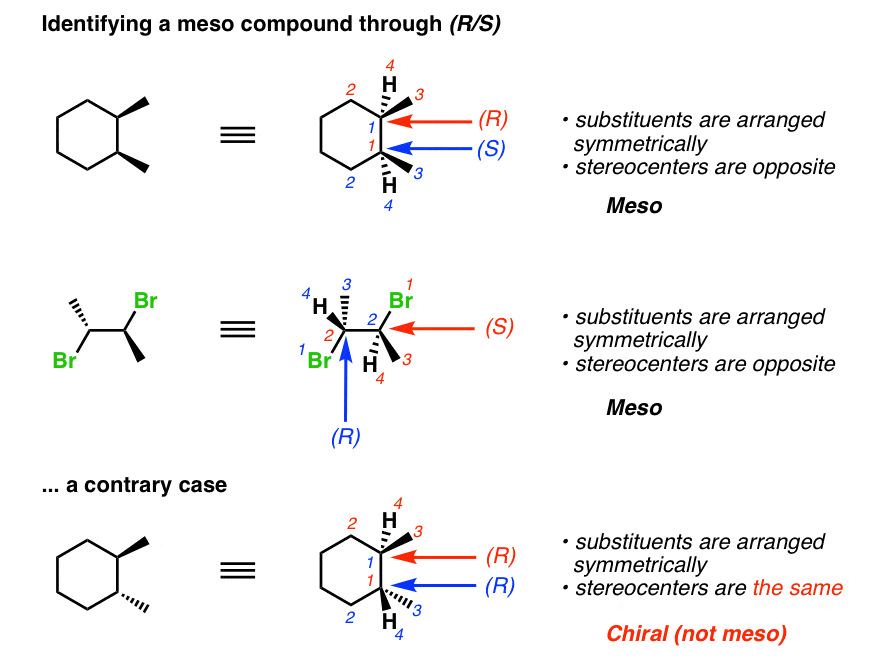
If you were to build models or carefully draw the (2R, 3S) and (2S, 3R) structures, you would find that they are the exact same molecule. They are superimposable on each other. This molecule possesses an internal plane of symmetry, which makes it achiral overall, despite having two chiral centers.
This leads to the definition of a meso compound:
A meso compound is an achiral compound that has two or more chiral centers. It is optically inactive due to an internal plane of symmetry that causes the rotations from the individual chiral centers to cancel out.
Because the (2R, 3S) and (2S, 3R) forms are identical, 2,3-dibromobutane has only 3 stereoisomers, not 4: the (R,R) enantiomer, the (S,S) enantiomer, and the meso diastereomer.
5.3 Molecules with Multiple Chiral Centers | Enantiomers, Diastereomers, and Meso Compounds | OChem
The concept of meso compounds can be tricky. Let's start with Chad's Prep, who introduces the idea using an internal mirror plane and then reinforces it with R/S configurations.
Watch from 10:51 to 24:05. This is a crucial section. Pay close attention to: The definition of a meso compound (achiral, but has chiral centers). How an internal plane of symmetry leads to achirality. The R/S relationship in a meso compound (e.g., R,S for a symmetrical molecule). The explanation for why it's optically inactive: 'internal compensation'. This directly addresses the 'why' you are interested in.
To drive the point home that the (R,S) and (S,R) isomers are identical in this symmetrical case, visualizing the molecule's rotation is very effective.
Enantiomers, Diastereomers and Meso Compounds: Multiple Chiral Centers
This video from Leah4sci uses molecular models and drawings to demonstrate that the supposed fourth isomer is actually identical to the third, beautifully illustrating what a meso compound is.
Watch from 03:27 to 08:54. Focus on the part where she rotates the molecule 180 degrees to show that the (R,S) form can be superimposed on the (S,R) form. This physical manipulation is a powerful proof of their identity.
This image provides a clear summary for identifying meso compounds using their R/S configurations.
4. Comparing Properties
The distinction between these isomer types is not just academic; it has profound consequences for their physical and chemical properties.
- Enantiomers: Have identical physical properties (boiling point, melting point, density, solubility in achiral solvents). Their only difference in physical properties is their interaction with plane-polarized light—they rotate it in equal but opposite directions. They also react differently with other chiral molecules.
- Diastereomers: Have different physical properties. This means they can be separated from each other using standard laboratory techniques like distillation, recrystallization, or chromatography.
- Meso Compounds: Being achiral, they are optically inactive. Their physical properties are different from their chiral diastereomers (the enantiomeric pair).
STEREOCHEMISTRY - Properties of Diastereomers
For a concise summary of the differing properties of these stereoisomers, please review the following text.
Read section 4.7.5, 'PROPERTIES OF DIASTEREOMERS'. This section clearly lists the ways in which diastereomers differ from each other and from enantiomers.
Test your understanding!
Consider the four stereoisomers of 2-bromo-3-chlorobutane shown below.
- (2R, 3R)
- (2S, 3S)
- (2R, 3S)
- (2S, 3R)
a) Identify all pairs of enantiomers.
b) Identify all pairs of diastereomers.
c) Can any of these isomers be a meso compound? Why or why not?
Show answer
a) Enantiomers: To find an enantiomer, you must invert all chiral centers.
* The pair (2R, 3R) and (2S, 3S) are enantiomers.
* The pair (2R, 3S) and (2S, 3R) are also enantiomers.
b) Diastereomers: Any pair of stereoisomers that are not enantiomers are diastereomers.
* (2R, 3R) is a diastereomer of (2R, 3S) and (2S, 3R).
* (2S, 3S) is a diastereomer of (2R, 3S) and (2S, 3R).
c) Meso Compound: No. A meso compound requires an internal plane of symmetry. In 2-bromo-3-chlorobutane, the substituents on C2 (H, Br, CH₃, rest of molecule) are different from the substituents on C3 (H, Cl, CH₃, rest of molecule). The molecule is inherently unsymmetrical, so it cannot have an internal mirror plane. Therefore, all 4 possible stereoisomers exist, and none are meso.
Conclusion
You have now extended your understanding of stereochemistry to encompass molecules with multiple chiral centers. You can now predict the maximum number of isomers and, more importantly, precisely define the relationship between any pair of them.
Key Takeaways:
- A molecule with n stereocenters can have a maximum of 2^n stereoisomers.
- Enantiomers have opposite configurations at all stereocenters (e.g., R,R vs. S,S).
- Diastereomers have opposite configurations at some, but not all, stereocenters (e.g., R,R vs. R,S).
- Meso compounds are an exception to the 2^n rule. They are achiral molecules that contain chiral centers, made possible by an internal plane of symmetry.
- Enantiomers have identical physical properties (except for optical rotation), while diastereomers have different physical properties.
Preview of the Next Lesson:
We've repeatedly mentioned that chiral molecules are "optically active" and that enantiomers rotate plane-polarized light in opposite directions. In our next lesson, we will explore the physical basis of optical activity. We'll delve into how this phenomenon is measured using a polarimeter and learn to calculate specific rotation and enantiomeric excess, which are quantitative measures of a sample's chirality and purity.