Hello! Welcome to the third lesson in our module on stereoisomerism.
In our last lesson, we mastered the Cahn-Ingold-Prelog (CIP) priority rules to assign the absolute configuration, (R) or (S), to chiral centers. This allowed us to unambiguously describe the 3D arrangement of atoms in space.
Today, we'll see that the utility of the CIP rules extends beyond chiral centers. We will apply the very same set of rules to a different class of stereoisomers: geometric isomers. The learning outcome for this lesson is to assign E/Z configuration to geometric isomers using Cahn-Ingold-Prelog priority rules.
This lesson will connect directly to your interest in the "why" behind chemical structures by first exploring the quantum mechanical reason for the existence of these isomers before diving into the systematic naming convention.
1. The Origin of Geometric Isomerism: Restricted Rotation
Before we learn how to name them, let's address a fundamental question: why do geometric isomers exist in the first place? The answer lies in the nature of the carbon-carbon double bond (C=C).
A C=C double bond consists of one sigma ($\sigma$) bond and one pi ($\pi$) bond. The $\sigma$ bond is formed by the head-on overlap of hybrid orbitals and is cylindrically symmetrical, allowing free rotation. However, the $\pi$ bond is formed by the side-to-side overlap of unhybridized p-orbitals above and below the plane of the atoms.

This restricted rotation means that the groups attached to the double-bonded carbons are locked in their positions relative to one another. This gives rise to stereoisomers called geometric isomers.
2. The Limits of cis/trans and the Need for E/Z
You are likely familiar with cis/trans notation. For a disubstituted alkene like 2-butene, this system works well:
- cis: Identical groups are on the same side of the double bond.
- trans: Identical groups are on opposite sides of the double bond.
But what happens when we have three or four different substituents on the double bond?
In 1-bromo-2-chloro-1-fluoro-2-iodoethene, which group is "cis" or "trans" to which? The terminology becomes ambiguous.
To solve this ambiguity, IUPAC developed a more rigorous and universal system: the E/Z notation.
E/Z Absolute Configuration of Alkenes
This short video from Professor Dave Explains clearly introduces the problem with cis/trans nomenclature and presents the E/Z system as the solution.
Watch the first 1 minute and 13 seconds of the video. Focus on understanding why cis/trans notation fails for tri- and tetrasubstituted alkenes and learn the meaning of the German words that E and Z come from.
As the video explains:
- Z comes from the German word Zusammen, meaning "together".
- E comes from the German word Entgegen, meaning "opposite".
The E/Z system uses the same Cahn-Ingold-Prelog (CIP) priority rules we learned in the last lesson to determine whether the highest-priority groups are zusammen or entgegen.
3. The E/Z Assignment Procedure
The process is systematic and builds directly on your previous knowledge.
Step 1: Divide the Alkene. Conceptually split the double bond down the middle. You will analyze the two groups on the left carbon and the two groups on the right carbon independently.
Step 2: Assign Priorities on Each Side. For each carbon of the double bond, use the CIP rules to assign a priority of (1) for the higher-priority group and (2) for the lower-priority group.
- Quick Recap of CIP Rules:
- Atomic Number: Higher atomic number of the atom directly attached gets higher priority.
- First Point of Difference: If there's a tie, move outward atom-by-atom along each chain until you find a difference.
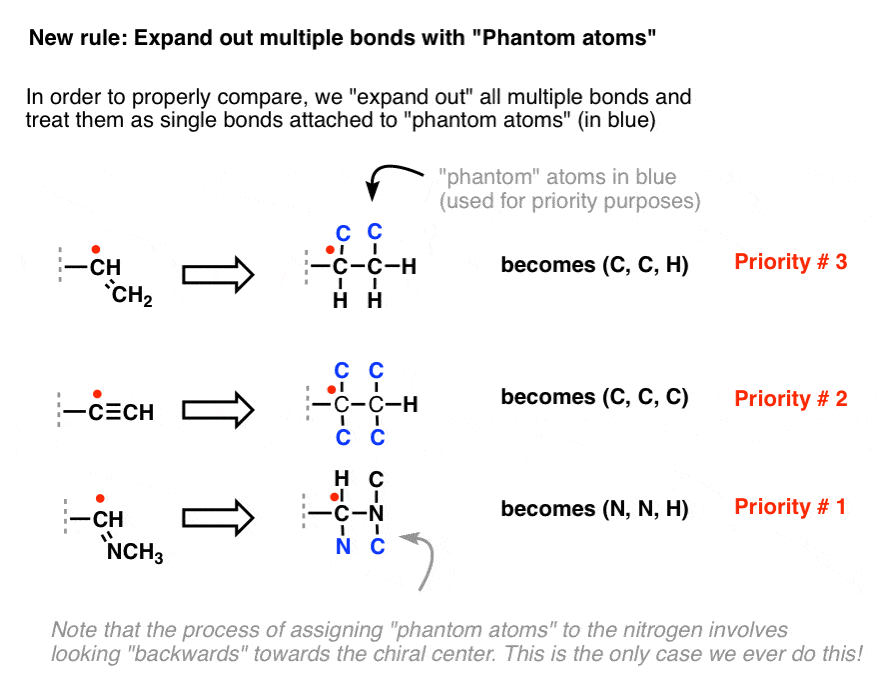
- Multiple Bonds: Treat atoms in double/triple bonds as if they are bonded to an equivalent number of "ghost" single-bonded atoms.
- Isotopes: Higher mass number gets higher priority.
Step 3: Determine E or Z. Compare the positions of the two higher-priority groups (the #1 groups on each carbon).
- If the #1 groups are on the same side of the double bond, the configuration is (Z).
- If the #1 groups are on opposite sides of the double bond, the configuration is (E).
The mnemonic "Zee Zame Zide" can be helpful for remembering the Z configuration.
E–Z system | Alkenes and alkynes | Organic chemistry | Khan Academy
Let's watch a clear, step-by-step walkthrough from Khan Academy that demonstrates this entire process.
Watch from the beginning to 03:25. Pay attention to how Sal Khan systematically looks at each side of the double bond, assigns priorities based on atomic number, and then compares the positions of the high-priority groups to assign E and Z.
Test your understanding!
Assign the configuration (E or Z) to the following alkene: 1-bromo-1-chloro-2-fluoroethene.
Show answer
-
Analyze the left carbon (C1): It is bonded to Br (atomic number 35) and Cl (atomic number 17).
- Priority 1: -Br
- Priority 2: -Cl
-
Analyze the right carbon (C2): It is bonded to F (atomic number 9) and H (atomic number 1).
- Priority 1: -F
- Priority 2: -H
-
Compare high-priority groups: The high-priority group on C1 is -Br (pointing up). The high-priority group on C2 is -F (also pointing up).
- Since both high-priority groups are on the same side of the double bond, the configuration is (Z).
4. Handling Complex Cases
The real power of the E/Z system shines in more complex molecules where tie-breakers are necessary.
Tie-Breaker: "First Point of Difference"
Just as with chiral centers, when the atoms directly attached to a double-bond carbon are the same, we must move outward to find the first point of difference.
Tie-Breaker: Multiple Bonds
This rule is also identical to the one for R/S configuration. A double-bonded atom is treated as being bonded to two atoms, and a triple-bonded atom to three.
E-Z notation for geometric isomerism
For a detailed text-based explanation of the CIP rules in the context of E/Z notation, including how to handle ties and multiple bonds, please review the following resource from Chemguide.
Read the section titled 'Rules for determining priorities'. This will reinforce the video content and provide written examples of applying the 'first point of difference' and multiple bond rules.
Now let's see a complex example worked out.
E–Z system | Alkenes and alkynes | Organic chemistry | Khan Academy
This segment of the Khan Academy video demonstrates how to handle a tie, and more importantly, how the rule for multiple bonds (using an aldehyde group as an example) is applied.
Watch from 03:25 to 06:16. Focus on the logic used to break the tie between the two carbon-containing groups on the right side of the alkene. Note how the C=O group is treated as a carbon bonded to (O, O, H) for priority assignment.
5. A Critical Distinction: E/Z is Not The Same as trans/cis
It is a common mistake to assume that trans always corresponds to (E) and cis always corresponds to (Z). While this is often true for simple, disubstituted alkenes, it is not a rule. The systems are based on different criteria:
- cis/trans compares the positions of identical groups or the parent carbon chain.
- E/Z compares the positions of the highest-priority groups according to CIP rules.
Consider this example: (E)-3-methyl-2-pentene.
If we were to use cis/trans, we would see the two methyl groups are on the same side, so we might incorrectly label it "cis". Let's apply the E/Z rules correctly:
-
Left Carbon (C2): Bonded to -CH₃ and -H.
- Priority 1: -CH₃ (C beats H)
- Priority 2: -H
-
Right Carbon (C3): Bonded to -CH₂CH₃ (ethyl) and -CH₃ (methyl).
- Ethyl group's first carbon is bonded to (C, H, H).
- Methyl group's carbon is bonded to (H, H, H).
- The first point of difference is C vs H. Ethyl wins.
- Priority 1: -CH₂CH₃
- Priority 2: -CH₃
-
Compare: The high-priority group on the left is -CH₃ (up). The high-priority group on the right is -CH₂CH₃ (down). They are on opposite sides.
Therefore, the correct configuration is (E), even though the two identical methyl groups are "cis" to each other. This is a perfect example of why the rigorous E/Z system is superior and necessary. Always determine E/Z from first principles using the CIP rules.
6. Incorporating E/Z into IUPAC Names
Finally, the (E) or (Z) designator is placed in parentheses at the beginning of the IUPAC name. If there are multiple double bonds, a locant (number) is used to specify which double bond the designator refers to (e.g., (2E, 4Z)-...).
E–Z system | Alkenes and alkynes | Organic chemistry | Khan Academy
Let's finish with a final clip that shows how to construct the full IUPAC name for a complex alkene, incorporating the E/Z designator.
Watch from 06:16 to 11:30. This is a comprehensive example that combines IUPAC naming rules with a very tricky E/Z determination. Follow the entire process of finding the parent chain, numbering it, and then performing the detailed priority analysis to assign the final (E) configuration.
Conclusion
In this lesson, you have leveraged your knowledge of the CIP rules to master the E/Z system for naming geometric isomers. This provides you with a powerful and unambiguous tool for describing molecular structure.
Key Takeaways:
- Geometric isomerism in alkenes is a consequence of restricted rotation around the pi bond.
- The E/Z system is the IUPAC-approved method for naming geometric isomers, resolving the ambiguities of the older cis/trans system.
- The assignment uses the same Cahn-Ingold-Prelog (CIP) priority rules you learned for R/S configuration.
- Priorities are assigned independently to the two groups on each carbon of the double bond.
- (Z) configuration: The two highest-priority groups are on the same side (Zusammen).
- (E) configuration: The two highest-priority groups are on opposite sides (Entgegen).
- The E/Z and cis/trans systems are based on different criteria and are not interchangeable.
Preview of the Next Lesson:
We have now learned to assign absolute configurations to individual stereocenters ((R)/(S)) and to double bonds ((E)/(Z)). In our next lesson, we will explore the relationships between molecules that have multiple stereocenters. You will learn to distinguish between enantiomers, diastereomers, and meso compounds, which are crucial concepts for understanding the properties and interactions of complex organic molecules.