Hello! Welcome to the second lesson in our module on Stereoisomerism.
In our last lesson, we built our foundational toolkit for visualizing molecules in three dimensions by learning to interpret and interconvert between various 2D projections: wedge-dash, Newman, sawhorse, and Fischer. You learned that these are essentially different geometric projections, each with its own rules and optimal use cases.
Today, we move from representing stereoisomers to naming them. When a molecule is chiral, it can exist as two enantiomers—non-superimposable mirror images. How do we unambiguously distinguish between them in a name? The answer is the Cahn-Ingold-Prelog (CIP) system, which assigns an absolute configuration—either (R) or (S)—to each chiral center. Our learning outcome is to identify chirality centers and assign R/S configuration using the Cahn-Ingold-Prelog priority rules.
This process is systematic and rule-based, which should resonate with your mathematical inclinations. We'll break down the logic of the rules, focusing on the "why" behind each step.
1. Identifying Chirality Centers
First, a quick recap. A chirality center (or chiral center) is typically a carbon atom bonded to four different groups. This is the structural requirement for a molecule to have an enantiomer. For example, in 2-butanol, C2 is a chiral center because it is bonded to -H, -OH, -CH₃, and -CH₂CH₃. Our goal is to assign a label, (R) or (S), to this carbon to define its exact 3D arrangement.

Enantiomers of 2-butanol. Although they share the same name and connectivity, their 3D arrangements are mirror images. The R/S system allows us to tell them apart.
2. The Cahn-Ingold-Prelog (CIP) Priority Rules
The first step in assigning R/S configuration is to rank the four groups attached to the chiral center from highest priority (1) to lowest priority (4). This ranking is done using a set of hierarchical rules.
5.2 How to Assign R and S Configuration | Absolute Configuration | Organic Chemistry
Let's begin with an excellent overview from Chad's Prep that covers the core priority rules.
Watch from 01:28 to 03:06. Pay close attention to two key ideas: The primary rule: Priority is determined by the atomic number of the atom directly attached to the chiral center. The tie-breaker rule: If two directly attached atoms are the same (e.g., two carbons), you compare the atoms attached to them until you find a 'first point of difference'.
Let's formalize and deepen our understanding of these rules.
Rule 1: Priority by Atomic Number
The atom directly bonded to the chiral center with the highest atomic number gets the highest priority.
For example: I > Br > Cl > S > F > O > N > C > H.
Rule 2: The Principle of Outward Exploration (Tie-Breaker)
When the directly attached atoms are identical (a tie), we must explore further out along each chain. You compile a list of the atoms attached to the tied atom, arranged in decreasing atomic number, and compare the lists at the first point of difference. The chain with the higher atomic number at the first point of difference wins.
For example, comparing an ethyl group (-CH₂CH₃) and a methyl group (-CH₃):
- The ethyl group's first carbon is bonded to (C, H, H).
- The methyl group's carbon is bonded to (H, H, H).
- Comparing the lists (C, H, H) vs. (H, H, H), the first point of difference is C vs. H. Since C has a higher atomic number than H, the ethyl group has higher priority than the methyl group.
Rule 3: Handling Multiple Bonds with "Ghost Atoms"
How do we handle double or triple bonds when exploring outward? A C=O double bond isn't bonded to two different atoms. The CIP system resolves this by treating multiple bonds as if they were bonded to an equivalent number of single-bonded "ghost" atoms.
- A
C=Ois treated as a carbon bonded to two oxygens: one "real" and one "ghost". The oxygen is likewise treated as being bonded to two carbons. We write this asC-(O, O)andO-(C, C). - A
C≡Nis treated as a carbon bonded to three nitrogens. We write this asC-(N, N, N).
This is a mathematical abstraction to ensure the rules can be applied universally.
Chemistry I (Organic) Stereochemistry LECTURE 3
This document from Imperial College London formalizes the concepts of 'outward exploration' and 'ghost atoms'. Reading this will give you the rigorous definitions that underpin the video's explanation.
Read 'slide 8' of the PDF, titled 'Cahn Ingold Prelog (CIP) - sequence rule application'. Focus on the descriptions for 'The Principle of Outward Exploration' and the diagrams showing how to use 'ghost atoms' for unsaturated groups. This provides the formal basis for the tie-breaking rules.
Rule 4: Isotopes
If all else is tied, an isotope with a higher mass number receives higher priority. For example, Deuterium (²H or D) has higher priority than Protium (¹H or H).
3. Assigning (R) and (S)
Once you have assigned priorities 1, 2, 3, and 4 to the four groups, you are ready to determine the configuration. The procedure depends on the position of the lowest-priority group (group #4).
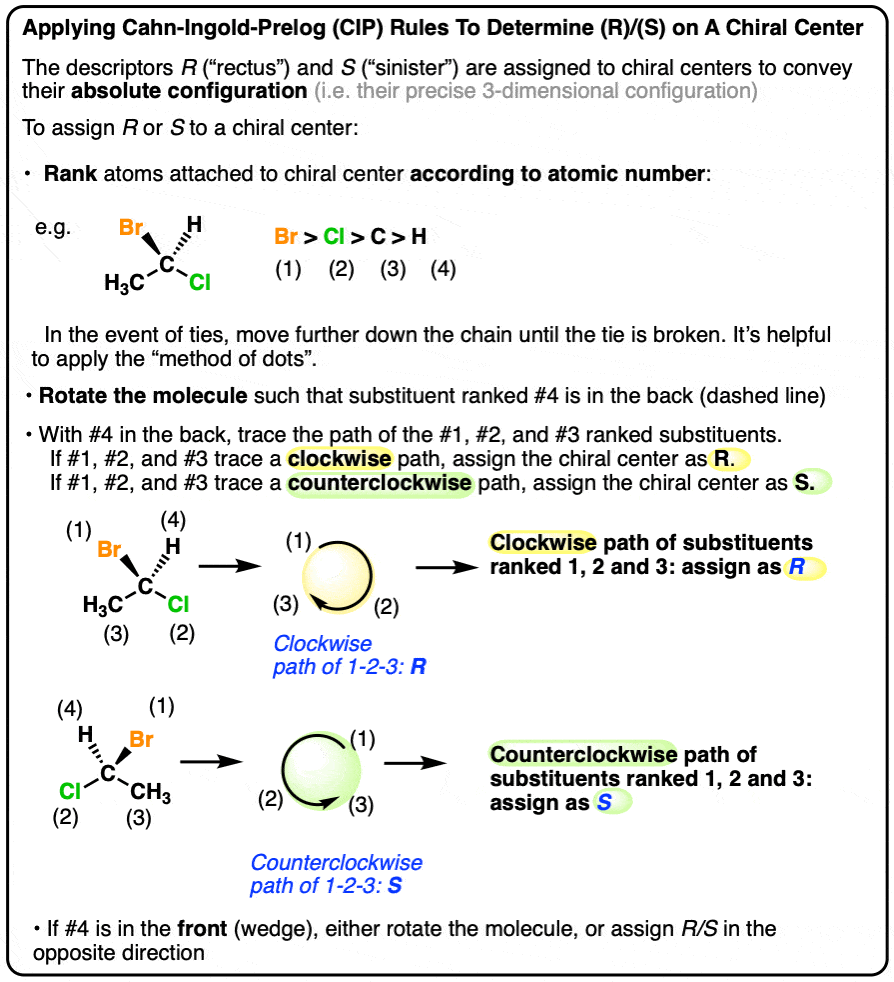
Let's watch a video that walks through the three possible scenarios for the position of group #4.
5.2 How to Assign R and S Configuration | Absolute Configuration | Organic Chemistry
This segment from the same Chad's Prep video clearly explains how to assign the configuration in all three cases you'll encounter.
Watch from 02:56 to 10:27. This is the most crucial part of the lesson. Focus on: Case 1 (02:56): The ideal scenario where group #4 is in the back (dashed). Note how a clockwise (right-handed) turn is (R) for Rectus and counter-clockwise (left-handed) is (S) for Sinister. Case 2 (04:37): When group #4 is in the front (wedge). The result is the opposite of what you see. Case 3 (06:15): The trickiest case, where group #4 is in the plane. The instructor presents a reliable method: swapping group #4 with the group in the back. Determine the configuration of this new, 'swapped' molecule, and the original molecule will be the opposite. This works because a single swap of any two groups on a chiral center inverts its configuration.
Let's reinforce the "swap" trick for when group #4 is in the plane, as it's a powerful and fail-safe technique.
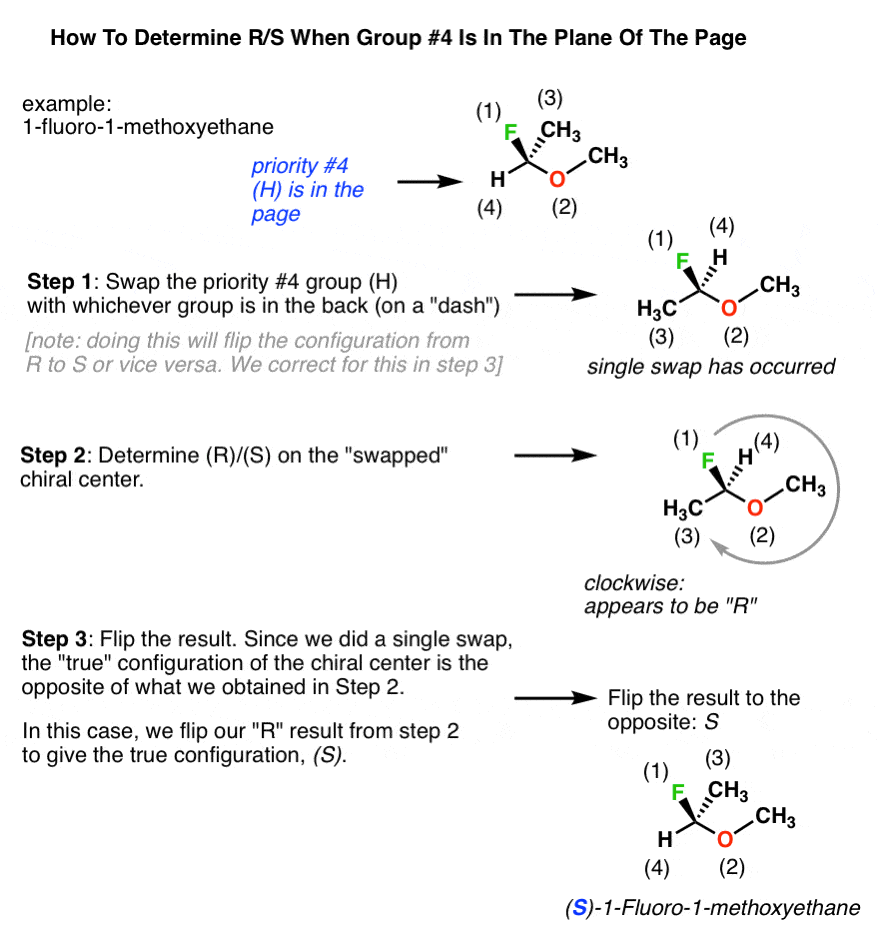
Test your understanding!
Assign the absolute configuration (R or S) to the chiral center in the following molecule, (S)-2-chlorobutane. Use the CIP rules and the methods we've discussed.

Show answer
-
Identify the chiral center: The carbon bonded to Cl, H, a methyl group, and an ethyl group.
-
Assign Priorities (CIP rules):
- Priority 1: Cl (atomic number 17).
- Priority 2: The ethyl group (-CH₂CH₃). The first carbon is bonded to (C, H, H).
- Priority 3: The methyl group (-CH₃). Its carbon is bonded to (H, H, H).
- Priority 4: H (atomic number 1).
- So, the ranking is: Cl (1) > -CH₂CH₃ (2) > -CH₃ (3) > H (4).
-
Determine Configuration:
- The lowest priority group (H) is in the plane of the page. This is Case 3.
- We will use the swap trick. Swap the group in the plane (H, priority 4) with the group in the back (Cl, priority 1).
- New 'swapped' molecule: H is now dashed (back), and Cl is in the plane.
- Assign configuration to the 'swapped' molecule: Now that H is in the back, we can trace the path 1 → 2 → 3. The priority 1 group (Cl) is now in the plane, priority 2 (ethyl) is up, and priority 3 (methyl) is wedged. The path from Cl → ethyl → methyl is clockwise.
- Therefore, the configuration of the 'swapped' molecule is (R).
-
Find the Original Configuration:
- Since we performed one swap, the original molecule must have the opposite configuration.
- The configuration of the original molecule is (S).
4. Naming Molecules with Chiral Centers
The final step is to incorporate the (R) or (S) designator into the IUPAC name.
- For one chiral center: The designator is placed in parentheses at the very beginning of the name. e.g., (R)-2-butanol.
- For multiple chiral centers: Each configuration is specified with its locant number. e.g., (2R, 3S)-2,3-dibromobutane.
5.2 How to Assign R and S Configuration | Absolute Configuration | Organic Chemistry
Let's conclude with the final segment of the video, which demonstrates how to apply these labels in IUPAC nomenclature for both simple and complex molecules.
Watch from 18:47 to the end. Observe how the (R) or (S) label is integrated into the full IUPAC name, both for a molecule with one chiral center and for one with two.
Conclusion
Today you have mastered a fundamental skill in stereochemistry: the ability to assign an unambiguous name to the three-dimensional arrangement of atoms at a chiral center. This system is crucial for communicating the exact structure of a molecule.
Key Takeaways:
- The Cahn-Ingold-Prelog (CIP) rules provide a hierarchical system for assigning priorities to groups around a chiral center based primarily on atomic number.
- Ties are broken by the Principle of Outward Exploration, looking for the first point of difference. Multiple bonds are handled using hypothetical "ghost atoms".
- To assign configuration, orient the molecule so the lowest priority group (#4) points away from you. A clockwise path from 1→2→3 is (R); a counter-clockwise path is (S).
- If group #4 is not in the back, you can use tricks. The most reliable is the swap trick: swap group #4 with the group in the back, determine the configuration of the new molecule, and the original is the opposite.
Preview of the Next Lesson:
The CIP priority rules are not just for chiral centers. In our next lesson, we will see how these same rules are applied to a different class of stereoisomers—geometric isomers (alkenes). You will learn how to use the CIP system to assign E/Z configuration, which is the modern, unambiguous replacement for the cis/trans notation you may have encountered.