Hello! Welcome to the third module of our course, where we pivot from the two-dimensional world of electronic effects to the fascinating three-dimensional architecture of molecules.
In the last module, we delved into concepts like resonance and aromaticity, which are largely concerned with electron distribution within a planar framework. We finished by learning to predict the exceptional stability of aromatic compounds based on their electronic structure.
Today, we begin our exploration of Stereoisomerism and Conformational Analysis. Our learning outcome is to interpret and interconvert between Newman, sawhorse, and Fischer projections for acyclic molecules. These projections are the fundamental language of stereochemistry. Mastering them is not just about learning to draw; it's about training your mind to see and manipulate three-dimensional objects on a two-dimensional page. Given your interest in the mathematical underpinnings of chemistry, you can think of these as different geometric projections, each transforming a 3D molecule into a 2D representation from a unique viewpoint and with a specific set of rules.
1. From 3D Space to 2D Paper: An Overview of Projections
The most intuitive way to represent a tetrahedral carbon on paper is the wedge-dash notation, which you're likely familiar with.
wedge dash structures,fischer, saw horse,newman projection formulas &their interconversions oneshot
Let's start with a quick review of the wedge-dash formula. This video from Komali Mam provides a clear, model-based explanation of what the different types of lines represent.
Watch from 00:59 to 03:21. Focus on how the solid wedge (towards you), dashed wedge (away from you), and thin lines (in the plane) represent the 3D arrangement of bonds around a central carbon.
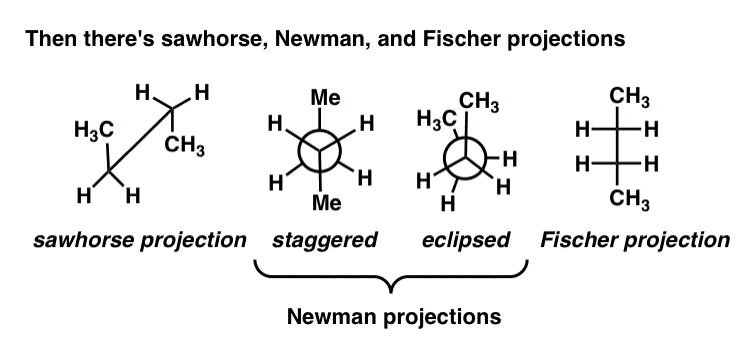
While wedge-dash is excellent for single chiral centers, it can become cluttered for larger molecules. To analyze relationships between adjacent carbons, chemists developed other specialized projections. The three we will master today are:
- Sawhorse Projection: A side-on view of a carbon-carbon bond, showing the molecule from an oblique angle.
- Newman Projection: An end-on view, looking directly down a specific carbon-carbon bond. This view is ideal for analyzing rotation around that bond.
- Fischer Projection: A highly standardized top-down view that is 'flattened' onto the page according to strict rules. It is particularly useful for comparing molecules with multiple chiral centers, like sugars.
2. The Sawhorse and Newman Projections: Viewing the C-C Bond
Sawhorse and Newman projections are two ways of looking at the relationship between substituents on two adjacent carbon atoms. They are directly interconvertible as they represent a simple change in perspective.
Concept of Chirality and Optical Activity
Let's formally define these two projections using this PDF from Egrass B. College. It provides clear, concise definitions.
On pages 10 and 13, read the sections titled 'Newman Projection Formulae' and 'Sawhorse Projection Formula'. Focus on understanding: For Newman projections: How the front carbon is a dot and the back carbon is a circle. For Sawhorse projections: How the C-C bond is explicitly drawn from a side-angle.
From Sawhorse to Newman
Imagine you are looking at a sawhorse projection. To get the Newman projection, you simply "walk around" to the front and look straight down the C-C bond axis.
- The front carbon in the sawhorse becomes the dot in the Newman projection.
- The back carbon in the sawhorse becomes the large circle in the Newman projection.
- The substituents on each carbon maintain their relative up/down/left/right positions.

Conformations: Eclipsed and Staggered
Both sawhorse and Newman projections can depict different rotational isomers, or conformations. The two most important are:
- Eclipsed: Substituents on the front carbon are directly in front of the substituents on the back carbon. The dihedral angle is 0°. This is a high-energy conformation due to steric and torsional strain.
- Staggered: Substituents on the front carbon are positioned exactly between the substituents on the back carbon. The dihedral angle is 60°. This is a low-energy, more stable conformation.
Test your understanding!
Draw the staggered Newman projection corresponding to the following sawhorse projection of chloroethane.
(Note: The provided sawhorse is eclipsed. You need to draw the staggered Newman projection.)
Show answer
First, recognize that to get the staggered conformation, you must rotate one of the carbons by 60°. Let's rotate the back carbon. The front carbon (C1) remains a 'Y' shape with three Hydrogens. The back carbon (C2) was an upside-down 'Y'. Rotating it 60° will place its substituents in the gaps of the front carbon's substituents.
The resulting staggered Newman projection would look like this:
3. The Fischer Projection: A Standardized Convention
The Fischer projection is a rigid convention with a very specific meaning. Mastering it requires memorizing one simple rule:
Vertical lines go away from you, and horizontal lines come toward you.
The intersection of the lines represents the chiral carbon.
Converting Bond-Line, Newman, and Fischer Projection
This article from Chemistry Steps offers some great mnemonics for remembering this rule.
Read the section 'Converting Bond-Line to Fischer Projection'. The 'hug' analogy is a particularly effective way to remember the 3D orientation of the bonds.
The power of the Fischer projection is that it represents the molecule in a fully eclipsed conformation. This is a crucial point for interconversions. When converting any other projection to a Fischer, you must first manipulate it into an eclipsed conformation.
4. The Art of Interconversion
Now we'll combine these concepts to interconvert between all the projection types. The key is to be systematic.
Wedge-Dash to Fischer
This conversion involves mentally rotating the molecule into the specific orientation required for a Fischer projection before flattening it.
wedge dash structures,fischer, saw horse,newman projection formulas &their interconversions oneshot
The 'Komali Mam' video demonstrates some very effective shortcuts for this conversion, which are especially useful in an exam setting like the JEE.
Watch the sections on converting wedge-dash to Fischer for both one and two chiral centers (05:42 - 09:19 and 16:26 - 20:51). Note the practical tricks she uses, like how the position of a group (left/right) on the main chain determines the position of the dashed-line group in the Fischer. While these are tricks, they are rooted in the geometric rotations needed for the conversion.
The underlying principle of these tricks is to orient the molecule so the main carbon chain is vertical and arched away from the viewer, causing the other substituents to point towards the viewer on the horizontal axis.
Newman to Fischer (and back)
This is a critical skill. The conversion hinges on the fact that a Fischer projection is eclipsed.
Converting Newman to Fischer Projections (vid 4 of 5)
This video by Leah4sci is exceptionally clear and provides a robust, step-by-step method for the Newman-Fischer interconversion that emphasizes understanding over tricks.
Watch from 01:30 to 07:16. Pay close attention to the following process: Staggered Newman → Fischer: The key first step is to rotate the back carbon to create an eclipsed Newman projection. Once eclipsed, the molecule can be flattened directly into the Fischer projection. Fischer → Eclipsed Newman: This is the reverse and more direct. The groups on the Fischer cross map directly onto an eclipsed Newman projection. If a staggered conformation is needed, you simply rotate one of the carbons afterwards.
Putting It All Together
We can now see a clear pathway for converting between any of these forms. A common and reliable method is to use the Newman projection as a central hub. For example, to go from a sawhorse to a Fischer:
- Convert the sawhorse to its corresponding Newman projection.
- If the Newman is staggered, rotate the back carbon to make it eclipsed.
- Flatten the eclipsed Newman projection into the final Fischer projection.
This entire process is beautifully illustrated in the D-Erythrose image we saw earlier.
Test your understanding!
Convert the following staggered Newman projection of (2R, 3S)-2,3-dibromobutane into a Fischer projection.
Show answer
-
Identify front and back carbons:
- Front carbon (dot): CH₃ (up), Br (right), H (left).
- Back carbon (circle): CH₃ (down), Br (left), H (right).
-
Rotate to an eclipsed conformation: We need to align the vertical groups. The front CH₃ is up, and the back CH₃ is down. We must rotate the back carbon by 180° to make them both point in the same direction (e.g., both up or both down). Let's rotate the back carbon so its CH₃ points up.
- The back CH₃ goes from down to up.
- The back Br goes from left to right.
- The back H goes from right to left.
-
Draw the eclipsed Newman:
- Front carbon is unchanged: CH₃ up, Br right, H left.
- Back carbon is now: CH₃ up (eclipsing the front CH₃), Br right (eclipsing the front Br), H left (eclipsing the front H).

-
Flatten into a Fischer projection:
- The groups pointing up (the two CH₃ groups) go on the vertical axis.
- For the front (top) carbon, the group on the right (Br) goes right, and the group on the left (H) goes left.
- For the back (bottom) carbon, the group on the right (Br) goes right, and the group on the left (H) goes left.
The final Fischer projection is:
    CH3
    |
  H-C-Br
    |
  Br-C-H
    |
    CH3
Conclusion
Today, we've established the fundamental toolkit for visualizing and representing three-dimensional molecules. These projections are not arbitrary drawings; they are precise geometric representations that will be indispensable as we move forward.
Key Takeaways:
- Wedge-dash, sawhorse, Newman, and Fischer projections are different ways to represent a 3D molecule in 2D, each offering a unique perspective.
- The sawhorse projection is a side-view of a C-C bond, while the Newman projection is an end-on view. They are essential for analyzing conformations like staggered (low energy) and eclipsed (high energy).
- The Fischer projection is a standardized, fully eclipsed representation where vertical bonds recede and horizontal bonds protrude.
- The master rule for interconversion is that a Fischer projection always corresponds to an eclipsed conformation. Therefore, to convert any structure to a Fischer, you must first bring it into an eclipsed form.
Preview of the Next Lesson:
Now that you have the tools to draw and interpret these 3D representations, our next step is to label them unambiguously. In the next lesson, we will learn how to identify chirality centers and assign R/S configuration using the Cahn-Ingold-Prelog priority rules. This will allow us to precisely name and differentiate between stereoisomers.