Hello! Welcome back to our course on organic chemistry.
In our last lesson, we explored the quantum mechanical origins of aromaticity, using Hückel's Molecular Orbital (HMO) theory and Frost circles to understand why the -electron rule leads to exceptional stability. You saw that for benzene, this electron count results in a perfectly filled, closed shell of bonding molecular orbitals.
Today, we will build directly on that theoretical foundation. Your learning outcome is to identify aromatic, antiaromatic, and nonaromatic systems and predict their relative stabilities. We will move from the idealized case of benzene to a wide variety of cyclic systems, including ions and molecules containing heteroatoms. This lesson will equip you with a systematic framework to classify any given compound and understand the delicate interplay between electron count and molecular geometry.
1. The Three Classes of Cyclic Conjugated Systems
Based on the principles of MO theory from our last lesson, we can sort cyclic, conjugated (or potentially conjugated) systems into three distinct categories based on their electronic structure and stability:
- Aromatic: These compounds are significantly more stable than their open-chain analogues. They exhibit a special 'aromatic stabilization'.
- Antiaromatic: These compounds are significantly less stable than their open-chain analogues. They suffer from 'antiaromatic destabilization' and are often highly reactive and difficult to isolate.
- Nonaromatic: These compounds have a stability comparable to their open-chain analogues. They do not experience significant stabilization or destabilization from cyclic conjugation.
2. The Four Conditions for Aromaticity and Antiaromaticity
For a molecule to be classified as either aromatic or antiaromatic, it must satisfy a strict set of structural requirements. If a molecule fails to meet even one of the first three conditions, it is classified as nonaromatic, and the electron count becomes irrelevant.
The four conditions are:
- Cyclic: The molecule must contain a ring of atoms.
- Planar: All atoms participating in the system must lie in the same plane. This allows for continuous, parallel overlap of the p-orbitals.
- Fully Conjugated: Every atom in the ring must have an unhybridized p-orbital available to participate in the system. This means there can be no sp³-hybridized atoms within the ring.
- Hückel's Rule (Electron Count):
- For aromaticity, the cyclic system must contain electrons, where is a non-negative integer (0, 1, 2, ...). Common counts are 2, 6, 10, 14.
- For antiaromaticity, the cyclic system must contain electrons, where is a positive integer (1, 2, 3, ...). Common counts are 4, 8, 12.
The crucial takeaway is the stability hierarchy:
Nature abhors the instability of antiaromaticity. As we will see, a molecule that meets the criteria for antiaromaticity will often distort its geometry (i.e., become non-planar) to escape this fate, thereby becoming nonaromatic.
3. Predicting Stability with Frost Circles
As we saw last time, the Frost circle is a powerful mnemonic for generating the relative energy levels of molecular orbitals in a monocyclic, conjugated system. It provides a visual explanation for Hückel's rule.
Let's watch a short video to refresh our memory on constructing these diagrams and see how they immediately distinguish between aromatic and antiaromatic systems.
Frost Circles and Hückel's Rule
This video by Michael Evans provides a concise demonstration of the Frost Circle method for benzene and cyclo-octatetraene, and clearly derives Hückel's 4n+2 rule from the resulting orbital patterns.
Watch from 01:00 to 03:54. Pay attention to: The step-by-step construction for benzene (6\pi e⁻) and how it leads to all electrons being paired in bonding orbitals. The construction for cyclo-octatetraene (8\pi e⁻) and how it results in two unpaired electrons in non-bonding orbitals, predicting instability. The explanation of how the general pattern (one lowest orbital + pairs of degenerate orbitals) gives rise to the 4n+2 rule.
The key insight from the Frost circle is that aromatic () systems have just enough electrons to form a stable, closed shell of bonding MOs, much like a noble gas electron configuration. In contrast, antiaromatic () systems are forced to place electrons into higher-energy non-bonding or antibonding orbitals, often leaving them unpaired, which is a recipe for extreme instability (a diradical character).

4. A Gallery of Annulenes: Case Studies
Let's now apply this framework to classify a variety of compounds. We'll use an excellent article from Chemistry Steps that walks through numerous examples.
Benzene vs. Cyclobutadiene: The Archetypes
You are already familiar with these two from the previous lesson.
- Benzene: Cyclic, planar, fully conjugated, 6 electrons (). Aromatic. Its Frost circle shows a beautiful, stable, closed shell of electrons.
- Cyclobutadiene: Cyclic, planar, fully conjugated, 4 electrons (). Antiaromatic. Its Frost circle predicts a highly unstable diradical.
To deepen your understanding of the quantum mechanical destabilization in antiaromatic systems, the following video is highly recommended.
17.4 Aromaticity and Molecular Orbital Theory
This video from Chad's Prep revisits the MO diagrams for benzene and cyclobutadiene side-by-side, providing a clear visual explanation for their difference in stability.
Watch from the beginning to 04:08. Focus on how the filling of molecular orbitals in cyclobutadiene leads to two unpaired electrons in non-bonding orbitals, explaining its diradical character and extreme instability.
The Cyclooctatetraene (COT) Puzzle
COT has 8 electrons (). Based on electron count, it should be antiaromatic. However, experiments show it is a stable, non-polar molecule with alternating single and double bonds, much like a typical polyene. Why?
Let's investigate the case of cyclooctatetraene using the 'Frost Circle' article. This section explains the critical role of planarity.
Read the section titled 'Is Frost Circle an Ultimate Indicator for Aromaticity?'. It starts just after the discussion of cyclobutadiene and ends before the discussion of COT ions. Focus on how COT avoids antiaromaticity by adopting a non-planar 'tub' shape.
As the article explains, the -membered ring is flexible enough to twist out of planarity. By breaking the continuous overlap of p-orbitals (failing condition #2), it becomes nonaromatic, thereby escaping the severe penalty of antiaromaticity. This is a fundamental principle: if a molecule can avoid being antiaromatic by breaking planarity or conjugation, it will.
5. Charged Species and Heterocycles
The rules of aromaticity are not limited to neutral hydrocarbons. They are powerful tools for predicting the stability of ions and heterocyclic compounds as well.
The 'Frost Circle' article provides an excellent survey of various ring sizes, ions, and heterocycles. We will now study several key examples from it.
Read the sections covering three-, five-, six-, and seven-membered rings. Specifically focus on the following examples: 3-Membered Rings: Compare the cyclopropenyl cation (2\pi e⁻) and anion (4\pi e⁻). 5-Membered Rings: Compare the cyclopentadienyl cation (4\pi e⁻) and anion (6\pi e⁻). Also, analyze how heterocycles like pyrrole and furan achieve aromaticity. 6-Membered Rings: Note how pyridine is aromatic and understand why its nitrogen lone pair does not participate in the \pi system. 7-Membered Rings: Analyze the tropylium cation (6\pi e⁻) and see how its anion counterpart avoids antiaromaticity.
Let's summarize the key principles from this reading:
-
Ions: Aromaticity can explain the unusual stability of certain ions.
- Cyclopropenyl cation (2 e⁻, ): Aromatic and surprisingly stable.
- Cyclopentadienyl anion (6 e⁻, ): Aromatic. This explains why cyclopentadiene is unusually acidic (pKa ~16) for a hydrocarbon; its conjugate base is aromatic and thus highly stabilized.
- Tropylium cation (6 e⁻, ): Aromatic and remarkably stable.
-
Heterocycles: The key is to determine if the heteroatom's lone pair is part of the system.
- Pyridine: The nitrogen is sp² hybridized and already part of a double bond. Its lone pair resides in an sp² orbital in the plane of the ring, perpendicular to the system. It does not count towards the electron total. Pyridine has 6 electrons and is aromatic.
- Pyrrole: The nitrogen is single-bonded to two carbons. To achieve a fully conjugated system, it becomes sp² hybridized and places its lone pair in the p-orbital. This lone pair does count. Pyrrole has 6 electrons (4 from C=C bonds + 2 from N lone pair) and is aromatic.
- Furan: Similar to pyrrole, the oxygen becomes sp² hybridized. One lone pair occupies the p-orbital to participate in the aromatic 6 system, while the other remains in an sp² orbital.
Test your understanding!
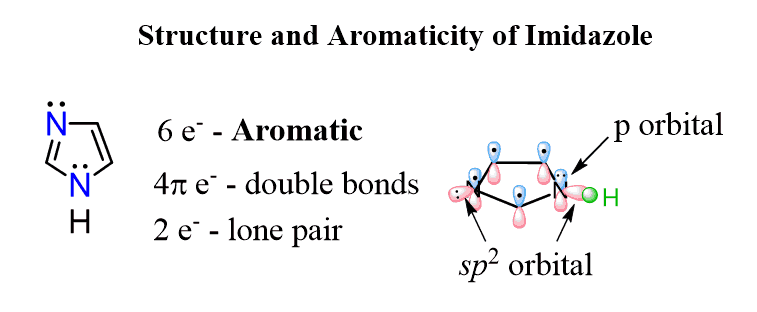
Consider the molecule imidazole, a five-membered ring containing two nitrogen atoms. Is it aromatic, antiaromatic, or nonaromatic? Justify your answer by checking the four conditions and determining the electron count.
Show answer
- Cyclic: Yes.
- Planar: Yes, it is a planar five-membered ring.
- Fully Conjugated: Yes. All atoms in the ring are sp² hybridized.
- The nitrogen analogous to pyridine (part of the C=N bond) contributes one electron. Its lone pair is in an sp² orbital and does not participate.
- The nitrogen analogous to pyrrole (N-H bond) contributes its lone pair (two electrons) to the system.
- Electron Count: 2 electrons from the C=C bond + 1 electron from the C=N nitrogen + 2 electrons from the N-H nitrogen's lone pair = 6 electrons.
This is a system (for ). Since all four conditions are met, imidazole is aromatic.
Conclusion
You can now see that aromaticity is a concept with broad predictive power. By systematically applying the four core conditions, you can analyze unfamiliar molecules and make confident predictions about their stability and chemical character.
Key Takeaways:
- Organic compounds are classified as aromatic, antiaromatic, or nonaromatic based on their stability relative to open-chain analogues.
- The stability hierarchy is Aromatic >> Nonaromatic > Antiaromatic.
- Classification as aromatic or antiaromatic requires a molecule to be cyclic, planar, and fully conjugated. Failure to meet any of these results in a nonaromatic classification.
- The final decider is the electron count: for aromatic and for antiaromatic.
- Molecules will go to great lengths, such as distorting their geometry to become non-planar, to avoid the extreme instability of antiaromaticity.
- The rules of aromaticity apply to ions and heterocycles, where careful counting of electrons (including participating lone pairs) is essential.
Preview of the Next Lesson:
With this module on electronic effects and aromaticity complete, we have a solid understanding of electron distribution and its consequences for stability. We will now shift our focus to the three-dimensional nature of molecules in our next module, Stereoisomerism and Conformational Analysis. In the first lesson, you will learn to interpret and interconvert between Newman, sawhorse, and Fischer projections, essential tools for visualizing and analyzing molecules in 3D space.