Hello! Welcome back to our exploration of reactive intermediates.
In our last lesson, we focused on carbocations, which are electron-deficient species. We established a clear hierarchy of stabilizing effects: resonance is the most powerful, followed by hyperconjugation, and then the weaker inductive effect. Understanding this hierarchy allowed you to predict the relative stabilities of various carbocations, a crucial skill for predicting reaction pathways.
Today, we extend this analysis to the other key reactive intermediates: free radicals and carbanions. Your learning outcome for this lesson is to predict the relative stability of carbanions and free radicals using resonance, inductive effects, and orbital hybridization (s-character).
We will see that free radicals, being electron-deficient like carbocations, follow many of the same stability rules. In contrast, carbanions are electron-rich, and you will find that the effects of some stabilizing factors are inverted. As always, we will connect these trends back to their quantum mechanical origins in orbital theory.
1. Stability of Free Radicals
A free radical is a neutral species containing an atom with an unpaired electron. Carbon radicals, like carbocations, do not have a complete octet of electrons, making them electron-deficient and reactive. Because of this electron deficiency, factors that donate electron density will stabilize a free radical.
1.1 Inductive Effect and Hyperconjugation
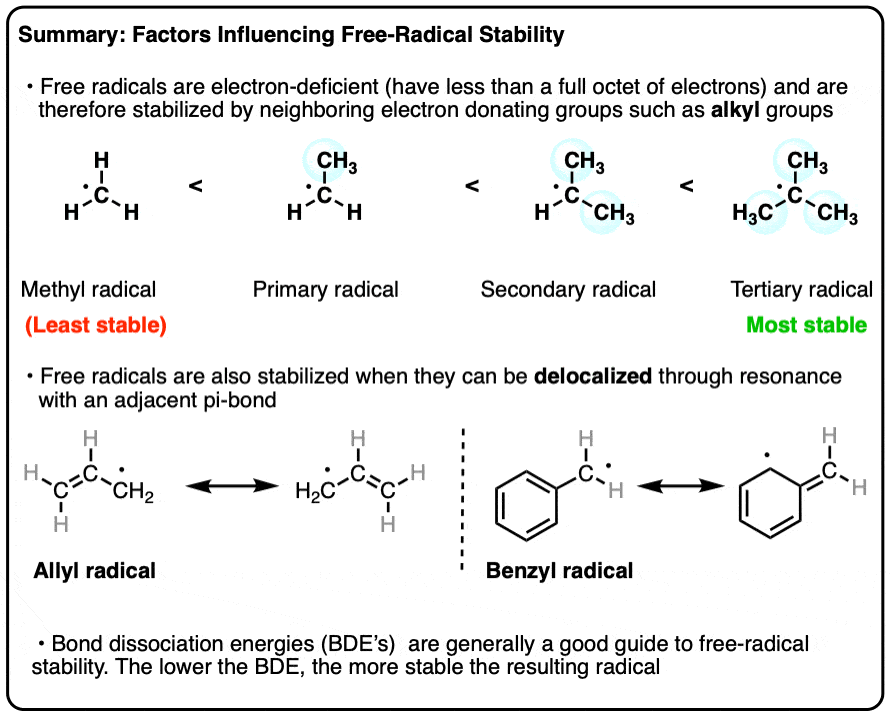
Similar to carbocations, the stability of alkyl radicals increases with the number of alkyl substituents on the radical carbon.
Stability Order: Tertiary (3°) > Secondary (2°) > Primary (1°) > Methyl
This trend is explained by two familiar effects:
- Inductive Effect: Alkyl groups are weakly electron-donating and "push" electron density through the sigma bonds toward the electron-deficient radical center, dispersing its need for electrons.
- Hyperconjugation: This is the more significant effect. It involves the overlap of adjacent, filled C-H -bond orbitals with the singly-occupied p-orbital of the radical.
From a molecular orbital perspective, this interaction is slightly different from the carbocation case. Here, a filled orbital (HOMO) mixes with a singly-occupied p-orbital (SOMO - Singly Occupied Molecular Orbital). This creates a new, lower-energy bonding MO and a higher-energy antibonding MO. The three electrons involved (two from the -bond, one from the radical) populate these new orbitals. Two electrons go into the stabilized bonding MO, and one goes into the destabilized antibonding MO. The net result is a stabilization because the energy drop of the two bonding electrons is greater than the energy rise of the single antibonding electron.
Stability of Radical Compounds
The following video provides an excellent quantum mechanical explanation for why hyperconjugation stabilizes radicals. Pay close attention to the molecular orbital energy diagram for the three-electron interaction.
Watch the video from the beginning until 04:17. Focus on how the interaction between the half-filled 2p orbital and the filled sp³ orbital leads to a net stabilizing effect, as shown in the energy diagram.
1.2 Resonance Delocalization
Just as with carbocations, resonance is a powerful stabilizing effect for free radicals. If the radical's p-orbital is adjacent to a -system, the unpaired electron can be delocalized over multiple atoms. This delocalization drastically lowers the energy of the species.
For this reason, allylic and benzylic radicals are significantly more stable than even tertiary alkyl radicals.
To understand this from a deeper, MO perspective, let's consider the allyl system. The three parallel p-orbitals combine to form three -molecular orbitals: one bonding (), one non-bonding (), and one antibonding (). The allyl radical has three electrons. Two fill the bonding MO, and the lone unpaired electron resides in the non-bonding molecular orbital (NBMO), which serves as the SOMO.
Chapter 1: Molecular Orbital Concepts
This advanced text explains the molecular orbitals of the allyl system. It will show you precisely how MO theory accounts for the delocalization we draw with resonance structures.
Read the section titled 'E. Allylic conjugation.', focusing on part 1, 'MO’s of the Allyl System (Radical, Cation, and Anion)'. Note the description of the Nonbonding MO (NBMO): it has zero electron density on the central carbon (C2) and all its density on the terminal carbons (C1 and C3). This is the quantum-mechanical reason why the radical character is shared between the two ends of the allyl system.
The key insight is that the distribution of the unpaired electron (the "spin density") is determined by the shape of the SOMO. For the allyl radical, the SOMO is the NBMO, which has coefficients only on the terminal carbons. Thus, the radical character is entirely on C1 and C3, perfectly matching our resonance picture.
1.3 Hybridization and s-Character
The effect of hybridization on radical stability is counterintuitive and highlights a key difference from other species. The unpaired electron of a radical resides in a specific orbital.
- Alkyl radical: The carbon is nearly sp² hybridized, so the unpaired electron is in a p-orbital (~0% s-character).
- Vinylic/Phenyl radical: The carbon is sp² hybridized, and the unpaired electron is in an sp² orbital (~33% s-character).
- Alkynyl radical: The carbon is sp hybridized, and the unpaired electron is in an sp orbital (~50% s-character).
Increasing the s-character of an orbital brings it closer to the positively charged nucleus. For an orbital containing an electron pair (like in a carbanion), this is stabilizing. However, for a singly-occupied orbital, pulling it closer to the nucleus increases its electronegativity or electron affinity, making it more reactive and thus less stable.
Therefore, radical stability decreases with increasing s-character of the orbital holding the unpaired electron.
Stability Order: Alkyl (p) > Vinylic (sp²) > Alkynyl (sp)
3 Factors That Stabilize Free Radicals
This article provides a clear explanation of how s-character influences radical stability.
Please read section 6, 'Radical Stability Decreases With Increasing s-Character Of The Orbital'. This section explains why holding the half-filled orbital closer to the nucleus is a destabilizing effect.
2. Stability of Carbanions
A carbanion is a species containing a carbon atom with a lone pair of electrons and a formal negative charge. It is trigonal pyramidal and sp³ hybridized (though it can re-hybridize if it allows for stabilization). As an electron-rich species, its stability is governed by factors that can withdraw or delocalize this excess electron density.
2.1 Inductive Effect
The influence of the inductive effect is reversed for carbanions compared to carbocations.
- Electron-donating groups (like alkyl groups) push more electron density onto the already electron-rich carbon, intensifying the negative charge and destabilizing the carbanion.
- Electron-withdrawing groups (like halogens, -NO₂, -CN) pull electron density away from the carbon center, dispersing the negative charge and stabilizing the carbanion.
This leads to the opposite stability trend for simple alkyl carbanions:
Stability Order: Methyl > Primary (1°) > Secondary (2°) > Tertiary (3°)
2.2 Resonance Delocalization
Resonance is a paramount stabilizing factor for carbanions. Delocalizing the negative charge of the lone pair over several atoms is highly effective at reducing electron-electron repulsion and lowering the overall energy.
Just as with radicals, allylic and benzylic carbanions are vastly more stable than their localized alkyl counterparts. The delocalization can be represented by resonance structures and is explained at a deeper level by molecular orbital theory, as you read in the text on the allyl system.
Acids & Bases - Inductive Effect, Electronegativity, Hybridization, Resonance & Atomic Size
This video explains stabilizing factors in the context of acidity, but the principles for stabilizing the conjugate base are identical to those for stabilizing a carbanion. Watch how resonance delocalizes the negative charge.
Watch from 05:37 to 07:39 and from 08:32 to 09:19. The first segment shows stabilization by an adjacent carbonyl group, and the second shows the classic allylic carbanion. Notice how drawing resonance structures illustrates the delocalization of the negative charge.
2.3 Hybridization and s-Character
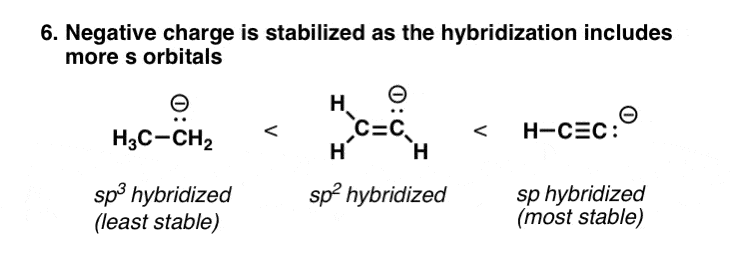
This is arguably the most important factor determining the stability of localized carbanions. The lone pair of the carbanion resides in a hybrid orbital.
- An orbital with higher s-character is held closer to the positively charged nucleus.
- Placing the negative charge (the lone pair) into an orbital closer to the nucleus is a very stabilizing electrostatic interaction.
Therefore, carbanion stability increases dramatically with the s-character of the orbital containing the lone pair.
Stability Order: sp (50% s) > sp² (33% s) > sp³ (25% s)
This trend has profound chemical consequences. It explains why the hydrogen on a terminal alkyne is acidic enough (pKa ≈ 25) to be removed by a strong base, forming a relatively stable acetylide (sp) anion. In contrast, forming a simple alkyl (sp³) carbanion requires an extremely strong base (pKa of alkanes is ~50).
Test your understanding!
Rank the following species from most stable to least stable. Justify your answer by identifying the dominant stabilizing or destabilizing factor for each.
A. tert-Butyl radical
B. Allyl carbanion
C. Isopropyl carbanion
D. Ethyl radical
E. Acetylide anion (HC≡C⁻)
Show answer
The correct order from most stable to least stable is B > E > A > D > C.
- B (Allyl carbanion): Most stable. The negative charge is strongly stabilized by resonance delocalization over two carbons. Resonance is the most powerful stabilizing effect on this list.
- E (Acetylide anion): The negative charge is on an sp-hybridized carbon. The high (50%) s-character provides significant stabilization by holding the lone pair close to the nucleus. While not as strong as resonance in B, this is a very strong effect.
- A (tert-Butyl radical): This is a tertiary radical. It is stabilized by hyperconjugation from 9 alpha-hydrogens. This makes it quite stable for a radical.
- D (Ethyl radical): This is a primary radical, stabilized by hyperconjugation from only 3 alpha-hydrogens. It is less stable than the tertiary radical (A).
- C (Isopropyl carbanion): Least stable. This is a secondary carbanion. It is actively destabilized by the inductive effect of two electron-donating alkyl groups and has no resonance or favorable hybridization to counteract this.
Conclusion
You have now completed your survey of the fundamental factors governing the stability of the three major carbon-based reactive intermediates. By analyzing the electronic nature of each species—whether it is electron-deficient or electron-rich—you can logically predict how it will respond to its structural environment.
Key Takeaways:
| Factor | Carbocation (e⁻ deficient) | Free Radical (e⁻ deficient) | Carbanion (e⁻ rich) |
|---|---|---|---|
| Inductive (Alkyl) | Stabilizing | Stabilizing | Destabilizing |
| Resonance | Stabilizing | Stabilizing | Stabilizing |
| Hybridization (% s-char) | Destabilizing (e.g., vinylic) | Destabilizing | Strongly Stabilizing |
Preview of the Next Lesson:
Now that we have a firm grasp on the relative stabilities of carbocations, we are ready to see this knowledge in action. In our next lesson, we will analyze carbocation rearrangements, including 1,2-hydride/alkyl shifts and ring expansions. You will see how less stable carbocations spontaneously rearrange into more stable ones, a process that dictates the products of many important organic reactions.