Hello! Welcome to the next lesson in our journey through reactive intermediates.
In the previous lesson, we established a clear hierarchy for the stability of carbocations, carbanions, and free radicals based on resonance, inductive effects, and hybridization. You learned that for carbocations, stability increases with alkyl substitution (tertiary > secondary > primary) and is dramatically enhanced by resonance. This understanding is the essential foundation for today's topic.
A key feature of carbocations, which sets them apart from many other intermediates, is their ability to rearrange. An initially formed carbocation is not necessarily the one that proceeds to form the final product. Today, we will explore this dynamic behavior. Your learning outcome is to analyze carbocation rearrangements, including 1,2-hydride/alkyl shifts and ring expansions.
We will examine the fundamental driving force behind these rearrangements—the relentless pursuit of stability—and explore the mechanisms through which they occur. This is a critical concept that explains the formation of seemingly unexpected products in many organic reactions.
1. The Driving Force: The Quest for Stability
The central principle of carbocation rearrangement is simple: a less stable carbocation will rearrange to a more stable one if a plausible pathway exists. This is a classic example of a reaction driven by thermodynamics, where the system moves towards a lower energy state. The stability rules you learned in the last lesson (3° > 2° > 1°; resonance-stabilized is best) are your guide.
This phenomenon, often called a Wagner-Meerwein rearrangement, is typically observed in reactions that proceed via carbocation intermediates, such as SN1 and E1 reactions, or electrophilic additions to alkenes.
To see this in action, let's start with a foundational text.
The following text from Michigan State University provides an excellent introduction to cationic rearrangements. It uses the classic example of the neopentyl system to illustrate the core concepts.
Please read the section titled '1. Wagner-Meerwein Rearrangements', starting from the beginning down to (but not including) the discussion of the terpene α-pinene. Focus on the explanation for why neopentyl bromide yields 2-methyl-2-butanol. Pay close attention to the mechanism diagram showing the '1,2-shift of an adjacent methyl group'.
As the text explains, the forced hydrolysis of neopentyl bromide should, in theory, form a primary (1°) carbocation. However, this is a high-energy intermediate. By shifting a methyl group from the adjacent carbon, the system can transform this unstable 1° carbocation into a much more stable tertiary (3°) carbocation. The reaction then proceeds from this rearranged intermediate.
This migration of a group (like an alkyl group or a hydrogen atom) from one atom to an adjacent electron-deficient atom is called a 1,2-shift.
2. The Mechanism of 1,2-Shifts
Let's dissect the mechanism of the 1,2-shift from a more rigorous, orbital-based perspective. This isn't just a group "hopping" over; it's a concerted electronic process.
During a 1,2-shift, the bonding electrons of the migrating group are used to form a new bond with the adjacent carbocationic carbon. The transition state for this process involves a three-center, two-electron bond, where the migrating group is partially bonded to both the origin and destination carbons, and the positive charge is delocalized across all three centers.
Transition state for a 1,2-methyl shift. The C-C bond of the migrating methyl group overlaps with the empty p-orbital of the carbocation, forming a bridged, three-center, two-electron bond. The positive charge is delocalized across C1, C2, and the migrating methyl group.
This process can be classified as a [1,2]-sigmatropic shift, a concept from the theory of pericyclic reactions. A key stereochemical feature is that the migrating group retains its configuration. For this overlap to be effective, the bond of the migrating group must be aligned with the empty p-orbital of the carbocation.
Migratory Aptitude
When a carbocation has a choice of which group to migrate (e.g., a hydrogen vs. a methyl group on the same adjacent carbon), one group will typically migrate much faster than another. This relative rate of migration is called migratory aptitude.
To understand this in more detail, let's watch a short video segment that introduces the key concepts and provides a general ranking.
What is Wagner Meerwein Rearrangement ? 🧪😊👍 | Basics, Mechanism & Top 10 Problems | One Chemistry
This video introduces the concept of migratory aptitude and gives a useful hierarchy.
Watch the segment from 03:22 to 04:20. Focus on the different types of shifts (hydride, methyl) and the discussion on migratory aptitude.
The general order of migratory aptitude is:
Aryl (especially electron-rich) > Hydride (H⁻) > 3° alkyl > 2° alkyl > 1° alkyl
The reason for this trend lies in the stability of the bridged transition state. The migrating group must bear a portion of the positive charge.
- Hydride (H): A hydrogen atom is small, and its 1s orbital can effectively bridge the two carbons, leading to a low-energy transition state. It often migrates very readily.
- Aryl groups: A phenyl group can stabilize the positive charge through delocalization into its -system, forming a stabilized intermediate called a phenonium ion.
- Alkyl groups: A more substituted alkyl group is better at stabilizing positive charge (via hyperconjugation and inductive effects), making it a better migrating group.
3. Ring Expansion
Another major type of carbocation rearrangement involves the expansion of a strained ring. This is driven by two powerful thermodynamic forces simultaneously:
- Formation of a more stable carbocation.
- Relief of ring strain.
Cyclobutane and cyclopropane rings are highly strained due to non-ideal bond angles (angle strain) and eclipsed conformations (torsional strain). Expanding to a less-strained cyclopentane or cyclohexane ring is highly favorable.
The mechanism is a 1,2-shift, but instead of an H or an alkyl group migrating, a C-C bond from the ring itself migrates.
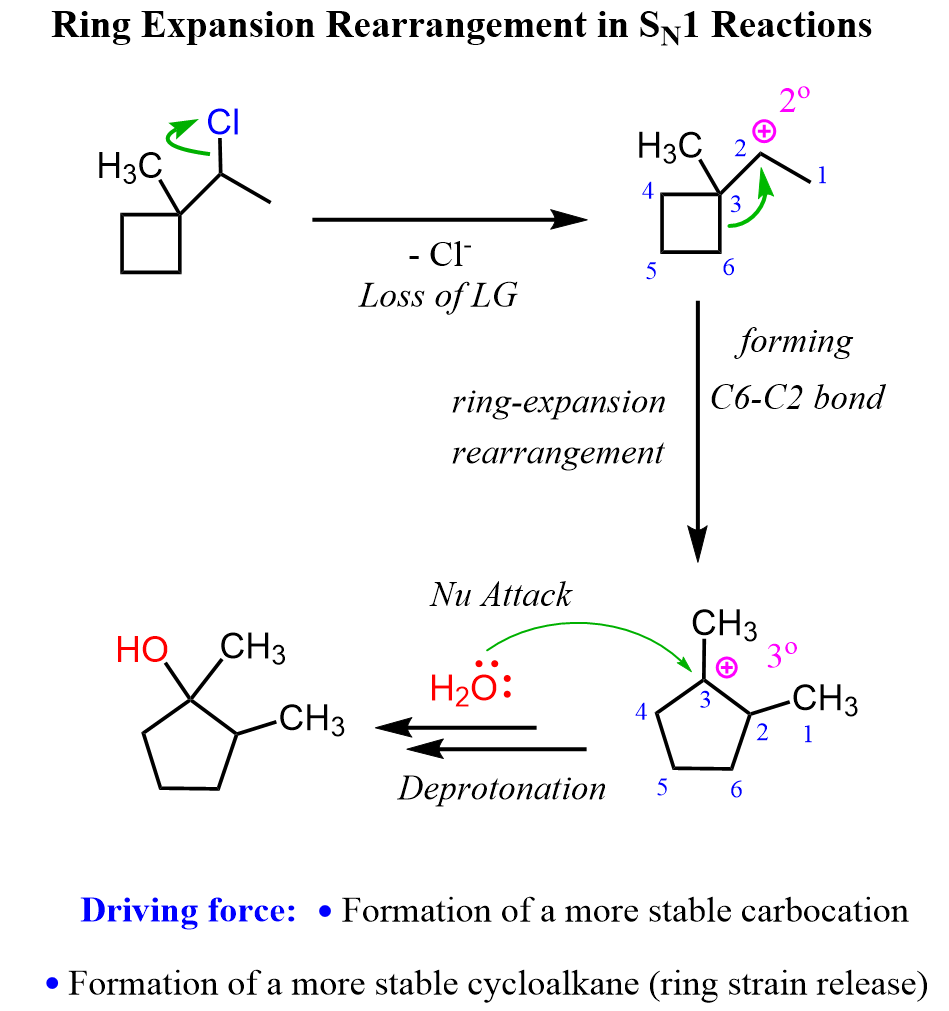
Let's watch an example of this process.
What is Wagner Meerwein Rearrangement ? 🧪😊👍 | Basics, Mechanism & Top 10 Problems | One Chemistry
The following clip from the 'One Chemistry' video shows a clear example of a ring expansion rearrangement.
Watch the example from 06:07 to 06:59. Notice how the initial tertiary carbocation still rearranges. Although the carbocation stability decreases from 3° to 2°, the significant energy gain from relieving the strain of the four-membered ring drives the reaction forward. The final product is then formed from this rearranged secondary carbocation.
This example highlights an important nuance: sometimes, the relief of ring strain is such a powerful driving force that a rearrangement will occur even if it leads to a carbocation of nominally equal or slightly lesser stability (e.g., 3° to 2°). However, often you will find that a subsequent 1,2-hydride shift occurs after the ring expansion to generate an even more stable carbocation.
For instance, if the ring expansion shown in the image above resulted in a secondary carbocation that was adjacent to a carbon with a hydrogen, a subsequent 1,2-hydride shift could occur to form a tertiary carbocation, leading to the final product. Always be on the lookout for a sequence of rearrangements that leads to the most stable possible carbocation.
Test your understanding!
Propose a mechanism for the following reaction. Be sure to show the initial carbocation, the rearrangement step, the rearranged carbocation, and the final product formation.
Show answer
Here is the step-by-step mechanism:
-
Protonation and Water Loss: The hydroxyl group is protonated by the strong acid (H₂SO₄) to form a good leaving group (H₂O). The water molecule departs, generating a secondary (2°) carbocation on the five-membered ring.
-
Ring Expansion (1,2-Alkyl Shift): The adjacent C-C bond of the cyclopentane ring migrates to the carbocation center. This expands the five-membered ring into a six-membered ring. This step is driven by both the relief of the slight strain in the 5-membered ring and the formation of a more stable carbocation in the next step. The immediate result is a secondary (2°) carbocation on the new six-membered ring.
-
Hydride Shift (1,2-H Shift): The secondary carbocation formed after ring expansion is adjacent to a tertiary carbon atom that has a hydrogen. A rapid 1,2-hydride shift occurs, moving the hydrogen and its electrons to the secondary carbocation center. This forms a much more stable tertiary (3°) carbocation.
-
Elimination (E1): A base in the medium (H₂O or HSO₄⁻) removes a proton from an adjacent carbon to form a double bond. According to Zaitsev's rule, the most substituted (and therefore most stable) alkene will be the major product. This results in the final product, 1,2-dimethylcyclohexene.
Conclusion
Today, you have learned that carbocations are not static intermediates. They are dynamic species that undergo rapid rearrangements to find their most stable electronic configuration. This behavior is a fundamental principle that governs the outcome of many reactions in organic chemistry.
Key Takeaways:
- Driving Force: Carbocation rearrangements (Wagner-Meerwein shifts) are driven by the formation of a more stable carbocation and/or the relief of ring strain.
- Mechanisms: The primary mechanisms are 1,2-hydride shifts, 1,2-alkyl shifts, and ring expansions (which are a form of 1,2-alkyl shift).
- Process: The rearrangement involves a concerted migration of a group with its bonding electrons to an adjacent carbocationic center through a bridged transition state.
- Predictive Power: By assessing the stability of a potential carbocation and examining its neighbors, you can predict whether a rearrangement is likely and what the structure of the resulting product will be.
Preview of the Next Lesson:
The bridged transition states and phenonium ions we mentioned today are examples of "neighboring group participation." This idea is central to the concept of non-classical carbocations, where a -bond itself can be delocalized to stabilize a positive charge. In our next lesson, we will delve into this advanced topic, exploring the famous and controversial 2-norbornyl cation, a perfect subject for your interest in the deeper quantum mechanical models of bonding.