Hello! Welcome to our next lesson on reactive intermediates.
In our previous lesson, we analyzed how classical carbocations rearrange via 1,2-shifts to achieve greater stability. We briefly touched upon the idea of a bridged, three-center, two-electron transition state during these shifts. This concept was a crucial foreshadowing of today's topic, where we will explore a more profound form of electronic delocalization.
Today, we move beyond the "classical" view of carbocations. Your learning outcome is to describe the stabilization mechanism in non-classical carbocations. We will investigate how -bonds, which we typically think of as localized between two atoms, can participate in delocalization to stabilize a positive charge. This leads to fascinating structures with "pentacoordinate" carbons, often called carbonium ions. This topic is a perfect bridge between your interests in fundamental quantum mechanics and the tangible behavior of molecules.
1. From Carbenium to Carbonium: A New Bonding Paradigm
First, let's establish our terms.
- Carbenium ions (Classical): These are the carbocations you are most familiar with. They contain a trivalent,
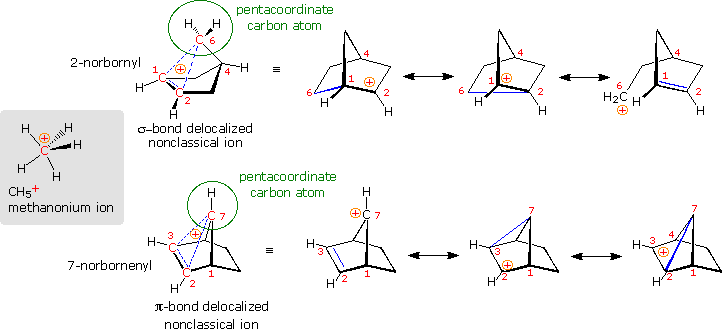
sp²-hybridized carbon with a vacant p-orbital (e.g.,tert-butyl cation). - Carbonium ions (Non-classical): These are cations that contain at least one tetra- or pentacoordinate carbon atom. The charge is stabilized by the delocalization of -bond electrons over three or more centers.
The fundamental bonding model for this phenomenon is the three-center, two-electron (3c-2e) bond. Here, three atoms are held together by a molecular orbital containing just two electrons. You've likely encountered this concept in inorganic chemistry with diborane (B₂H₆), where two boron atoms and a bridging hydrogen atom are linked by a 3c-2e bond.
To begin, let's get a formal introduction to non-classical stabilization and the 3c-2e bond concept.
The following presentation slides from Princeton University provide a concise definition of non-classical carbocations and introduce the 3c-2e bond using the familiar example of diborane.
Please review the slides from the beginning down to the section titled 'The 3-center, 2-electron bond'. Focus on the definition provided (stabilization via σ-bonds) and how the bonding in diborane is used as an analogy for the bonding in carbonium ions. Pay attention to the distinction between carbenium and carbonium ions introduced in the slides on the ethyl cation.
As the resource illustrates, non-classical stabilization involves the electrons of a C-C or C-H -bond donating into an adjacent empty p-orbital. This is a deeper form of delocalization than hyperconjugation; it's a full sharing of the -bond electrons across three centers, creating a bridged structure.
2. The Great Debate: The 2-Norbornyl Cation
The story of non-classical carbocations is one of the great scientific controversies of the 20th century, centered on one molecule: the 2-norbornyl cation. Understanding this debate is the best way to understand the evidence and reasoning behind the non-classical model.
The debate began in 1949 with Saul Winstein, who observed two puzzling facts during the solvolysis of 2-norbornyl derivatives:
- Anomalous Rate: The
exoisomer reacted 350 times faster than theendoisomer. - Stereochemistry: Solvolysis of an enantiomerically pure
exostarting material resulted in a completely racemic mixture ofexoproducts. Noendoproduct was formed.
To explain these results, Winstein proposed a bridged, non-classical intermediate. He argued that the C1-C6 -bond provides "anchimeric assistance," pushing out the leaving group from the exo position and forming a symmetric, delocalized cation.
This radical idea was fiercely opposed by Herbert C. Brown, who argued for a classical model: two rapidly equilibrating sp² carbenium ions. He attributed the rate difference to steric hindrance in the endo isomer.
This set the stage for decades of debate, which was ultimately settled by the groundbreaking work of George Olah and the definitive evidence from modern spectroscopy and crystallography.
The following resource walks through this compelling scientific story.
Nonclassical Carbocations: From Controversy to Convention
This presentation provides a fantastic historical account of the Winstein-Brown debate, the key experiments, and the eventual resolution that confirmed the non-classical structure.
Please read through the slides covering the core of the controversy. Start with the slide titled 'The Nonclassical Problem: An Indecent Proposal', and continue through Brown's challenge ('A Bonding Experience'), and Olah's crucial experiments ('Enter George Olah' and 'Proving the Existence of the Carbonium Ion'). Focus on: Winstein's experimental observations (rate and stereochemistry). Brown's classical alternative (equilibrating ions). Olah's use of superacids and key spectroscopic evidence from NMR and ESCA.
3. The Verdict: Unambiguous Proof of a Non-Classical Structure
The evidence gathered over the years overwhelmingly supported Winstein's non-classical hypothesis:
- Low-Temperature ¹³C NMR: Even at temperatures as low as 5 K, where classical rearrangements would be frozen, the NMR spectrum showed a symmetric structure, not two distinct classical ions. The chemical shifts were averaged, indicating the charge was delocalized.
- ESCA (X-ray Photoelectron Spectroscopy): This technique, which measures core electron binding energies on a very fast timescale ( s), showed that the positive charge was smeared over C1, C2, and C6, not localized on C2 as a classical ion would require.
- X-ray Crystallography (2013): The final, irrefutable proof came from the crystal structure of the 2-norbornyl cation. It showed a perfectly symmetric, bridged structure, with elongated C1-C6 and C2-C6 bonds and a short C1-C2 distance, exactly as predicted by the non-classical model.
Let's visualize the orbital interactions that lead to this stabilization.
Test your understanding!
The solvolysis of exo-2-norbornyl brosylate leads to the exclusive formation of exo-2-norbornyl acetate. In contrast, a typical SN1 solvolysis, such as that of (S)-2-bromobutane, leads to a racemic mixture of products from nucleophilic attack on both faces of the planar carbocation.
Explain this striking difference in stereochemical outcome by directly referring to the structure of the 2-norbornyl cation intermediate.
Show answer
The difference in stereochemistry is direct evidence for the non-classical structure of the 2-norbornyl cation.
- In the case of the 2-butyl cation, the intermediate is a classical,
sp²-hybridized carbenium ion. It is planar and achiral. The nucleophile (e.g., acetate or water) can attack with equal probability from the top or bottom face of the empty p-orbital, leading to a racemic mixture of products. - In contrast, the 2-norbornyl cation is a non-classical, bridged ion. The C1-C6 bond is delocalized to stabilize the charge at C2. This creates a "roof" of electron density over the
endoface of the molecule. Thisendoface is therefore sterically and electronically blocked. The incoming nucleophile (acetate) can only attack from the openexoface. This explains why only theexoproduct is formed and why the reaction proceeds with overall retention of theexoconfiguration.
4. A Gallery of Non-Classical Ions
The 2-norbornyl cation is the most famous, but it is not the only example. The principle of - or -bond participation is a general one.
Nonclassical Carbocations: From Controversy to Convention
To broaden your understanding, let's look at several other important examples of non-classical cations presented in the same resource.
Please review the section titled 'Other Important Nonclassical Carbocations'. Note the structures of the: Methonium ion (CH₅⁺): The parent carbonium ion. Cyclopropylcarbinyl cation: Shows stabilization from the high p-character 'bent bonds' of a cyclopropane ring. 7-Norbornenyl cation: Shows stabilization via participation of a \pi-bond (homo-conjugation). Phenonium ion: Shows participation by an adjacent aromatic ring.
These examples demonstrate that delocalization of electron density from neighboring -bonds, -bonds, or even lone pairs (anchimeric assistance) is a powerful and general strategy that molecules use to stabilize high-energy carbocation intermediates. The cyclopropylcarbinyl system, in particular, undergoes solvolysis at rates that rival or even exceed resonance-stabilized allylic systems, highlighting the potency of this effect.
Conclusion
Today we have ventured into one of the more profound areas of physical organic chemistry, revealing that the simple lines we draw to represent bonds are sometimes insufficient to capture the complex, delocalized reality described by quantum mechanics.
Key Takeaways:
- Non-classical stabilization is the delocalization of -bond electrons into an adjacent, empty p-orbital.
- This is described by the three-center, two-electron (3c-2e) bond model, resulting in bridged structures with pentacoordinate carbons known as carbonium ions.
- The 2-norbornyl cation is the archetypal example, and its non-classical nature was confirmed through decades of experiments, including rate studies, stereochemical outcomes, low-temperature NMR, ESCA, and finally, X-ray crystallography.
- This type of stabilization is a general phenomenon, with other key examples including the cyclopropylcarbinyl and 7-norbornenyl cations.
Preview of the Next Lesson:
We have now examined carbocations, both classical and non-classical, in detail. Our next lesson will shift focus to another critical class of reactive intermediates: carbenes. These are neutral species containing a divalent carbon atom. You will learn to distinguish between the two different electronic states of carbenes—singlet and triplet—and see how their unique structures dictate their distinct and powerful reactivity patterns in organic synthesis.