Hello! Welcome to our next lesson.
In our last session, we explored the fascinating world of non-classical carbocations, seeing how sigma bonds can delocalize to stabilize a positive charge through three-center, two-electron bonding. This revealed that our simple Lewis structures sometimes fall short of describing the quantum mechanical reality of molecules.
Today, we turn our attention to another powerful and unique class of reactive intermediates: carbenes. Your learning outcome is to distinguish between singlet and triplet carbenes and predict their characteristic reactivity patterns. Carbenes are neutral species containing a divalent carbon atom, but they are electron-deficient and highly reactive. The key to understanding them lies in the quantum mechanical property of electron spin, which gives rise to two distinct electronic states—singlet and triplet—with dramatically different structures and reactivities.
1. The Duality of Carbenes: Structure and Electronic States
A carbene, with the general formula R₂C, is a neutral molecule containing a carbon atom with two bonds and two non-bonding electrons. This leaves the carbon with only six valence electrons, making it highly reactive.
The crucial question is: how are those two non-bonding electrons arranged? Their arrangement defines the two fundamental types of carbenes.
To get an introduction to the structure of carbenes and how they are formed, please watch the first few minutes of the following video.
This video from Andrey K will introduce the basic definition of a carbene, its formation from diazo compounds, and the concept of singlet versus triplet states based on electron arrangement.
Please watch from the beginning to the 4:31 mark. Focus on: The definition of a carbene. The sp² hybridization of the carbene carbon. The two distinct ways the non-bonding electrons can be placed in the available orbitals to form singlet and triplet carbenes.
As the video explained, the carbene carbon is typically sp² hybridized. This creates three sp² orbitals (two for bonding, one for non-bonding electrons) and one unhybridized p orbital. This leads to two possible electronic configurations:
- Singlet Carbene: Both non-bonding electrons are paired up in the sp² hybrid orbital. This leaves the p orbital completely empty.
- Triplet Carbene: The two non-bonding electrons are unpaired. One occupies the sp² orbital, and the other occupies the p orbital. Following Hund's rule, they have parallel spins.
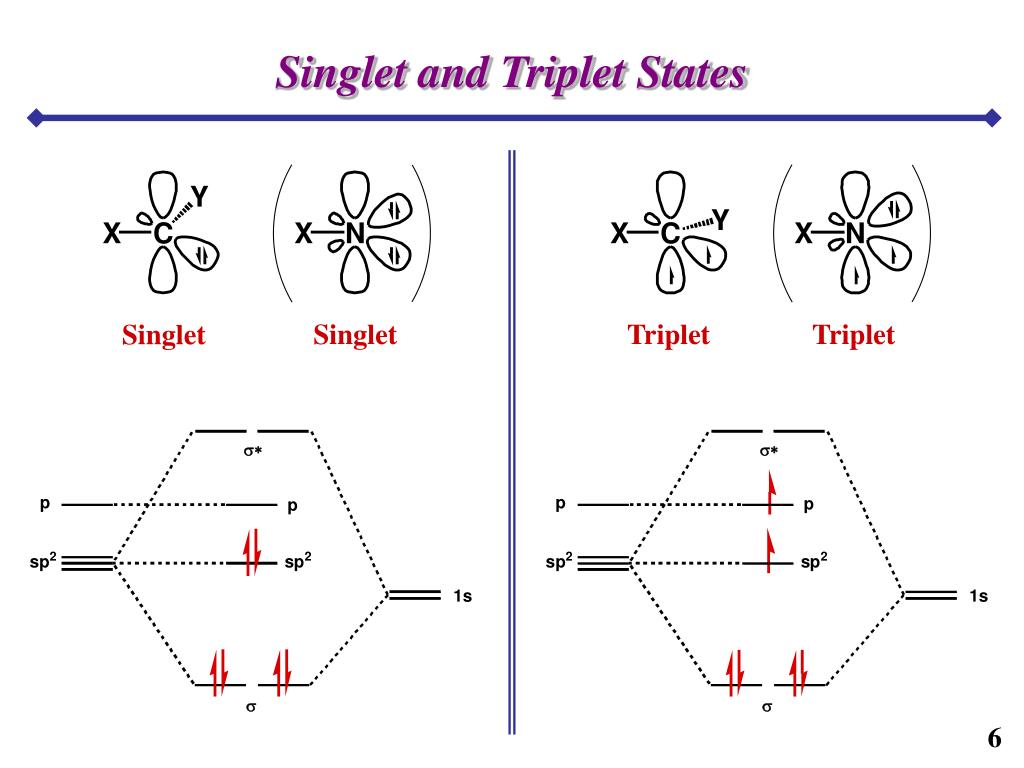
The terms "singlet" and "triplet" come from the quantum mechanical concept of spin multiplicity, which is calculated as , where is the total electron spin.
- For a singlet state, the spins are paired (), so the multiplicity is .
- For a triplet state, the spins are parallel (), so the multiplicity is .
2. Stability and the Singlet-Triplet Energy Gap ()
Now, which state is more stable? The answer lies in a delicate balance between two competing quantum mechanical effects.
Let's continue with the same video to understand the relative stabilities of singlet and triplet carbenes.
Please watch the segment from 4:31 to 6:59. The video discusses the thermodynamic stability of the two states, focusing on the competition between orbital energy and electron-electron repulsion.
As explained, the triplet state is generally the ground state (more stable) for the parent carbene, CH₂. This might seem counterintuitive since the singlet state places both electrons in the lower-energy sp² orbital. The reason is that placing two electrons in the same orbital results in significant coulombic repulsion (). The triplet state avoids this by placing the electrons in different orbitals, an energetically favorable arrangement that outweighs the cost of promoting one electron to the higher-energy p orbital.
We can formalize this relationship. The energy difference, known as the singlet-triplet splitting (), is determined by the competition between coulombic repulsion () and the energy gap between the (sp²) and p orbitals ().
- A positive means the triplet state is lower in energy (the ground state).
- A negative means the singlet state is the ground state.
For CH₂, is about +9 kcal/mol, making the triplet the ground state. However, this balance can be easily tipped by substituents.
3. How Substituents Control the Carbene Ground State
The true depth of carbene chemistry comes from understanding how we can control the ground state by changing the substituents on the carbene carbon.
Carbenes: multiplicity and reactivity
The following resource provides a rigorous, graduate-level look at the factors determining carbene multiplicity. This aligns with your goal of a 'hyper deep' understanding.
Please review the slides covering 'Mesomeric effects', 'Inductive effects', and 'Steric effects'. Focus on how each factor influences the σ-p energy gap (ΔE) and, consequently, the singlet-triplet splitting (ΔGST). Mesomeric (Resonance) Effects: See how π-donating groups (like -NR₂, -OR, halogens) stabilize the empty p-orbital of the singlet state. Inductive Effects: Understand how σ-electron withdrawing groups stabilize the σ-orbital, increasing the gap and favoring the singlet. Steric Effects: Note how bulky substituents decrease the bond angle, which increases the s-character of the σ-orbital, again favoring the singlet.
To summarize the key takeaways from this advanced resource:
- π-Donating Substituents (e.g., -NH₂, -OH, -Cl): These groups have lone pairs that can donate into the empty p-orbital of the singlet carbene. This resonance stabilization is very powerful and dramatically lowers the energy of the singlet state, often making it the ground state. For example, in dichlorocarbene (:CCl₂), the singlet state is the ground state.
- π-Accepting Substituents (e.g., -C=O): These groups have low-lying π* orbitals that can interact with the singly occupied orbitals of the triplet state, stabilizing it.
- Steric Bulk: Bulky substituents force the R-C-R bond angle to become smaller. According to Bent's rule, a smaller bond angle implies more p-character in the C-R bonds, which in turn means the non-bonding orbital gains more s-character. This lowers its energy, increasing the gap and favoring the singlet state.
4. Distinct Reactivity: Concerted vs. Stepwise Mechanisms
The different electronic structures of singlet and triplet carbenes lead to profoundly different reaction mechanisms and stereochemical outcomes. This is the predictive power of understanding their structures.
Carbenes Part 2: Cyclopropanation, C-H Insertion, and the Bamford-Stevens Reaction
This video from Professor Dave Explains provides a clear and concise summary of how the electronic differences between singlet and triplet carbenes translate directly into different reaction pathways.
Watch the segment from 2:13 to 4:24. Pay close attention to the distinction between the 'concerted' reaction of a singlet carbene and the 'stepwise radical addition' of a triplet carbene, and how this impacts the stereochemistry of the products.
Let's break down the key reaction pattern: cycloaddition to an alkene.

A. Singlet Carbene Reactivity
A singlet carbene has both a filled -type orbital (nucleophilic) and an empty p-orbital (electrophilic). It can react with an alkene in a single, concerted step. The electron pair from the carbene's orbital and the electrons from the alkene rearrange simultaneously to form two new C-C bonds.
- Mechanism: Concerted [2+1] cycloaddition.
- Stereochemistry: Stereospecific. Because the reaction happens in one step, there is no opportunity for bond rotation. The original stereochemistry of the alkene is perfectly preserved in the cyclopropane product. For example, a cis-alkene gives a cis-disubstituted cyclopropane.
B. Triplet Carbene Reactivity
A triplet carbene behaves like a diradical. It cannot undergo a concerted reaction because the electrons have parallel spins. The reaction must occur in steps.
- Mechanism: Stepwise radical addition.
- One of the singly occupied orbitals of the carbene interacts with the alkene system to form one C-C bond, creating a diradical intermediate.
- This intermediate now has two unpaired electrons with the same spin. Before the second C-C bond can form to close the ring, one electron must undergo a spin inversion, which is a relatively slow process.
- During this delay, single-bond rotation in the intermediate is fast. This rotation scrambles the original stereochemistry of the alkene.
- Stereochemistry: Non-stereospecific. Due to the free rotation in the diradical intermediate, a cis-alkene will typically yield a mixture of cis- and trans-disubstituted cyclopropane products.
Test your understanding!
You treat cis-2-butene with diazomethane (CH₂N₂) and light. In one experiment (A), you simply irradiate the mixture. In a second experiment (B), you add benzophenone as a "photosensitizer" before irradiating. Direct irradiation of diazomethane produces primarily singlet methylene (:CH₂), while using a photosensitizer produces triplet methylene.
Predict the structure(s) of the product(s) formed in Experiment A and Experiment B.
Show answer
-
Experiment A (Singlet Carbene): The reaction is a stereospecific, concerted cycloaddition. The singlet carbene will add to the cis-2-butene to form a single product: cis-1,2-dimethylcyclopropane. The stereochemistry of the starting alkene is retained.
-
Experiment B (Triplet Carbene): The reaction is a non-stereospecific, stepwise radical addition. The triplet carbene will add to form a diradical intermediate. During the time required for spin inversion, the C-C bond will rotate. This leads to a mixture of products: both cis-1,2-dimethylcyclopropane and trans-1,2-dimethylcyclopropane. The more thermodynamically stable trans product will likely be the major product.
Conclusion
Today, you've delved into the quantum mechanical heart of carbene chemistry, learning how electron spin dictates the existence of two very different chemical entities from the same molecular formula.
Key Takeaways:
- Carbenes are neutral, divalent carbon intermediates that exist in two electronic states: singlet and triplet, distinguished by their electron spin multiplicity.
- For the parent carbene :CH₂, the triplet state is the ground state due to reduced electron-electron repulsion. However, the ground state can be switched to singlet by π-donating or sterically bulky substituents.
- Singlet carbenes react in a concerted fashion. Their cycloadditions are stereospecific, preserving the alkene's geometry.
- Triplet carbenes react like diradicals in a stepwise manner. Their cycloadditions are non-stereospecific because bond rotation occurs in the diradical intermediate, leading to a mixture of stereoisomeric products.
Preview of the Next Lesson:
You have now thoroughly analyzed the structure, stability, and reactivity of carbocations (classical and non-classical), carbanions, free radicals, and carbenes. In our next lesson, we will synthesize this knowledge. The learning outcome will be: Given an intermediate, predict the most likely subsequent reaction pathway. You will learn to look at a reactive species and, based on its structure and the surrounding conditions, decide whether it is most likely to rearrange, substitute, eliminate, or add to another molecule.