Hello! In our last lesson, we established the fundamental electronic structures and geometries of reactive intermediates. We saw that a carbocation is sp² hybridized and trigonal planar, with a crucial feature: a vacant, high-energy p-orbital. This electron deficiency makes carbocations highly reactive.
Today, we will delve into the factors that can mitigate this instability. Your learning outcome is to predict the relative stability of carbocations using hyperconjugation, resonance, and inductive effects. We will move beyond simple rules and explore the quantum mechanical origins of these effects, connecting them directly to the orbital picture we developed previously. This will allow you to analyze and rank the stability of various carbocations from first principles.
1. The Core Principle: Dispersing Positive Charge
A carbocation is unstable because it has an electron-deficient carbon with a formal positive charge. Therefore, any effect that donates electron density to this electron-poor center will help to disperse the positive charge, lowering the potential energy and stabilizing the species. We will examine three primary mechanisms through which this occurs.
2. Inductive Effect: Stabilization Through Sigma Bonds
The simplest stabilizing mechanism is the inductive effect. This is the transmission of charge through a chain of atoms in a molecule, resulting in a permanent dipole in a bond.
- The positively charged sp² carbon of a carbocation is highly electronegative.
- It pulls electron density toward itself through the surrounding sigma () bonds.
- Alkyl groups are more polarizable than hydrogen atoms and are considered weak electron-donating groups. They can more effectively "push" electron density towards the positive center compared to hydrogen.
As a result, the more alkyl groups attached to the carbocation center, the more the positive charge is dispersed, and the more stable the carbocation. This gives us our first and most basic trend for alkyl carbocations:
Tertiary (3°) > Secondary (2°) > Primary (1°) > Methyl
7.10: Carbocation Structure and Stability
To solidify your understanding of this effect, please read the following brief sections from Chem LibreTexts. Focus on how alkyl groups inductively donate electron density to stabilize the carbocation.
Please read the text under the heading 'Stability of Carbocation Intermediates'. Pay attention to the paragraph explaining the inductive effect (it starts with 'Alkyl groups stabilized carbocations for two reasons. The first is through inductive effects...') and the part under 'Carbocation Structure' that describes the sp2 geometry and empty p-orbital.
While the inductive effect provides a correct trend, it's not the complete picture. A more powerful effect, rooted in orbital overlap, is at play.
3. Hyperconjugation: A Molecular Orbital Perspective
Hyperconjugation is a stabilizing interaction that involves the delocalization of electrons from an adjacent, filled -bond (usually C-H or C-C) into the empty p-orbital of the carbocation. This is often called "sigma-pi conjugation" or, less formally, "no-bond resonance."
From a molecular orbital perspective, which will appeal to your interest in quantum chemistry, hyperconjugation is a classic example of a stabilizing HOMO-LUMO interaction.
- The HOMO (Highest Occupied Molecular Orbital) is the filled orbital of the adjacent C-H bond.
- The LUMO (Lowest Unoccupied Molecular Orbital) is the empty p-orbital on the carbocation.
The spatial overlap between these orbitals allows them to mix. A fundamental principle of MO theory states:
When an occupied orbital and an empty orbital mix, they form two new molecular orbitals. The occupied orbital is stabilized (lowered in energy), and the empty orbital is destabilized (raised in energy). The net result is a stabilization of the overall system because the electrons now occupy a lower-energy orbital.
The more C-H bonds are adjacent to the carbocationic center (these are called alpha-hydrogens), the more opportunities there are for this stabilizing overlap.

This video provides an excellent visual explanation of hyperconjugation from a molecular orbital standpoint. It directly contrasts the tertiary carbocation with the methyl carbocation to show why substitution is so important.
Watch from the beginning to 05:00. Pay close attention to how the video depicts the interaction between the filled sp³ orbital of a C-H bond and the empty 2p orbital of the carbocation. The explanation of the HOMO-LUMO interaction is particularly relevant.
Counting the number of alpha-hydrogens gives a quantitative way to predict stability:
- Tertiary carbocation (e.g., tert-butyl): 9 -H's
- Secondary carbocation (e.g., isopropyl): 6 -H's
- Primary carbocation (e.g., ethyl): 3 -H's
- Methyl carbocation: 0 -H's
This perfectly matches the stability trend we saw with the inductive effect, but provides a more rigorous quantum mechanical explanation for it.
Advanced Topic: The Isotopic Effect (Baker-Nathan Effect)
How can we be sure that hyperconjugation is the dominant effect, not just induction? A clever experiment involves isotopic labeling. We can compare the stability of a carbocation stabilized by a -CH₃ group versus one stabilized by a -CD₃ group (where D is deuterium, ²H).
Inductively, deuterium is slightly more electron-donating than hydrogen. So, based on induction alone, the -CD₃ group should be more stabilizing.
However, the C-D bond is shorter and stronger than the C-H bond. This means the C-H -bonding electrons are held less tightly and are higher in energy, making them better donors for hyperconjugation. The C-D orbital is lower in energy and less effective at this overlap.
Experimentally, the carbocation stabilized by -CH₃ is more stable than the one stabilized by -CD₃. This result, known as the Baker-Nathan effect, provides strong evidence that the electron-donating hyperconjugation effect is more significant than the inductive effect in stabilizing alkyl carbocations.
Hyperconjugation - Isotopic Effect | Electronic Effects | Chemistry | Khan Academy
The following video explains this isotopic effect in detail, clearly contrasting the predictions from hyperconjugation and induction. This is a higher-level concept that solidifies the importance of hyperconjugation.
Please watch from the beginning to 08:56. The video explains why C-H, C-D, and C-T bonds have different strengths and how this impacts their ability to participate in hyperconjugation. Note the final conclusion about which effect—hyperconjugation or induction—is dominant.
4. Resonance: The Most Powerful Stabilizing Effect
When a carbocation is adjacent to a system (like a double bond or a benzene ring), an even more powerful stabilizing effect comes into play: resonance.
In this case, the empty p-orbital of the carbocation can overlap in a parallel fashion with the p-orbitals of the adjacent system. This creates a larger, conjugated system of molecular orbitals, allowing the positive charge to be delocalized over multiple atoms. Spreading the charge over a larger area is highly stabilizing.
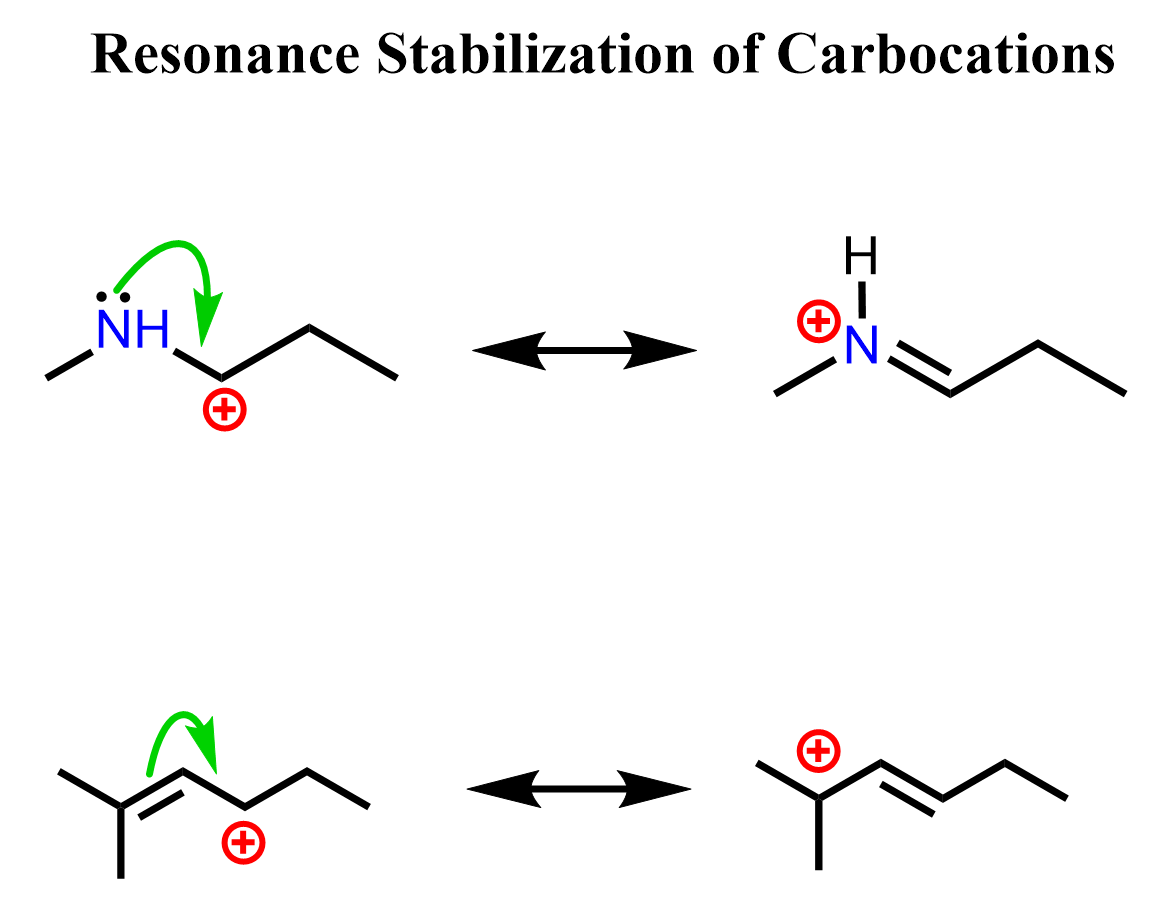
Two common examples are allylic and benzylic carbocations.
- Allylic Carbocation: The positive charge is delocalized over two carbons.
- Benzylic Carbocation: The positive charge is delocalized over four carbons (the benzylic carbon and the ortho and para positions of the aromatic ring).
Because resonance delocalizes charge so effectively, resonance-stabilized carbocations are significantly more stable than even tertiary alkyl carbocations that rely only on hyperconjugation and induction.
7.10: Carbocation Structure and Stability
This reading explains how resonance provides superior stabilization for carbocations. It also introduces the crucial case of stabilization by adjacent heteroatoms.
Read the section titled 'Stabilization of a carbocation can also occur through resonance effects'. Pay special attention to the comparison between benzylic/allylic cations and alkyl cations, and the explanation for why an adjacent oxygen or nitrogen atom is so powerfully stabilizing.
5. Summary: A Hierarchy of Stabilizing Effects
When predicting carbocation stability, you must consider all three effects and understand their relative importance. The general hierarchy is:
Resonance > Hyperconjugation > Inductive Effect
This leads to the following general order of stability:
Benzylic ≈ Allylic (with resonance) > Tertiary alkyl (9 -H) > Secondary alkyl (6 -H) > Primary alkyl (3 -H) > Methyl (0 -H)
An important outlier is the vinylic carbocation, where the charge is on a double-bonded carbon. This is extremely unstable because the sp-hybridized carbon is more electronegative and holds the positive charge poorly, and the empty p-orbital is perpendicular to the bond, preventing any resonance.
Test your understanding!
Rank the following carbocations from most stable to least stable. Explain your reasoning by identifying the key stabilizing (or destabilizing) effects for each.
A. Isopropyl cation
B. Benzyl cation
C. tert-Butyl cation
D. Ethyl cation
E. A cation stabilized by an adjacent -OCH₃ group
Show answer
The correct order from most stable to least stable is E > B > C > A > D.
- E (Most Stable): The carbocation is adjacent to an oxygen atom. Although oxygen is inductively electron-withdrawing, its lone pair can be donated via resonance. This creates a structure where every atom has a full octet, which is an overwhelmingly powerful stabilizing effect.
- B: This is a benzylic carbocation. The positive charge is delocalized over four atoms in the aromatic ring through resonance. This is a very strong stabilizing effect.
- C: This is a tertiary (3°) carbocation. It has no resonance but is stabilized by hyperconjugation from 9 alpha-hydrogens and by the inductive effect of three alkyl groups.
- A: This is a secondary (2°) carbocation. It is stabilized by hyperconjugation from 6 alpha-hydrogens and the inductive effect of two alkyl groups. It is less stable than the tertiary cation.
- D (Least Stable): This is a primary (1°) carbocation, stabilized only by hyperconjugation from 3 alpha-hydrogens.
Conclusion
You can now predict the relative stability of carbocations by systematically analyzing the electronic effects at play. This skill is not just academic; it is the key to understanding reaction rates and predicting major products in many organic reactions, such as electrophilic additions and substitution reactions.
Key Takeaways:
- Carbocation stability is determined by the dispersal of positive charge.
- The three main stabilizing mechanisms are the inductive effect, hyperconjugation, and resonance.
- Inductive Effect: Weak electron donation through -bonds by alkyl groups.
- Hyperconjugation: A stronger effect involving the overlap of adjacent C-H -orbitals with the empty p-orbital (a HOMO-LUMO interaction). Stability increases with the number of alpha-hydrogens.
- Resonance: The most powerful effect, involving delocalization of charge through an adjacent system or via lone pairs on heteroatoms.
Preview of the Next Lesson:
Having mastered carbocation stability, we will turn our attention to the other reactive intermediates. In the next lesson, we will predict the relative stability of carbanions and free radicals. You will see how some of these principles apply directly (especially for radicals) and how others are inverted (for carbanions), deepening your understanding of electronic effects in chemistry.