Hello! Welcome to our next lesson in the study of addition reactions.
In our last lesson, we investigated the halogenation of alkenes, where the formation of a bridged halonium ion intermediate dictated a very specific stereochemical outcome: anti-addition. This provided a powerful example of how the structure of an intermediate controls the spatial arrangement of the final product.
Today, we shift our focus to a mechanistically distinct, yet equally important, addition reaction: catalytic hydrogenation. This reaction stands in stark contrast to halogenation, as it proceeds via an entirely different pathway—one involving a metal surface—to produce the exclusive outcome of syn-addition.
Your learning outcome for this lesson is to describe the mechanism of catalytic hydrogenation of alkenes and alkynes and explain its stereoselectivity (syn-addition). By the end of this session, you will understand the fundamental principles of heterogeneous catalysis and be able to predict the stereochemical products of hydrogenation for various unsaturated systems.
The Challenge: Activating Molecular Hydrogen
The overall reaction of hydrogenation seems simple: an alkene or alkyne reacts with hydrogen gas (H₂) to form a saturated alkane. From a thermodynamic perspective, this reaction is typically exergonic and favorable.
Alkene + H₂ → Alkane
However, if you mix an alkene and hydrogen gas at room temperature, nothing happens. The reaction is kinetically prohibited. The reason for this is the immense strength of the H–H sigma bond (bond dissociation energy ≈ 436 kJ/mol). Breaking this bond to allow the hydrogen atoms to add across the π system requires overcoming a very large activation energy.
To make this reaction feasible, we need a catalyst.
Catalytic Hydrogenation of Alkenes - Heterogeneous Catalysts
The video 'Catalytic Hydrogenation of Alkenes - Heterogeneous Catalysts' from The Organic Chemistry Tutor begins by perfectly illustrating this kinetic problem and introduces the role of a catalyst.
Please watch from the beginning to 05:20. Pay close attention to the potential energy diagram, which visually explains how a catalyst provides an alternative, lower-energy reaction pathway without changing the overall thermodynamics.
As the video explains, catalysts like platinum (Pt), palladium (Pd), and nickel (Ni) provide a new reaction mechanism with a much lower activation energy. These are typically used as finely divided powders supported on an inert material like carbon (Pd/C) or as specialized preparations like Adams' catalyst (PtO₂) and Raney Nickel.
Because the metal catalyst is a solid and the reactants (alkene and H₂) are in a liquid or gas phase, this is known as heterogeneous catalysis. The reaction chemistry occurs not in solution, but on the active surface of the metal.
The Horiuti–Polanyi Mechanism: Chemistry on a Surface
The accepted mechanism for catalytic hydrogenation was proposed by Juro Horiuti and Michael Polanyi. It describes a sequence of events occurring on the metal catalyst's surface. A deep understanding of this mechanism is the key to explaining the reaction's stereoselectivity.
Mechanism (Horiuti–Polanyi Sequence)
The article 'Alkene Hydrogenation with H₂ over Pd, Pt, or Ni' from OrgoSolver provides a clear, step-by-step description of the Horiuti–Polanyi mechanism. It breaks down the process into its essential surface-level events.
Please read the section titled 'Mechanism (Horiuti–Polanyi Sequence)'. Focus on understanding the sequence of events: dissociative adsorption of H₂, π-binding of the alkene, and the two successive hydride transfers.
Let's summarize the key steps from your reading:
- Adsorption and Activation of H₂: Molecular hydrogen adsorbs onto the metal surface. The interaction with the metal's d-orbitals weakens and cleaves the H-H bond. This process, called dissociative chemisorption, generates individual hydrogen atoms bonded to the metal surface (M-H). This is the crucial activation step that overcomes the high H-H bond energy.
- Adsorption of the Alkene: The alkene molecule also adsorbs onto the catalyst surface. It binds through an interaction between its π-orbitals and the vacant d-orbitals of the metal. The alkene lies flat on the surface.
- First Hydrogen Transfer: A hydrogen atom migrates from the metal surface to one of the carbons of the double bond. This forms a C-H bond and leaves a "half-hydrogenated" intermediate, which is an alkyl group still sigma-bonded to the metal surface.
- Second Hydrogen Transfer: A second hydrogen atom migrates from the surface to the adjacent carbon, forming the second C-H bond and completing the addition.
- Desorption: The newly formed, saturated alkane no longer has a π bond to coordinate with the metal. It detaches from the surface (desorbs), freeing up the catalytic site for the next cycle.
The image below provides a visual summary of this process.
The Origin of Syn-Addition
The Horiuti-Polanyi mechanism elegantly explains the observed stereochemistry. Because the alkene adsorbs onto the flat metal surface, one of its faces is blocked. Both hydrogen atoms are delivered from the same side—the side of the metal catalyst. This enforced delivery from the same face is called syn-addition.
This is the direct opposite of the anti-addition we saw in halogenation, where the bridged intermediate forced a backside attack. Here, the surface-mediated mechanism forces a frontside attack from the same direction.
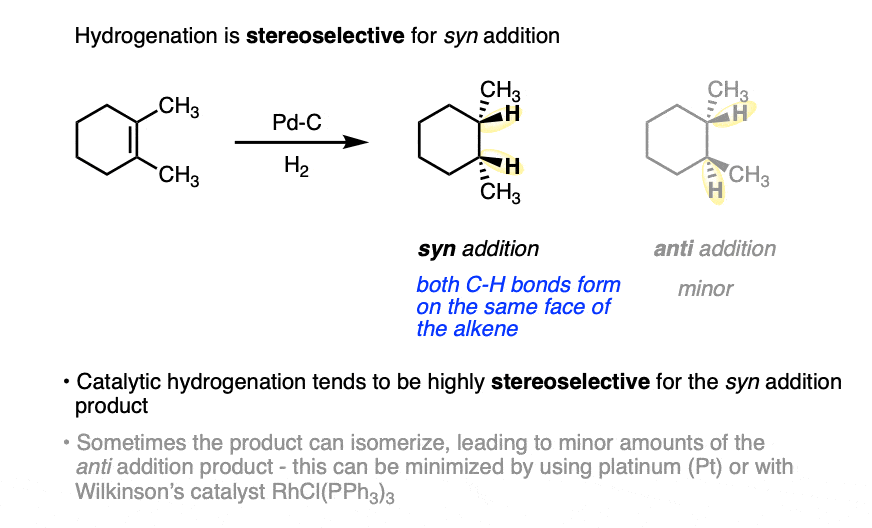
To make the stereochemistry even clearer, chemists often use deuterium (D₂), an isotope of hydrogen.
Catalytic Hydrogenation of Alkenes - Heterogeneous Catalysts
Let's return to the video from The Organic Chemistry Tutor, which has an excellent segment demonstrating syn-addition using deuterium.
Please watch from 06:12 to 08:57. Notice how the addition of D₂ to cyclohexene results in a cis product. The discussion of this product being a meso compound is a great connection to stereochemical concepts we will explore in more detail later.
Test your understanding!
Predict the major product(s) formed when 1-methyl-1,2-cyclopentene is treated with H₂ over a Pd/C catalyst. Pay careful attention to the stereochemistry.
Show answer
The reaction is a catalytic hydrogenation, so it will proceed via syn-addition. The hydrogen atoms will add to the same face of the double bond in 1-methyl-1,2-cyclopentene.
- Syn-addition: Both H atoms add to the same face. This means the existing methyl group and the newly added hydrogen on the adjacent carbon will be cis to each other.
- Two possibilities: The alkene is planar. The H₂ molecule can add from the "top" face or the "bottom" face with equal probability.
- If H₂ adds from the top, the methyl group is pushed down, and the hydrogen on the adjacent carbon is also down.
- If H₂ adds from the bottom, the methyl group is pushed up, and the hydrogen on the adjacent carbon is also up.
- Product: The two products formed are (1R,2R)-1-methyl-2-hydrocyclopentane (which is just 1-methylcyclopentane with a specific stereochemistry) and its enantiomer, (1S,2S)-1-methyl-2-hydrocyclopentane. Therefore, the reaction yields a racemic mixture of the cis product. The key is that in both enantiomers, the methyl group and the adjacent new hydrogen are cis.
Hydrogenation of Alkynes
Alkynes, with their two π bonds, can also be hydrogenated. Using the same powerful catalysts (Pd, Pt, Ni), the reaction typically proceeds all the way to the alkane. The reaction happens in two stages, with the alkene as an intermediate.
Alkyne + 2 H₂ --(Pd/C)--> Alkane
The first syn-addition converts the alkyne to a cis-alkene, which remains adsorbed on the catalyst surface. Since the catalyst is still highly active, a second syn-addition occurs rapidly, converting the cis-alkene to the alkane.
Alkyne Hydrogenation Mechanism (6 Surface Steps)
The OrgoSolver guide 'Alkyne Reactions: Catalytic Hydrogenation with H₂' provides an excellent visualization of this two-step process on the catalyst surface.
Please review the diagrams in the section 'Mechanism (6 Surface Steps)'. Notice how the first syn-addition produces a cis-alkene still bound to the catalyst, which then undergoes the second addition.
The most interesting chemistry with alkynes arises when we want to stop the reaction at the alkene stage. To do this, we need to make the catalyst less reactive. This is achieved by using a poisoned catalyst.
The most famous example is Lindlar's catalyst. This consists of palladium supported on calcium carbonate (CaCO₃) or barium sulfate (BaSO₄) and treated with a "poison" such as quinoline or lead(II) acetate.
Catalytic Hydrogenation of Alkenes and Alkynes
The video from Professor Dave Explains provides a concise explanation of Lindlar's catalyst and its role in alkyne hydrogenation.
Please watch from 03:13 to 03:48. Focus on how the 'poisoned' catalyst allows for the selective hydrogenation of an alkyne to a Z-alkene (cis-alkene).
The poison deactivates the catalyst surface just enough so that it can still catalyze the addition of H₂ to the highly reactive alkyne but is no longer effective at catalyzing the addition to the less reactive alkene product. The cis-alkene then desorbs from the surface before it can react further. This allows us to isolate the cis-alkene as the major product, a direct and predictable consequence of the syn-addition mechanism.
R-C≡C-R' + H₂ --(Lindlar's catalyst)--> cis-R-CH=CH-R'
Conclusion
Today, we've explored the mechanism of catalytic hydrogenation, a reaction fundamentally governed by surface chemistry. This provides a beautiful contrast to the solution-phase ionic mechanisms we've studied previously. The key distinction is the role of the metal surface in orchestrating the reaction.
Key Takeaways:
- Catalytic hydrogenation is a heterogeneous reaction that reduces alkenes and alkynes to alkanes using H₂ and a metal catalyst (Pd, Pt, Ni).
- The reaction proceeds via the Horiuti–Polanyi mechanism, where H₂ is first activated by dissociative chemisorption on the metal surface.
- The stereochemical outcome is exclusively syn-addition, as both hydrogen atoms are delivered from the same face of the π system—the face adsorbed to the catalyst.
- Alkynes can be fully hydrogenated to alkanes or selectively hydrogenated to cis-alkenes using a poisoned catalyst, such as Lindlar's catalyst.
Preview of the Next Lesson:
We have now seen electrophilic addition (Markovnikov, anti-addition) and catalytic addition (syn-addition). In our next lesson, we will explore a third major mechanistic pathway: radical addition. We will examine the addition of HBr in the presence of peroxides, which proceeds via a radical chain mechanism and leads to an "anti-Markovnikov" regiochemical outcome, further expanding our toolkit of alkene reactions.