Hello! Welcome to our next lesson on alkene reactions.
In our previous session, we focused on electrophilic additions that proceed through a carbocation intermediate. We saw how the principle of forming the most stable carbocation governs the reaction's regioselectivity, leading to the "Markovnikov" product. The key takeaway was that the intermediate's structure dictates the final outcome.
Today, we investigate another fundamental electrophilic addition: the halogenation of alkenes. We will explore how its unique stereochemical outcome provides compelling evidence for a different kind of intermediate—one that is not a simple carbocation. This lesson will challenge our previous model and introduce a new, crucial concept in reaction mechanisms.
Your learning outcome for this lesson is to describe the mechanism and stereochemistry (anti-addition) of halogenation to alkenes via a halonium ion intermediate. By the end, you will understand not just what happens, but why the reaction proceeds with such exquisite spatial control.
The Key Observation: Stereospecific Anti-Addition
When an alkene reacts with a halogen like bromine (Br₂) or chlorine (Cl₂), the halogen adds across the double bond to form a vicinal dihalide (halogens on adjacent carbons). On the surface, this looks like a simple addition. However, careful stereochemical analysis reveals a strict rule: the two halogen atoms always add to opposite faces of the original double bond. This is called anti-addition.
This outcome is not just a preference; it's a requirement of the mechanism. The reaction is stereospecific, meaning that different stereoisomers of the starting alkene will lead to different stereoisomers of the product.
Halogenation Is Stereoselective For anti- Addition Products
The article 'Bromination of Alkenes - The Mechanism' from Master Organic Chemistry provides an excellent introduction to this phenomenon. It clearly defines anti-addition and uses classic examples to illustrate the stereospecific nature of the reaction.
Please read the section titled '2. Halogenation Is Stereoselective For anti- Addition Products'. Focus on the example of cyclohexene to visualize anti-addition. Then, pay close attention to the reactions of cis- and trans-but-2-ene. Note how one starting material gives a racemic mixture while the other gives a meso compound, which is powerful evidence that the stereochemistry is strictly controlled.
This strict anti-addition presents a puzzle. If the reaction proceeded through a planar carbocation intermediate like the H-X additions we studied, the nucleophile (Br⁻) could attack from either face of the carbocation. This would lead to a mixture of syn- and anti-addition products. The fact that we only observe anti-addition tells us that a simple carbocation cannot be the intermediate.
The Halonium Ion: A Bridged Intermediate
To explain the observed stereospecificity, chemists proposed the formation of a bridged halonium ion intermediate. In this species, the halogen atom is simultaneously bonded to both carbons of the original double bond, forming a three-membered ring that carries a positive charge.
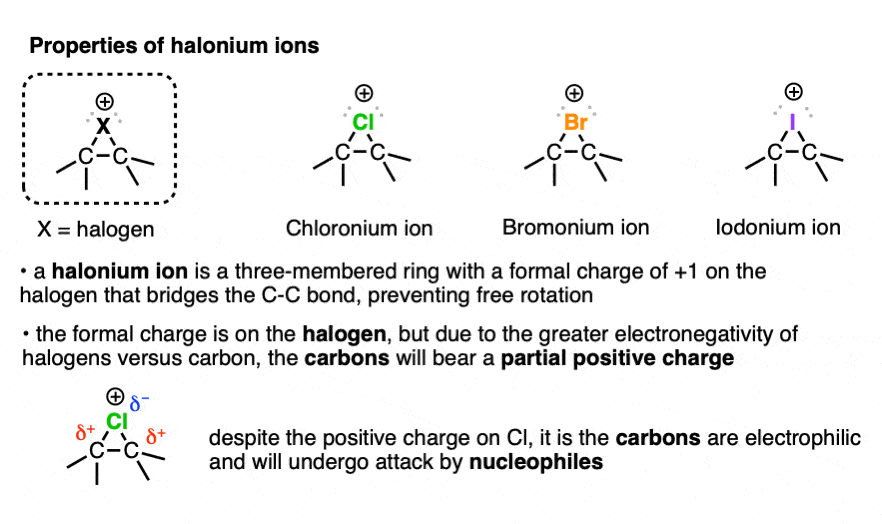
The formation of this ion is the key to the entire mechanism. The alkene's π bond attacks the electrophilic halogen (e.g., Br₂), but at the same time, a lone pair on that halogen attacks back onto the other carbon of the π system. This concerted formation of a three-membered ring avoids a discrete carbocation and "locks" the geometry of the original alkene in place.
The Two-Step Mechanism
Now let's put it all together into the accepted two-step mechanism for halogenation.
Halogenation of Alkenes & Halohydrin Formation Reaction Mechanism
This short clip from The Organic Chemistry Tutor provides a clear, animated depiction of the two key steps: formation of the bromonium ion and the subsequent backside attack by the bromide ion.
Watch the first 1 minute and 37 seconds of the video. Observe how the π bond attacks the bromine and how the bromonium ion forms. Critically, notice the direction from which the bromide nucleophile attacks in the second step.
As you saw, the mechanism is as follows:
-
Step 1: Electrophilic Attack and Formation of the Halonium Ion. The electron-rich π bond of the alkene attacks one atom of the Br₂ molecule. As the Br-Br bond breaks, the departing bromide (Br⁻) acts as a leaving group. Simultaneously, a lone pair on the bromine atom that was attacked forms a bond to the other carbon of the double bond. The result is a cyclic bromonium ion and a bromide ion.
-
Step 2: Nucleophilic Attack on the Halonium Ion. The bromide ion (Br⁻) formed in the first step now acts as a nucleophile. The bromonium ion is a strained, highly electrophilic species. The Br⁻ attacks one of the carbons of the three-membered ring. Crucially, this attack must occur from the face opposite to the bulky, electron-rich bromine bridge. This is a classic backside attack, analogous to what happens in an Sₙ2 reaction, and it forces the ring to open, resulting in the two bromine atoms being on opposite sides of the molecule—the anti-addition product.
A Deeper Look: The Orbital Perspective
Your interest in the quantum mechanical underpinnings of chemistry makes this reaction particularly fascinating. The necessity for backside attack is not just due to steric hindrance; it is fundamentally dictated by orbital symmetry.
Taking things a little further...
The article 'Alkenes as nucleophiles: Part 1' from Making Molecules contains an excellent advanced section that explains the reaction in terms of molecular orbital theory. This gets to the heart of why the reaction is stereospecific.
Please read the subsection titled 'Taking things a little further...'. You can find it about two-thirds of the way down the page. Focus on the explanation of the second step: the attack of the bromide anion on the bromonium ion. The key concept is the interaction between the HOMO of the nucleophile (a lone pair on Br⁻) and the LUMO of the electrophile (a C-Br σ* antibonding orbital).
As you just read, the highest occupied molecular orbital (HOMO) of the nucleophile (Br⁻) must overlap with the lowest unoccupied molecular orbital (LUMO) of the electrophilic carbon. In the bromonium ion, this LUMO is the C-Br σ* (sigma-star) antibonding orbital. A fundamental property of σ* orbitals is that their largest lobe is located at 180° to the bond itself—on the "backside" of the carbon atom. Effective overlap can only occur if the nucleophile attacks from this direction. This orbital requirement is the ultimate reason for the observed anti-stereochemistry.
Stereochemical Consequences and Regioselectivity
The stereospecific nature of halogenation leads to predictable, though sometimes complex, stereochemical outcomes. The key is to always apply the principle of anti-addition to the specific geometry of the starting alkene.
Halogenation of Alkenes | Mechanism | Stereochemistry | Examples
The video 'Halogenation of Alkenes' by Organic Chemistry with Victor provides a superb walkthrough of various stereochemical scenarios and introduces an important subtlety: regioselectivity.
Please watch the following two segments: (04:29 - 08:56): This part explores the reaction with 1-methylcyclohexene. Notice that the incoming nucleophile attacks the more substituted carbon of the bromonium ion. This is an important regiochemical point. (13:24 - 17:01): This segment discusses the bromination of cis- and trans-stilbene, leading to meso and enantiomeric products, respectively. It also touches on how a pre-existing stereocenter can lead to diastereomers. This showcases the full range of possible outcomes.
As the video highlighted, two key principles determine the product(s):
- Stereospecificity: Anti-addition is always observed.
- Addition to a trans alkene (like trans-2-butene or trans-stilbene) yields a meso compound if the molecule is symmetrical.
- Addition to a cis alkene (like cis-2-butene or cis-stilbene) yields a racemic mixture of enantiomers.
- Regioselectivity: In an unsymmetrical alkene, the nucleophilic attack occurs at the more substituted carbon of the halonium ion. This may seem counterintuitive, as a backside attack is usually sensitive to steric hindrance. The reason is electronic: the more substituted carbon can better stabilize a partial positive charge. The C-Br bond to this carbon is weaker and the carbon itself has more "carbocation-like" character, making it the more electrophilic site. This is a subtle but critical point that reinforces the idea that electronic effects often dominate over steric effects.
Test your understanding!
Predict the major product(s) of the reaction of cis-2-butene with Br₂. Be sure to correctly represent the stereochemistry. Will the product be chiral or achiral?
Show answer
- Mechanism: The reaction proceeds via a bromonium ion intermediate, followed by anti-addition of the bromide ion.
- Stereochemistry: Starting with the cis alkene, the two methyl groups are on the same side. The anti-addition of the two bromine atoms will result in a pair of enantiomers. If one bromine adds from the top face and the other from the bottom, you get one enantiomer. If the initial bromonium ion forms on the other face of the alkene, the subsequent attack yields the other enantiomer.
- Product: The products are (2R,3S)-2,3-dibromobutane and (2S,3R)-2,3-dibromobutane. This is a racemic mixture. Each individual molecule is chiral.
You can visualize this: with the methyl groups pointing away from you, one bromine will be 'up' and the other 'down', and the two methyl groups will be staggered relative to each other. The mirror image cannot be superimposed on the original.
Conclusion
Today we've seen that not all electrophilic additions are the same. The stereospecific anti-addition observed in halogenation is definitive proof against a simple carbocation intermediate. Instead, the reaction is mediated by a bridged halonium ion.
Key Takeaways:
- Halogenation of alkenes is a stereospecific reaction that exclusively yields the product of anti-addition.
- This stereochemistry is explained by a two-step mechanism involving a cyclic halonium ion intermediate.
- The first step is the formation of the halonium ion, which locks the alkene's geometry. The second step is a backside attack by the halide nucleophile on the halonium ion ring.
- From a quantum mechanical perspective, the backside attack is required for proper orbital overlap between the nucleophile's HOMO and the C-Br σ* LUMO.
- When the alkene is unsymmetrical, the nucleophile attacks the more substituted carbon of the halonium ion, as this carbon better stabilizes positive charge.
Preview of the Next Lesson:
We have established the key principles of anti-addition and the halonium ion intermediate. What happens if halogenation is carried out in a solvent that is also a nucleophile, like water? We will see how this leads to the formation of halohydrins, a reaction where both the regioselectivity and stereospecificity we've just discussed are critically important. Following that, we'll examine another stereospecific reaction, catalytic hydrogenation, which proceeds via a completely different mechanism to give exclusively syn-addition.