Hello! In our last few lessons, we've built a robust framework for understanding and predicting the outcomes of the major substitution (SN1, SN2) and elimination (E1, E2) reactions. We focused on the competition between these pathways, analyzing how factors like substrate structure, reagent choice, and reaction conditions dictate the final product.
Today, we'll add a third, more specialized elimination mechanism to our toolkit: the E1cB (Elimination, Unimolecular, Conjugate Base) reaction. While less common than E1 or E2, it's governed by a unique logic and is crucial for understanding reactions involving specific types of substrates, particularly in contexts like the aldol condensation. In line with your interest in the "why," we will not only describe the mechanism but also delve into the electronic requirements that make it possible and the experimental evidence that confirms its existence.
Introducing the E1cB Mechanism: A Carbanion-Centric Pathway
Let's briefly recall the mechanisms we know:
- E1 (Elimination, Unimolecular): A two-step process via a carbocation intermediate.
- E2 (Elimination, Bimolecular): A one-step, concerted process with no intermediate.
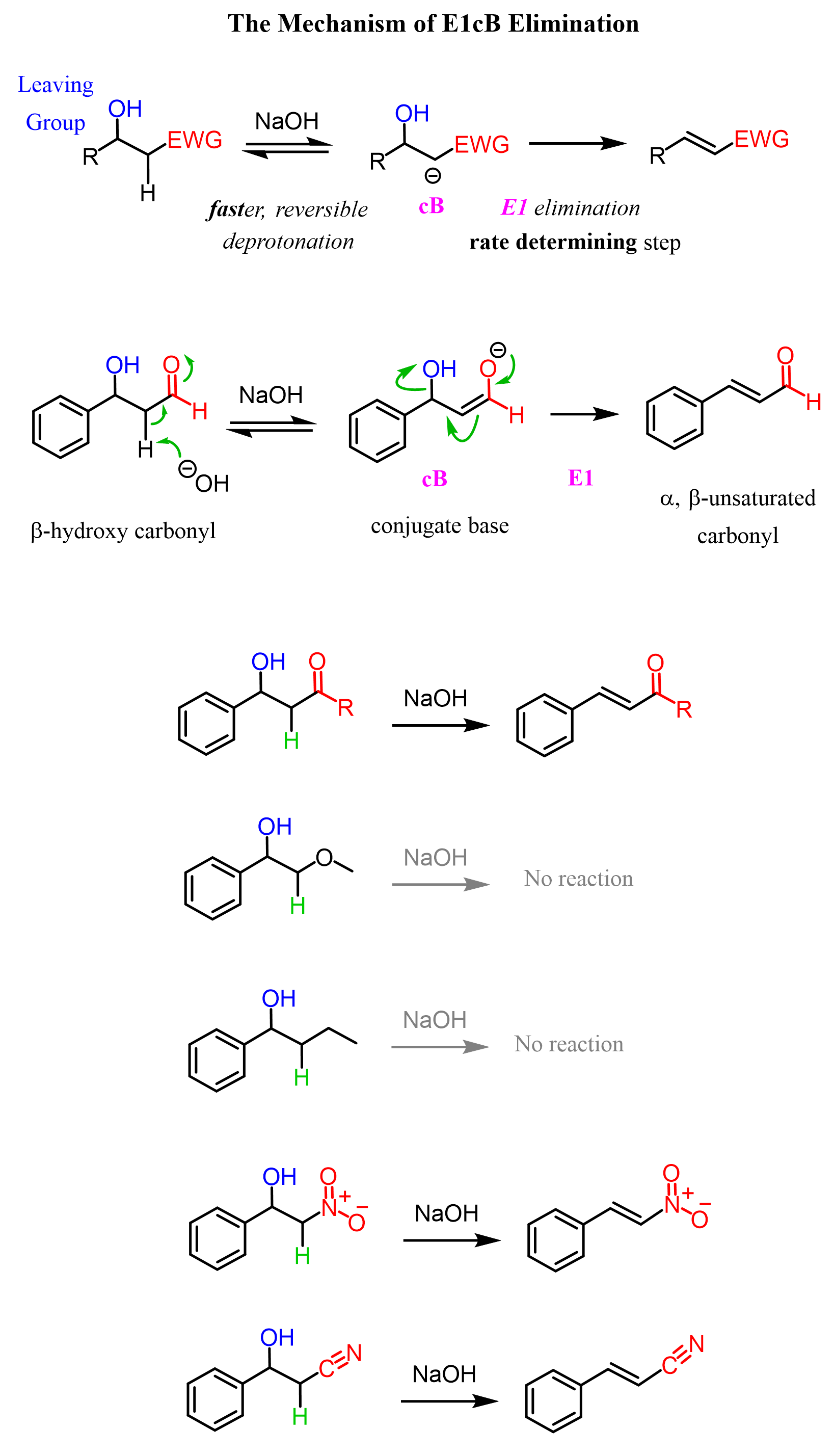
The E1cB reaction is also a two-step process, but its intermediate is the mirror opposite of the E1 intermediate. Instead of a carbocation, it proceeds through a carbanion.
The mechanism unfolds as follows:
- Step 1 (Deprotonation): A base removes a proton from the β-carbon, creating a carbanion intermediate. This carbanion is the conjugate base of the starting material, which gives the reaction its name.
- Step 2 (Loss of Leaving Group): The lone pair on the carbanion expels the leaving group from the α-carbon, forming a π bond.
E1cB Reacton and Hofmann Elimination
To start, watch this clear and concise introduction to the E1cB mechanism from the video 'E1cB Reacton and Hofmann Elimination' by Andrey K. It nicely contrasts the E1cB pathway with the E1 reaction you already know.
Watch the video from the beginning until 1:11. Focus on the two distinct steps: the initial formation of a carbanion, followed by the elimination of the leaving group.
The Energy Landscape of E1cB
Visualizing the reaction coordinate diagram helps to solidify the mechanistic difference. Notice how the E1cB profile, like the E1, has two humps (transition states) and a valley (intermediate). The crucial difference is the nature of that intermediate: a carbanion for E1cB versus a carbocation for E1.

What Makes a Substrate Prone to E1cB?
The E1cB pathway is not common for simple alkyl halides. It requires a specific combination of structural features that stabilize its unique carbanion intermediate and disfavor the more common E2 pathway. There are two main requirements.
1. An Acidic β-Proton (Stabilized Carbanion)
The formation of a carbanion is energetically costly. This step will only happen if the resulting negative charge on the β-carbon is stabilized. This stabilization is almost always provided by an adjacent electron-withdrawing group (EWG).
Common EWGs that promote E1cB reactions include:
- Carbonyl groups (ketones, aldehydes, esters)
- Nitriles (C≡N)
- Nitro groups (NO₂)
When a proton α to one of these groups is removed, the resulting carbanion is stabilized by resonance, delocalizing the negative charge onto the electronegative atoms of the EWG. For a carbonyl compound, this resonance-stabilized carbanion is known as an enolate.
Organic Chemistry Elimination Reactions - E1, E2, E1CB
The following clip from 'The Organic Chemistry Tutor' provides an excellent example of an E1cB reaction on a substrate containing a carbonyl group. It clearly shows how resonance stabilizes the intermediate enolate ion.
Watch the segment from 59:42 to 1:02:03. Pay close attention to the drawing of the resonance structures for the enolate intermediate. This visualizes the crucial role of the electron-withdrawing carbonyl group.
2. A Poor Leaving Group
This second requirement is subtle but just as important. Why would a poor leaving group favor E1cB? The answer lies in its competition with the E2 mechanism.
If a substrate has a good leaving group (e.g., Br⁻, I⁻, OTs⁻), the E2 reaction is typically very fast. The base will initiate a concerted process where the C-H and C-LG bonds break simultaneously.
However, if the substrate has a poor leaving group (e.g., OH⁻, OR⁻, F⁻), the C-LG bond is strong and reluctant to break. The high activation energy for the E2 pathway makes it kinetically unfavorable. This "closes the door" on the E2 mechanism and opens one for E1cB. If the β-proton is sufficiently acidic (due to an EWG), the base will take the only available path: deprotonate first to form the carbanion, which then uses its high electron density to force the poor leaving group out in a second step.
To summarize the conditions and see how they apply to the classic example of the Aldol Condensation, let's turn to a textual resource.
E1cB – Elimination (Unimolecular) Conjugate Base
The article 'E1cB – Elimination (Unimolecular) Conjugate Base' from Master Organic Chemistry provides a superb summary of these two requirements and shows how they operate in real reactions.
Read sections 2, 4, and 8 of the article. Section 2 ('The E1cB Mechanism'): Focus on the explanation of how EWGs stabilize the carbanion and how a poor leaving group slows the second step. Section 4 ('Examples Of The E1cB...'): Study the aldol condensation example. Note how the substrate (a β-hydroxy ketone) perfectly fits our criteria: an acidic proton (alpha to the carbonyl) and a poor leaving group (-OH). Section 8 ('Summary...'): Read the summary to consolidate the two key characteristics of an E1cB-prone substrate.
Test your understanding!
For each substrate below, determine if it is likely to undergo an E1cB elimination with a strong base (like NaOH). Explain your reasoning based on the two key requirements.
CH₃-CO-CH₂-CH₂-OH(4-hydroxybutan-2-one)CH₃-CH(OH)-CH₂-NO₂(1-nitropropan-2-ol)CH₃-CH(Br)-CH₂-CH₃(2-bromobutane)
Show answer
- Yes, E1cB is likely. This is a β-hydroxy ketone. The
-OHis a poor leaving group. The protons on the carbon between the carbonyl and the alcohol (-CO-CH₂-) are acidic because the resulting carbanion would be resonance-stabilized by the carbonyl group. This substrate perfectly matches the criteria. - Yes, E1cB is likely. The
-OHis a poor leaving group. The nitro group (-NO₂) is a very strong electron-withdrawing group. The protons on the carbon adjacent to it (-CH₂-NO₂) are highly acidic. A strong base will deprotonate here to form a resonance-stabilized carbanion, followed by elimination of hydroxide. - No, E1cB is not likely. While it has a leaving group, it fails both requirements. The
-Bris a good leaving group, which favors E2. More importantly, there is no electron-withdrawing group to stabilize a carbanion, so the β-protons are not particularly acidic. With a strong base, this substrate will undergo a standard E2 reaction.
Regioselectivity and Stereochemistry of E1cB
-
Regioselectivity: E1cB reactions typically follow the Hofmann rule, forming the less-substituted alkene. The reaction's regiochemistry is determined by the site of deprotonation. The base abstracts the most acidic proton, which is generally the one on the least-substituted carbon due to both electronic (alkyl groups are weakly donating) and steric factors. This leads to the more stable (less substituted) carbanion intermediate.
-
Stereochemistry: Unlike the E2 reaction, the E1cB mechanism does not require an anti-periplanar arrangement of the H and LG. Because the reaction proceeds through a distinct carbanion intermediate, which is often planar (sp² hybridized), the stereochemical relationship of the original C-H and C-LG bonds is lost. The lone pair on the intermediate can align with the C-LG antibonding orbital to cause elimination regardless of the initial conformation.
A Deeper Dive: Proving the Mechanism
Your interest in a "hyper deep" treatment leads us to a fascinating question: how do we know a reaction proceeds via E1cB and isn't just a very slow E2? Chemists use clever experiments to distinguish between these pathways. The E1cB designation is not just a theoretical construct; it's a family of mechanisms confirmed by experimental data. The primary methods involve deuterium exchange and the kinetic isotope effect (KIE).
Let's explore the more advanced section of the Master Organic Chemistry article. This goes far beyond standard JEE preparation and gets to the heart of mechanistic investigation.
E1cB – Elimination (Unimolecular) Conjugate Base
We will now read the advanced, optional section of the MOC article. This section is challenging but directly addresses your goal of understanding the deeper 'why' and the evidence behind the models we use.
Read the sections titled 'More on the E1cB' and 'What About Stereochemistry?'. Focus on understanding the logic behind these two key experimental proofs: Deuterium Exchange: Why does observing deuterium in the recovered starting material (when the reaction is run in a D₂O/NaOD solvent) prove the formation of a reversible carbanion intermediate? Kinetic Isotope Effect (KIE): The C-D bond is stronger than the C-H bond. In an E1cB_reversible reaction, deprotonation is fast and not rate-determining. Why would you expect the KIE (kH/kD) to be close to 1? In an E1cB_irreversible reaction, deprotonation is the slow, rate-determining step. Why would you expect a large KIE (kH/kD > 1)?
This type of analysis, using isotopic labeling and kinetics to dissect reaction steps, is fundamental to physical organic chemistry and provides the rigorous foundation for the reaction mechanisms we draw with arrows.
Conclusion
Today, we've explored the E1cB reaction, a pathway that highlights the importance of carbanion intermediates in organic chemistry. By understanding its requirements, we can better predict the behavior of a wider range of molecules, especially those central to biological chemistry and advanced organic synthesis.
Key Takeaways:
- Mechanism: E1cB is a two-step elimination proceeding through a carbanion intermediate.
- Key Requirements: The reaction is favored by substrates with:
- An acidic β-proton, stabilized by an adjacent electron-withdrawing group (EWG).
- A poor leaving group (like -OH, -OR) that disfavors the E2 pathway.
- Selectivity: E1cB typically follows Hofmann's rule to produce the less substituted alkene, as it proceeds via the most stable carbanion intermediate.
- Stereochemistry: It does not require the anti-periplanar geometry characteristic of E2 reactions.
- Experimental Proof: The existence of a carbanion intermediate can be proven through experiments like deuterium exchange and analysis of the kinetic isotope effect, which help distinguish the different "flavors" of the E1cB mechanism from a concerted E2 reaction.
Preview of the Next Lesson:
We are now concluding our deep dive into elimination reactions and their competition with substitution. In our next module, "Stereoisomerism and Conformational Analysis," we will shift our focus from reactivity to the molecule's three-dimensional structure. We will begin by learning how to represent and interpret the 3D shapes of molecules using specialized drawings like Newman, sawhorse, and Fischer projections. Mastering these representations is the first step toward understanding the subtle but profound effects of stereochemistry on a molecule's properties and reactions.