Hello! In our journey so far, we have dissected the four fundamental reaction mechanisms of alkyl halides: SN1, SN2, E1, and E2. We've explored their kinetics, stereochemistry, and the factors that favor each one individually. Our last lesson focused on synthesizing this knowledge to predict the specific regio- and stereochemical outcomes of elimination reactions.
Today, we reach a crucial point in our study of reactivity. We will develop a unified framework to analyze the competition between substitution and elimination. Given a substrate, a reagent, and a set of conditions, you will learn to predict which of the four pathways is most likely to dominate and, therefore, what the major product will be. This is less about memorizing rules and more about applying a logical, deductive process based on the mechanistic principles we've established.
The Four-Factor Analysis
Predicting the outcome of a reaction is a process of weighing several competing factors. We will organize our analysis around four key variables:
- Substrate Structure: The substitution of the alkyl halide (1°, 2°, 3°).
- Reagent Identity: Its strength and steric bulk as a nucleophile and/or base.
- Leaving Group: Its ability to depart.
- Solvent and Temperature: The environment in which the reaction occurs.
Let's break down how each factor influences the competition.
1. The Substrate: The First and Most Important Filter
The structure of the alkyl halide is the most powerful initial determinant because it can immediately rule out certain mechanisms based on carbocation stability and steric hindrance.
- Methyl Halides (CH₃-X): Can only undergo SN2. There are no β-hydrogens for elimination, and the methyl carbocation is too unstable for SN1/E1.
- Primary Halides (R-CH₂-X): Strongly favor SN2. The primary carbocation is too unstable for SN1/E1 pathways. E2 is a possibility, but it's typically a minor pathway unless a very bulky base is used (more on this later).
- Tertiary Halides (R₃C-X): Never undergo SN2 due to prohibitive steric hindrance at the reaction center. With a weak nucleophile/base, SN1 and E1 compete. With a strong base, E2 is the exclusive pathway.
- Secondary Halides (R₂CH-X): This is the ambiguous case where all four mechanisms are possible. The final outcome will depend entirely on the other three factors.
The following video provides an excellent summary of how the substrate structure sets the stage for the reaction.
Choosing Between SN1/SN2/E1/E2 Mechanisms
Watch this introductory segment from the video 'Choosing Between SN1/SN2/E1/E2 Mechanisms' by Professor Dave Explains. It clearly lays out which mechanisms are possible or impossible based on the substrate's degree of substitution.
Watch the video from the beginning until 2:51. Focus on the reasoning provided for why SN2 is impossible for tertiary substrates and why SN1/E1 are impossible for primary substrates.
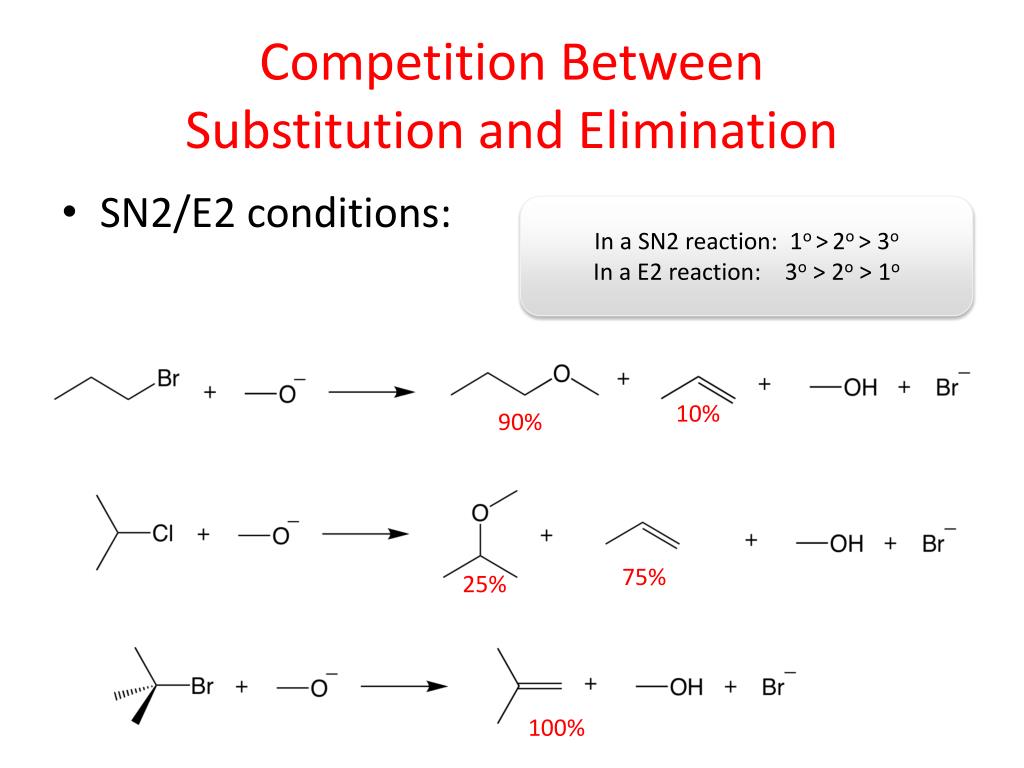
This image provides a clear visual summary of the competition between SN2 and E2 as substrate hindrance increases, assuming a strong, unhindered base/nucleophile.
2. The Reagent: Nucleophile vs. Base
Once the substrate has narrowed the possibilities, the nature of the reagent is the next critical factor. The key distinction is between strength (strong vs. weak) and size (bulky vs. unhindered).
A. Strength
- Strong Nucleophiles / Strong Bases: These are typically species with a negative charge, such as hydroxide (HO⁻) and alkoxides (RO⁻). They are reactive and will force a bimolecular reaction (SN2 or E2). They will not wait for a carbocation to form, effectively ruling out SN1 and E1.
- Weak Nucleophiles / Weak Bases: These are typically neutral molecules, like water (H₂O) and alcohols (ROH). They are not reactive enough to initiate a bimolecular attack. They must wait for the substrate to form a carbocation on its own, favoring unimolecular pathways (SN1 and E1).
B. Size (Steric Hindrance)
- Unhindered Reagents: Small, strong reagents like ethoxide (CH₃CH₂O⁻) can act as both a nucleophile (attacking the carbon) and a base (attacking a β-proton). For these, the competition between SN2 and E2 depends heavily on the substrate (as seen in the image above) and temperature.
- Hindered (Bulky) Reagents: A large, sterically hindered base like tert-butoxide ( (CH₃)₃CO⁻ ) is an excellent base but a terrible nucleophile. It's too big to access the crowded α-carbon for an SN2 attack but can easily pluck off a more exposed β-proton. Therefore, a bulky base strongly favors E2 elimination over any substitution pathway.
Choosing Between SN1/SN2/E1/E2 Mechanisms
Let's return to Professor Dave's video to see how reagent strength and steric hindrance influence the mechanism.
Watch the segment from 2:51 to 9:31. The first part (2:51-8:14) discusses the role of nucleophile/base strength. The second part (8:14-9:31) specifically addresses how the steric bulk of the nucleophile/base can favor elimination.
A Deeper Dive: Why Do Stronger Bases Favor Elimination?
You've expressed interest in the quantum mechanical "why" behind these rules. The preference of stronger bases for elimination (protophilic attack) over substitution (nucleophilic attack) is not arbitrary; it's rooted in the electronic structure of the reactants.
A fascinating computational study analyzed this very question. The key insight lies in how the substrate's Lowest Unoccupied Molecular Orbital (LUMO) changes depending on the conditions.
- Under Acidic/Neutral Conditions (e.g., substrate is CH₃CH₂OH₂⁺): The LUMO has Cα-LG antibonding character but is actually Cβ-H bonding. When a weak base like H₂O interacts with this LUMO (HOMO-LUMO interaction), the interaction assists in breaking the Cα-LG bond (for substitution) but not the Cβ-H bond. Rupturing the Cβ-H bond for elimination is electronically disfavored.
- Under Basic Conditions (e.g., substrate is CH₃CH₂OH): The character of the LUMO changes. It becomes antibonding (σ*) in both the Cα-LG bond and the Cβ-H bond. Now, when a strong base like OH⁻ interacts with this LUMO, the HOMO-LUMO interaction simultaneously promotes the rupture of both bonds. This makes the elimination pathway electronically accessible and highly favorable for a strong base.
Essentially, deprotonating the system (going from acidic to basic) qualitatively alters the shape and nature of the substrate's LUMO, making it "primed" for elimination when approached by a strong base.
Understanding E2 versus SN2 Competition under Acidic ...
To explore this advanced concept, we will look at a research paper that investigated this phenomenon using Density Functional Theory (DFT). You don't need to understand every detail, but focus on the main conclusion regarding the substrate's LUMO.
Please read the 'Abstract', 'Activation strain analyses: Basic conditions', and 'Conclusions' sections. Focus on understanding the following key points: The conclusion that basic conditions favor elimination. The statement that the substrate's LUMO changes character from acidic to basic conditions. The description of the LUMO under basic conditions as being 'σ* antibonding in both the Cα−LG and the Cβ−H bond.' This provides a rigorous quantum chemical explanation for the empirical rule that strong bases favor E2.
3. Solvent and Temperature
These factors act as "tie-breakers," especially when multiple pathways are viable (e.g., SN1 vs. E1, or SN2 vs. E2).
-
Solvent:
- Polar Protic Solvents (H₂O, ROH): These solvents excel at stabilizing charged species through hydrogen bonding. They stabilize the carbocation and leaving group anion in unimolecular reactions, thus favoring SN1 and E1. They also solvate and "weaken" strong nucleophiles, hindering SN2.
- Polar Aprotic Solvents (Acetone, DMSO, DMF): These solvents can stabilize cations but are poor at solvating anions. This leaves the nucleophile "naked" and highly reactive, favoring bimolecular reactions (SN2 and E2).
-
Temperature:
- Higher temperatures favor elimination over substitution.
- Why? Entropy. Elimination reactions typically increase the number of product molecules compared to reactant molecules (e.g., 2 reactants → 3 products). This results in a positive change in entropy (ΔS > 0). In the Gibbs free energy equation, ΔG = ΔH - TΔS, a positive ΔS makes the TΔS term larger and more negative at higher temperatures. This makes the overall ΔG for elimination more favorable compared to substitution, which often has a negligible change in entropy.
This thermodynamic argument provides a powerful and fundamental reason for the effect of temperature.
Choosing Between SN1/SN2/E1/E2 Mechanisms
Professor Dave explains the temperature effect very clearly using the Gibbs free energy equation. This is a crucial concept.
Watch the segment from 9:31 to 11:57. Pay close attention to the counting of molecules and the application of ΔG = ΔH - TΔS.
Synthesizing a Predictive Strategy
We can now combine these factors into a decision-making flowchart. The following chart is an excellent tool for summarizing the logic.

Let's walk through the logic:
- Identify the Substrate: Is it methyl, 1°, 2°, or 3°? This is your first branch point.
- Identify the Reagent: Is it a strong, unhindered base/nucleophile? A strong, hindered base? Or a weak base/nucleophile? This is your second branch point.
- Cross-reference in the chart: Find the intersection of your substrate and reagent. This gives you the predicted major pathway(s).
- Refine with Temperature/Solvent: If SN1 and E1 are competing, high temperature favors E1. If SN2 and E2 are competing, high temperature favors E2. Solvent choice (protic vs. aprotic) can also tip the balance.
Test your understanding!
For each reaction below, predict the major mechanism (SN1, SN2, E1, or E2) and draw the structure of the major organic product.
- 2-bromo-2-methylpropane + sodium ethoxide (NaOEt) in ethanol at 55 °C.
- 1-bromobutane + potassium tert-butoxide (t-BuOK) in tert-butanol.
- (S)-2-bromopentane + sodium iodide (NaI) in acetone.
Show answer
-
Analysis:
- Substrate: Tertiary (2-bromo-2-methylpropane). This rules out SN2.
- Reagent: Sodium ethoxide (EtO⁻) is a strong, unhindered base. Strong bases favor bimolecular pathways.
- Conclusion: The combination of a tertiary substrate and a strong base strongly points to E2.
- Product: The E2 reaction will remove a proton from one of the three equivalent methyl groups to form 2-methylpropene. The elevated temperature also favors elimination.
-
Analysis:
- Substrate: Primary (1-bromobutane). This favors SN2 and rules out SN1/E1.
- Reagent: Potassium tert-butoxide is a strong, sterically hindered base. Its bulk prevents it from acting as a nucleophile for SN2.
- Conclusion: The combination of a primary substrate with a bulky base is the classic recipe for an E2 reaction.
- Product: The E2 reaction will remove a proton from the C2 position to form but-1-ene.
-
Analysis:
- Substrate: Secondary ((S)-2-bromopentane). All mechanisms are possible.
- Reagent: Sodium iodide (I⁻) is an excellent nucleophile but a very weak base.
- Solvent: Acetone is a polar aprotic solvent.
- Conclusion: A good nucleophile, a weak base, and a polar aprotic solvent are the ideal conditions for an SN2 reaction. The reaction will proceed with inversion of configuration.
- Product: (R)-2-iodopentane.
Conclusion
You now possess a powerful analytical toolkit for predicting the outcomes of these fundamental organic reactions. By systematically evaluating the substrate, reagent, and conditions, you can move beyond simple memorization and make predictions based on a deep understanding of the underlying mechanisms and electronic principles.
Key Takeaways:
- Substrate is King: The structure of the alkyl halide (1°, 2°, 3°) is your primary filter.
- Strong Reagents = Bimolecular: Strong bases/nucleophiles (e.g., RO⁻, HO⁻) lead to SN2/E2.
- Weak Reagents = Unimolecular: Weak bases/nucleophiles (e.g., ROH, H₂O) lead to SN1/E1.
- Bulky Base = E2: Sterically hindered bases (e.g., t-BuO⁻) are selective for E2 elimination.
- Heat Favors Elimination: Due to entropy, higher temperatures always increase the proportion of elimination products relative to substitution products.
- The "Why": The preference for elimination under basic conditions can be traced to a fundamental change in the substrate's LUMO, which becomes antibonding for both the Cα-LG and Cβ-H bonds, favoring simultaneous rupture.
Preview of the Next Lesson:
We have spent significant time learning to predict the structures of reaction products. But how do chemists know they've actually made what they intended? In our next module, we will begin exploring the world of analytical techniques. We will start by learning the rules for naming complex polyfunctional molecules and then dive into how spectroscopic methods, particularly Infrared (IR) and Nuclear Magnetic Resonance (NMR) spectroscopy, are used to "see" molecular structures and provide definitive experimental evidence for the reactions we have been studying.