Hello! Welcome to the first lesson of our module on "Addition to Alkenes and Alkynes." In our previous modules, we focused on substitution and elimination reactions, where we frequently encountered carbocation intermediates in SN1 and E1 pathways. We saw how their stability governs reaction rates and product distributions.
Today, we will explore a new class of reactions: electrophilic additions to alkenes. You will find that your understanding of carbocations is once again crucial. Our learning outcome for this lesson is to explain the mechanism of electrophilic addition to alkenes via carbocation intermediates. We will dissect this fundamental reaction by examining the role of the alkene's π-electrons, the formation and stability of the carbocation, and the energetic landscape of the process. True to your goal, we will go beyond simple rules and delve into the molecular orbital interactions that provide the deeper "why" behind this reaction's selectivity.
The Alkene π-Bond: A Center of Nucleophilicity
Alkenes are characterized by a carbon-carbon double bond, which consists of one strong σ-bond and one weaker, more diffuse π-bond. The electrons in the π-bond are located above and below the plane of the molecule, making them more exposed and accessible than σ-bond electrons. This region of high electron density makes the alkene a nucleophile—an electron-pair donor.
When an alkene encounters a strong electrophile (an electron-pair acceptor), such as a hydrogen halide (H-X), a reaction can occur. This reaction is called an electrophilic addition because an electrophile adds across the double bond.
Let's begin by watching a short video that illustrates the overall process and introduces the key players.
This video from The Organic Chemistry Tutor, titled 'Alkene Reactions,' provides a great introduction. It establishes the alkene as the nucleophile and HBr as the electrophile, setting the stage for the mechanism.
Watch the first 5 minutes of the video (00:00 - 05:01). Focus on: The identification of the nucleophile (alkene) and electrophile (HBr). The initial concept of how the H and Br atoms add across the double bond. The introduction of the carbocation intermediate and the stability trend (tertiary > secondary > primary).
The Two-Step Mechanism of Electrophilic Addition
As the video explained, this reaction is not concerted. It proceeds through a two-step mechanism involving a carbocation intermediate, much like the SN1 and E1 reactions you've already mastered.
Step 1: Protonation of the π-Bond to Form a Carbocation
The electron-rich π-bond of the alkene attacks the partially positive hydrogen atom of the hydrogen halide (H-X). The two electrons from the π-bond form a new C-H σ-bond. Since the other carbon of the original double bond has lost its share of the π-electrons, it is left with only three bonds and thus bears a positive formal charge, becoming a carbocation. Simultaneously, the H-X bond breaks, with the electrons moving to the more electronegative halogen, forming a halide ion (X⁻).

Step 2: Nucleophilic Attack on the Carbocation
The newly formed halide ion (X⁻) is a nucleophile. It attacks the electron-deficient carbocation, forming a new C-X σ-bond and yielding the final neutral product.
For a more detailed visual breakdown of these steps, please watch the next segment of the video.
This clip continues from where the last one left off, providing a detailed, arrow-pushing depiction of the two-step mechanism.
Watch the segment from 05:01 to 08:19. Pay close attention to how the arrows represent the flow of electrons in both the protonation and the bromide attack steps.
Regioselectivity and the Role of Carbocation Stability
With an unsymmetrical alkene like propene, the initial protonation can theoretically occur on either carbon of the double bond. This would lead to two different carbocation intermediates.
- Path A: Proton adds to C1 → Secondary (2°) carbocation.
- Path B: Proton adds to C2 → Primary (1°) carbocation.
As we know, carbocation stability follows the trend: Tertiary (3°) > Secondary (2°) > Primary (1°) > Methyl. The reaction will proceed preferentially through the pathway that forms the more stable carbocation intermediate. In the case of propene, this is the secondary carbocation. This preference for one constitutional isomer over another is called regioselectivity. The observation that the hydrogen adds to the carbon that already has more hydrogens is known as Markovnikov's rule, but the underlying reason is carbocation stability.
But why are more substituted carbocations more stable? The answer lies in an electronic effect you've seen before: hyperconjugation.
A Quantum View of Carbocation Stability: Hyperconjugation
A carbocation possesses a vacant, high-energy p-orbital. Hyperconjugation is a stabilizing interaction where electrons from adjacent C-H or C-C σ-bonds (which are in filled σ-orbitals) can delocalize into this empty p-orbital. This spreads the positive charge over a larger volume, stabilizing the system.
Think of it in terms of molecular orbitals: it's an interaction between a filled σ-orbital (the HOMO of the C-H bond) and the empty p-orbital (the LUMO of the carbocation). The more alkyl groups that are adjacent to the carbocation center, the more C-H σ-bonds are available to participate in hyperconjugation, and the greater the stabilization.
- A tertiary carbocation has 9 adjacent C-H bonds for hyperconjugation.
- A secondary carbocation has 6.
- A primary carbocation has 3.
The following video offers an excellent molecular orbital-based explanation of this phenomenon, which directly aligns with your interest in the quantum underpinnings of chemistry.
In this video, 'Hyperconjugation,' Andrey K provides a clear and fundamental explanation for carbocation stability using molecular orbital theory.
Watch from the beginning to 05:17. Focus on the visual representation of the overlap between the filled sp³ orbital of a C-H bond and the empty 2p orbital of the carbocation. This is the key to understanding the 'why' behind the stability trend.
Test your understanding!
Predict the major product of the reaction between 2-methylpropene and HCl. Draw the two possible carbocation intermediates and explain why one is formed preferentially.
Show answer
The reaction is between (CH₃)₂C=CH₂ and HCl.
- Path A (Proton adds to C1): Forms a tertiary carbocation
(CH₃)₂C⁺-CH₃. This carbocation is highly stabilized by hyperconjugation from 9 adjacent C-H bonds. - Path B (Proton adds to C2): Forms a primary carbocation
(CH₃)₂CH-CH₂⁺. This carbocation is only stabilized by hyperconjugation from 1 adjacent C-H bond.
Path A is strongly favored because the tertiary carbocation is much more stable than the primary carbocation. The chloride ion (Cl⁻) will then attack the tertiary carbocation to form the major product: 2-chloro-2-methylpropane.
A Deeper Look: Reaction Energetics and Transition States
To fully grasp the mechanism, we must consider the reaction's energy profile. The formation of the carbocation is the step with the highest activation energy and is therefore the rate-determining step (RDS).
This resource from LibreTexts, 'Electrophilic Addition,' provides a reaction energy diagram and a more sophisticated analysis of the regiochemistry.
Please read through the entire page. Pay special attention to: The Reaction Energy Diagram: Note the two transition states and the carbocation intermediate. Identify the RDS. Sigma-Donation: This is another term for hyperconjugation. See how it's used to explain the energy difference between the 1° and 2° carbocations. Molecular Orbital Description (Regiochemistry): This is the most advanced part. It explains that hyperconjugation not only stabilizes the product carbocation but also polarizes the starting alkene's π-bond. This makes the terminal carbon more nucleophilic, lowering the transition state energy for the formation of the more stable carbocation. This is a key insight into why the reaction is selective from the very beginning. Summary: The final paragraph neatly distinguishes between stability (thermodynamics) and reactivity (kinetics).
The key insight from the LibreTexts article is that hyperconjugation has a dual effect:
- Thermodynamic Effect: It lowers the energy (increases the stability) of the more substituted carbocation intermediate.
- Kinetic Effect: It raises the energy of the HOMO of the more substituted alkene, making it more reactive, and polarizes the π-system, lowering the energy of the transition state leading to the more stable carbocation.
Both effects work in concert to favor the Markovnikov product.
When Carbocations Go Astray: Rearrangements
A defining feature of reactions involving carbocation intermediates is their ability to rearrange. If a 1,2-hydride shift or a 1,2-alkyl shift can convert a carbocation into a more stable one (e.g., 2° → 3°), this rearrangement will typically happen faster than the nucleophilic attack. This leads to products that might not be immediately obvious from a simple application of Markovnikov's rule.
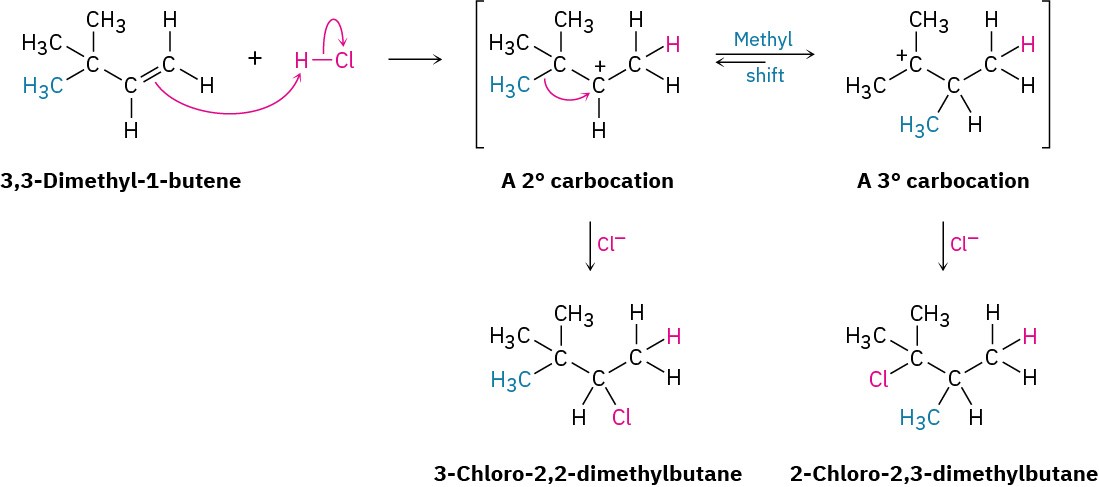
Rearrangements are a crucial consequence of the mechanism, and understanding them demonstrates a true mastery of carbocation chemistry. Ring expansions can also occur if they relieve ring strain and lead to a more stable carbocation.
To see rearrangements in action, let's return to The Organic Chemistry Tutor video. It provides clear examples of both hydride shifts and more complex rearrangements.
Watch the segments from 17:19 to 19:10 and 28:41 to 36:51. Observe how hydride shifts, methyl shifts, and even ring expansions are driven by the quest for the most stable carbocation intermediate.
Conclusion
In this lesson, we have dissected the mechanism of electrophilic addition to alkenes. We established that this is a fundamental reaction driven by the nucleophilicity of the alkene's π-bond, proceeding through a carbocation intermediate.
Key Takeaways:
- Mechanism: A two-step process involving (1) electrophilic attack by the alkene's π-bond to form a carbocation intermediate (the RDS), and (2) nucleophilic attack on the carbocation.
- Regioselectivity: The reaction is regioselective, governed by the formation of the most stable carbocation intermediate (3° > 2° > 1°). This is the electronic basis for Markovnikov's rule.
- The "Why" of Stability: The stability of substituted carbocations is explained by hyperconjugation, a stabilizing orbital interaction between adjacent filled C-H σ-bonds and the empty p-orbital of the carbocation.
- Energetics: The transition state leading to the more stable carbocation is lower in energy, reinforcing the regiochemical outcome.
- Rearrangements: A key consequence of the mechanism is the potential for 1,2-hydride and 1,2-alkyl shifts to form more stable carbocation intermediates, often leading to rearranged products.
Preview of the Next Lesson:
We have built a strong foundation for understanding Markovnikov's rule based on carbocation stability. In our next lesson, we will solidify this by applying the rule to a wider variety of substrates. We will then introduce the concept of "anti-Markovnikov" addition, setting the stage for reactions that follow a different regiochemical pathway and operate via different mechanisms.