Introduction
Welcome to your second lesson! In our previous session, we established a crucial fact by interpreting absorption spectra: plant pigments, particularly chlorophylls, are most effective at absorbing light in the blue-violet and red regions of the spectrum. This naturally leads to a fundamental question you've probably wondered about: if plants are absorbing red and blue light to power photosynthesis, why do we see them as green?
This lesson directly addresses that question, fulfilling the learning outcome: Explain why leaves appear green based on the relationship between pigment absorption and reflected light. We will connect the absorption data we studied previously to the physics of how we perceive color. We'll also move beyond the simple textbook answer to explore some of the physiological nuances and evolutionary hypotheses behind the green color of the plant world.
The Color of Light: Reflection and Absorption
The color an object appears to our eyes is determined by the wavelengths of visible light it reflects. An object that absorbs all wavelengths appears black, while one that reflects all wavelengths appears white.
Recall the absorption spectrum of chlorophyll from our last lesson. We saw prominent peaks in the blue and red parts of the spectrum, but a significant dip, or trough, in the green part.
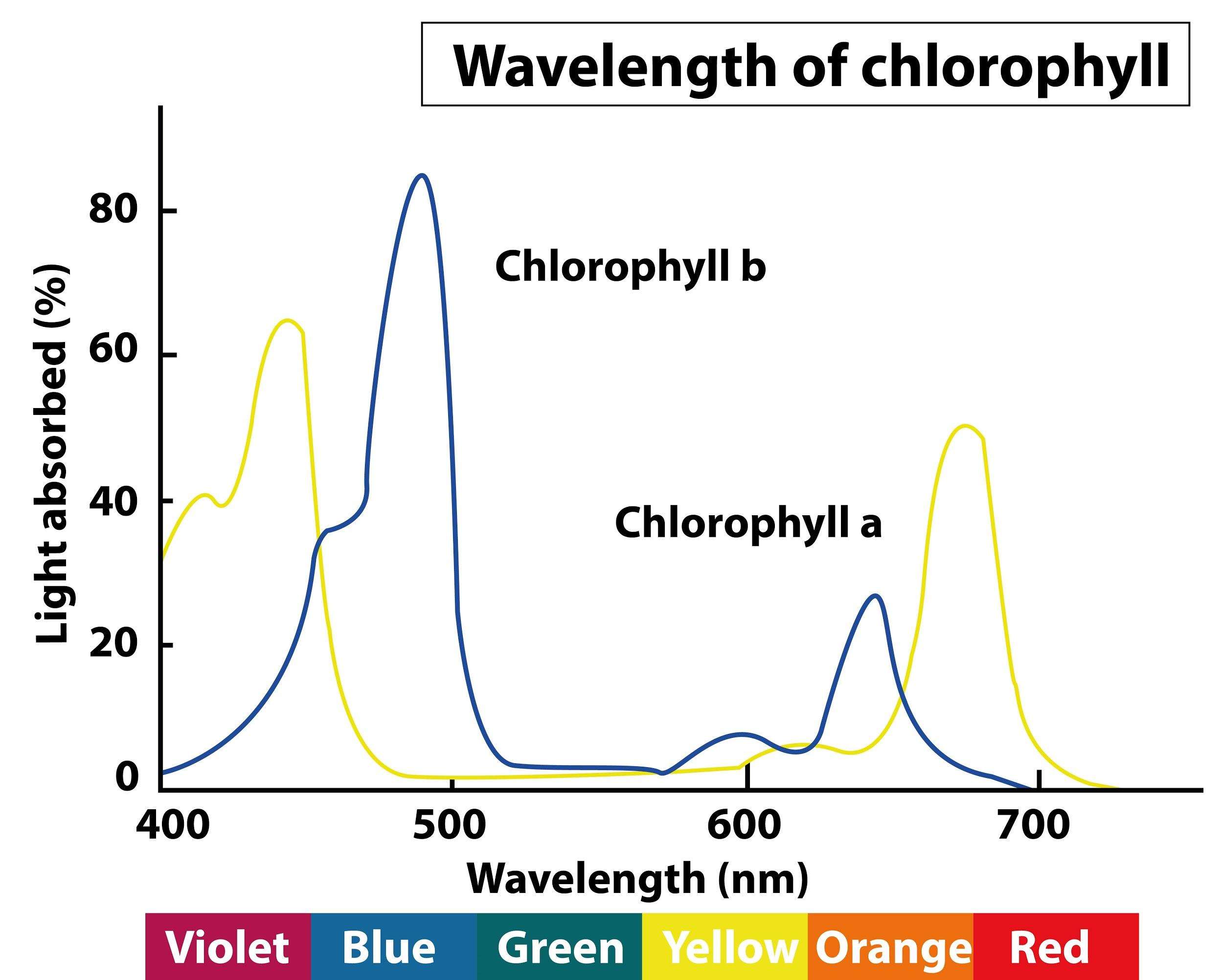
Since chlorophyll pigments do not absorb green light effectively, this light is either transmitted through the leaf or, more significantly, reflected from its surface. It is this reflected green light that reaches our eyes, causing us to perceive the leaf as green.
The following reading selection provides a concise explanation of this relationship.
11.2 Light and Photosynthesis – The Science of Plants
This text from 'The Science of Plants' clearly articulates the link between the absorption spectrum of chlorophyll and the green color of leaves.
Please read the section that begins just below the first graph, starting with 'High absorbance at a particular wavelength...'. Focus on how the text connects low absorbance in the green region to the color we perceive.
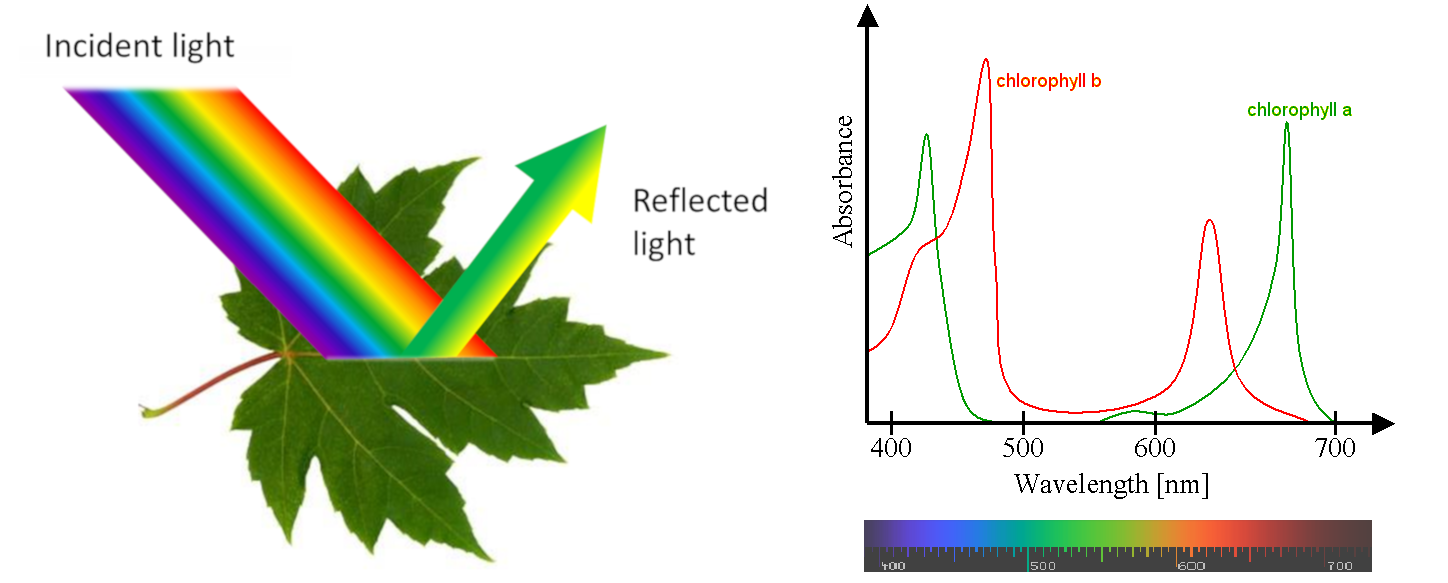
This next image provides a powerful visual summary of the entire process, linking the spectrum of incoming light, the leaf's interaction with it, and the resulting absorption graph.
Seeing it in the Lab
Your preference for interpreting experimental data is key to truly understanding this concept. The following video demonstrates how scientists measure the absorbance of plant pigments and what the results show. As you watch, notice how the data collected directly supports the explanation that leaves are green because they reflect green light.
In this video from PASCO scientific, you'll see a demonstration of plant pigment analysis using both a simple colorimeter and a more sophisticated spectrometer.
Please watch from 01:58 to 03:44 and then from 05:22 to 07:37. In the first segment, observe the direct comparison of absorbance for different colors. In the second, note how the full spectrum reinforces the finding that green light absorbance is low, and how this explains the leaf's color.
The experiment in the video provides clear, quantitative evidence. The low absorbance values for green light measured by both the colorimeter and the spectrometer are the direct cause of the leaf's green appearance.
A Deeper Look: Is Green Light Useless?
The simple story is that "plants don't use green light." However, from a physiological standpoint, the reality is more nuanced. While less efficient, green light is not entirely wasted. This is an area where older textbooks are often outdated.
Let's analyze some text that challenges this oversimplification and introduces a more accurate model.
Which part of the light spectrum is used for photosynthesis?
This article from '2H Aquarist' delves into the distinction between absorption and action spectra and clarifies the modern understanding of green light's role in photosynthesis.
Read the sections titled 'Absorption Spectrum', 'Action Spectrum', and 'Photosynthetically useful radiation ? (PUR)'. Pay close attention to the discussion on why the 'in vitro' absorption spectrum can be misleading and how green light can penetrate deeper into the leaf to drive photosynthesis.
As you read, you found that a whole leaf actually absorbs a significant amount of green light (around 70%). This is because while the top layer of cells might get saturated with red and blue light, the more penetrating green light can reach lower cell layers and drive photosynthesis there. So, while leaves appear green because some green light is reflected, they are still adept at putting the remaining absorbed green light to work.
An Evolutionary Perspective: Why Not Be Black?
This leads to a fascinating physiological and evolutionary question. If the goal is to maximize energy capture, why wouldn't plants have evolved to be black and absorb all wavelengths, including the abundant green light from the sun?
Recent scientific hypotheses suggest that reflecting green light might be a clever evolutionary strategy to protect the plant from the harmful effects of too much energy. Photosynthesis is a powerful process, but it's also delicate. A sudden surge in light energy can damage the photosynthetic machinery.
The following video explores a hypothesis that by absorbing light from two different regions of the spectrum (blue and red) and reflecting the one in the middle (green), plants can better average out energy input and maintain stability in fluctuating light conditions.
Why Are Plants Green Instead of Black?
This SciShow video discusses a compelling hypothesis that explains why being green might be an evolutionary advantage for plants, beyond simple pigment properties.
Watch the entire video. The analogy of the plant as a power grid is particularly useful for understanding the core of the hypothesis. Note how the researchers' model predicts the optimal color for organisms in different light environments.
This perspective transforms our understanding. The green color of leaves may not be an accident of pigment chemistry but rather a finely tuned evolutionary solution to a complex physics problem: how to gather energy safely and reliably.
Conclusion
In this lesson, we have answered the question of why leaves appear green by connecting it to the absorption properties of photosynthetic pigments.
Here are the key takeaways:
- Primary Reason: Leaves are green because their primary pigments, chlorophylls, do not absorb green wavelengths of light. This light is reflected, and our eyes perceive this reflected light as the color green.
- Evidence: The low absorbance in the 500-600 nm range on an absorption spectrum graph is the scientific evidence for this phenomenon.
- Physiological Nuance: Contrary to a common oversimplification, leaves do absorb a significant portion of green light, which penetrates deeper into the leaf and contributes to overall photosynthesis.
- Evolutionary Hypothesis: Reflecting green light may be an adaptive strategy to protect the photosynthetic apparatus from damage by creating a more stable energy input from sunlight.
In our next lesson, we will look more closely at the cast of characters involved in light absorption. We will explore the specific roles of chlorophyll a, chlorophyll b, and other accessory pigments, setting the stage to understand how they work together in the antenna complexes to harvest light energy.