Introduction
Welcome to your third lesson in our exploration of photosynthesis. In our last session, we answered the question of why leaves appear green by connecting the absorption spectrum of chlorophylls to the light they reflect. We established that chlorophylls are excellent at absorbing blue and red light, but not green light.
Today, we will build directly on that foundation to meet the "cast of characters" responsible for this absorption. Our goal is to describe the roles of chlorophyll a, chlorophyll b, and accessory pigments in light harvesting. We'll move beyond simply identifying them to understanding their specific jobs and how they work together as a highly efficient team. This will involve distinguishing the primary pigment from its helpers and uncovering a crucial protective role that is essential for a plant's survival in bright sunlight.
The Pigment Team: A Division of Labor
Photosynthesis in plants relies on not one, but a team of pigments located in the thylakoid membranes of chloroplasts. This team is primarily composed of two classes of pigments: chlorophylls and carotenoids. Let's get a formal introduction to them and their functions.
42. The Light-Dependent Reactions of Photosynthesis - Biology 2e
This reading from the OpenStax 'Biology 2e' textbook provides a clear and concise overview of the main photosynthetic pigments and their fundamental roles.
Please read the subsection titled 'Understanding Pigments'. As you read, focus on identifying the distinct functions described for chlorophyll a, chlorophyll b, and the carotenoid pigments.
Unpacking the Roles
That reading introduced the key players. Let's break down their specific roles to ensure the division of labor is clear.
-
Chlorophyll a: This is the star of the show. It is the primary photosynthetic pigment. This means it is the only pigment that can directly participate in the "photochemistry" of photosynthesis—the process of converting light energy into chemical energy. All other pigments are considered "accessory" because they must pass the energy they collect to a chlorophyll a molecule.
-
Chlorophyll b: This is a key accessory pigment. Its role is to expand the range of light that a plant can use for photosynthesis. As you may have noticed from the absorption spectra in previous lessons, its absorption peaks are in slightly different positions than those of chlorophyll a. It absorbs light energy in these regions and funnels it to chlorophyll a. Given your chemistry background, you might find it interesting that the only difference between the two molecules is a single functional group: chlorophyll a has a methyl group (-CH₃) while chlorophyll b has an aldehyde group (-CHO). This small change is enough to alter its absorption spectrum.
-
Carotenoids: This is another group of accessory pigments, which you may recognize as the source of color in carrots (β-carotene) and tomatoes (lycopene). They have two critical roles in photosynthesis:
- Expanded Light Harvesting: Like chlorophyll b, they absorb light in parts of the spectrum where chlorophylls are less efficient (primarily the blue-violet and blue-green regions) and transfer this energy to chlorophyll a.
- Photoprotection: This is a vital physiological function. When a leaf is exposed to intense sunlight, it can absorb more energy than the photosynthetic apparatus can handle. This excess energy can create damaging reactive oxygen species. Carotenoids absorb this excess energy and dissipate it safely as heat, acting as a protective buffer and preventing damage to the chlorophyll molecules and the surrounding proteins.
Visualizing the Teamwork
The idea of pigments "filling in the gaps" for each other is best understood visually. The graph below shows the absorption spectra for chlorophyll a, chlorophyll b, and β-carotene on the same axes.
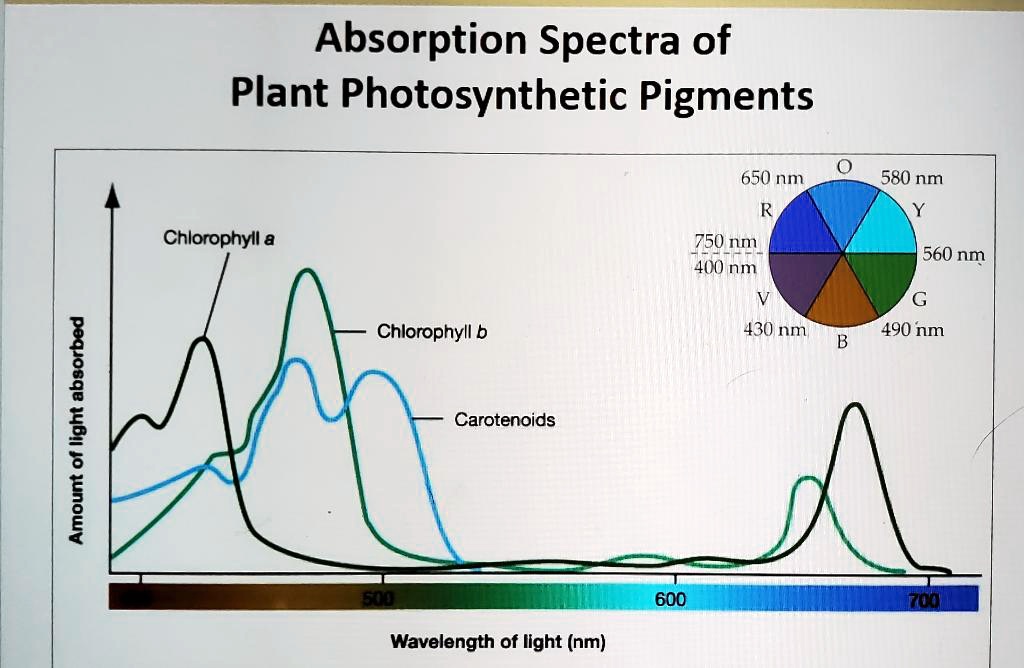
Take a moment to analyze the graph.
- Notice how chlorophyll b has a strong absorption peak around 470 nm, in a region where chlorophyll a's absorption is starting to decrease.
- See how the carotenoids absorb strongly between 400 nm and 500 nm, effectively capturing high-energy blue light that might be missed or incompletely absorbed by the chlorophylls.
Together, this collection of pigments allows the plant to harvest energy from a much wider portion of the visible spectrum than chlorophyll a could alone, significantly increasing the overall efficiency of photosynthesis.
Data Dive: Pigment Regulation in Action
Your preference for learning from experimental data gives us a great opportunity to see these principles in a real physiological context. Let's examine how a plant adjusts its pigment content in response to different environmental conditions.
A recent study investigated how growing microtomato plants under different qualities of light (e.g., broad-spectrum white light vs. monochromatic blue or red light) affected their physiology.
Light means power: harnessing light spectrum and UV-B to enhance ...
This research article, 'Light means power: harnessing light spectrum and UV-B to enhance...', provides real data on how light quality affects pigment levels. We'll focus on a figure from their results.
Please scroll to the section 'Different wavelength lights with and without UV-B modify the chloroplast pigment index' and examine Figure 1 (A, B, and C). You don't need to understand the statistical details (the letters above the bars). Focus on comparing the height of the bars for chlorophyll a, chlorophyll b, and total chlorophyll under the 'RBW' (broad-spectrum white light) treatment versus the 'B' (blue light) treatment. What is the main difference you observe?
You likely noticed that the plants grown under intense, monochromatic blue light had lower levels of both chlorophyll a and b compared to those grown under broad-spectrum light. This might seem counterintuitive since blue light is strongly absorbed. So, why would the plant make less chlorophyll?
This is a physiological trade-off, and the answer lies in the dual role of accessory pigments. Let's see what the researchers concluded.
Light means power: harnessing light spectrum and UV-B to enhance ...
The researchers discuss why these changes in chlorophyll might be occurring. Their explanation highlights the critical importance of photoprotection.
Please read two specific excerpts. First, in the main 'Discussion' section, find the paragraph beginning 'Various studies have focused...'. Read from the sentence starting 'Blue light-stimulated stomatal opening...'. Second, scroll down to the next subsection and find the paragraph starting 'Although the photosynthetic pigments observed...'. This paragraph directly discusses the role of carotenoids. What do the authors suggest the plant is doing with other pigments, like carotenoids, under these high-energy light conditions?
As the authors suggest, under high-intensity blue light, the plant is at risk of absorbing too much energy. In response, it appears to down-regulate its chlorophyll content to reduce overall absorption. At the same time, it likely increases the production of other pigments like carotenoids, not just for light harvesting, but for their crucial photoprotective capabilities.
This is a fantastic example of physiological regulation. The plant isn't just a passive light collector; it actively manages its pigment composition to balance the need for energy with the danger of over-exposure, perfectly illustrating the distinct and vital roles of its pigment team.
Conclusion
In this lesson, we've dissected the roles of the key pigments involved in capturing light for photosynthesis.
Here are the key takeaways:
- Chlorophyll a is the primary pigment, solely responsible for converting light energy into chemical energy.
- Chlorophyll b and carotenoids are accessory pigments that broaden the spectrum of usable light by absorbing wavelengths that chlorophyll a does not absorb well and transferring the energy to it.
- Carotenoids perform a second, vital function: photoprotection. They safely dissipate excess light energy as heat, protecting the delicate photosynthetic machinery from damage.
- Plants can dynamically regulate the concentration of these pigments to adapt to changing light conditions, balancing efficient energy capture with self-preservation.
Now that we know who the pigments are and their specific jobs, our next lesson will address how they are organized. We will explore the structure of antenna complexes, the sophisticated assemblies of proteins and pigments that funnel light energy with remarkable efficiency to the reaction center where the work of photosynthesis begins.