Introduction
In our last lesson, we identified the team of pigments responsible for capturing light energy: the primary pigment, chlorophyll a, and its crucial helpers, chlorophyll b and the carotenoids. We saw that their combined absorption spectra allow a plant to harvest energy from a much broader range of visible light.
Today, we address the next logical question: how are these pigments organized to work together so effectively? This lesson will explore the elegant molecular architecture that makes photosynthesis so efficient. Our objective is to explain the function of antenna complexes in funneling light energy to a reaction center to improve photosynthetic efficiency. We will see that the pigments are not just randomly distributed but are arranged in a highly structured way that acts like a sophisticated satellite dish for light, concentrating energy to the precise location where it can be converted into chemical form.
The Photosystem: An Energy-Harvesting Machine
The pigments we've discussed are organized within the thylakoid membrane into functional units called photosystems. Each photosystem is composed of two main parts: the antenna complex (also called the light-harvesting complex) and the reaction center.
Let's look at a diagram of this structure.
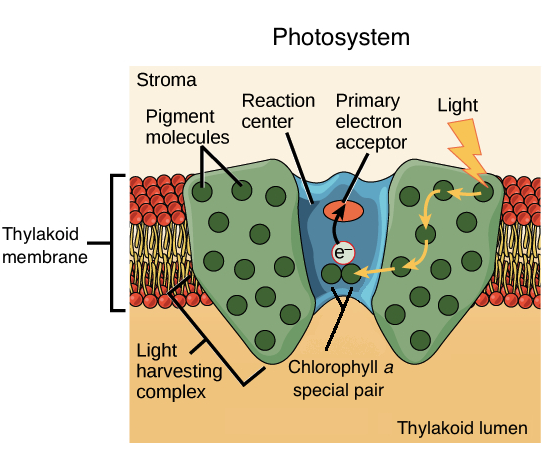
As you can see from the diagram:
- The antenna complex consists of numerous chlorophyll and carotenoid molecules bound to proteins. Its job is to absorb photons of light across a wide surface area and a range of wavelengths.
- The reaction center contains a unique pair of chlorophyll a molecules, located next to a primary electron acceptor. This is the specific site where light energy is converted into chemical energy by triggering the transfer of an excited electron.
To see this process in motion, the following short animation provides an excellent overview of how the photosystem components work together.
Photosynthesis Light reaction, Calvin cycle, Electron Transport 3D Animation
This animation from Love Snow shows how light energy is captured by the antenna and channeled to the reaction center.
Please watch the segment from 02:17 to 03:05. Focus on how the video visualizes the pigment molecules capturing light energy and passing the 'excitation energy' to the reaction center.
The Energy Funnel
How is the energy passed from a pigment molecule in the antenna to the reaction center? The mechanism is a physical phenomenon called fluorescence resonance energy transfer (FRET). An excited pigment molecule transfers its energy (but not its electron) to an adjacent pigment molecule, causing the second molecule to become excited while the first returns to its ground state.
This transfer is not random. The pigments are arranged in a way that creates an "energy funnel," ensuring the energy flows directionally toward the reaction center.

As the image caption notes, the energy is passed to pigments that absorb slightly lower-energy light (longer wavelengths). This is often called a "red-shift" because red light has a longer wavelength than blue light. Each step in the energy transfer goes slightly "downhill" energetically, which ensures the overall flow is one-way, towards the lowest-energy chlorophylls of all: the special pair in the reaction center.
This antenna system is a brilliant solution to an efficiency problem. A single chlorophyll a molecule at the reaction center is a tiny target. The antenna complex acts like a large net, increasing the effective surface area for capturing photons hundreds of times over. It allows the photosystem to collect energy from many photons of different colors simultaneously and channel it all to a single point for processing.
Data Dive: Is a Bigger Antenna Always Better?
Given that antenna complexes are so effective at capturing light, it's natural to ask if a larger antenna is always more efficient. Your preference for physiological scenarios gives us a perfect opportunity to explore this. Consider a plant in a farmer's field under bright, midday sun. The photosystems in its upper leaves are being bombarded with far more photons than their reaction centers can process.
This is the problem of light saturation. In this situation, a very large antenna becomes inefficient; most of the captured energy cannot be used for photochemistry and must be dissipated as heat, which can even cause damage (a problem we touched on in our last lesson regarding photoprotection).
This raises a fascinating question for crop scientists: Could we improve overall photosynthetic efficiency by reducing the size of the antenna? Let's examine the evidence.
Optimizing Antenna Size to Maximize Photosynthetic Efficiency - PMC
This article, 'Optimizing Antenna Size to Maximize Photosynthetic Efficiency,' reviews the theory and experimental evidence behind this very idea.
Please read the introduction and the section titled 'PROOF OF CONCEPT IN MICROALGAE MASS CULTURES.' Focus on these key points: Introduction: Why does the author state that evolution has not optimized chlorophyll content for crop monocultures? Proof of Concept: What happened to photosynthetic productivity when researchers used microalgae with 'truncated light-harvesting Chl antenna' (Tla)? What were the benefits?
The microalgae experiments provide clear proof of concept: under high light conditions, smaller antennas led to higher overall productivity. The key benefits were:
- Less wasteful dissipation of excess light at the surface.
- Reduced photodamage and photoinhibition.
- Better light penetration, allowing cells deeper in the culture to photosynthesize more effectively.
This last point is crucial for crops. If the leaves at the top of a plant canopy have smaller antennas, they absorb less light, allowing more sunlight to filter down to the lower leaves. This leads to a more even distribution of light and a higher rate of photosynthesis for the canopy as a whole.
Let's look at another paper that models this effect and clearly summarizes why a smaller antenna can boost efficiency.
The impact of modifying photosystem antenna size on canopy ... - NIH
This excerpt from a study on modifying antenna size explicitly explains the two main reasons why this strategy increases canopy photosynthesis.
Please read the first paragraph of the '4. DISCUSSION' section. The authors state that the increase in photosynthetic CO2 uptake is attributed to two major factors. What are they?
As the text confirms, decreasing antenna size improves overall efficiency for two reasons:
- At the molecular level: A higher proportion of the light that is absorbed is used for photochemistry, as less energy is wasted as heat.
- At the whole-plant level: Light is distributed more evenly throughout the canopy, increasing the total amount of photosynthesis occurring in the plant.
This is a fantastic example of how understanding a molecular mechanism—the function of the antenna complex—can lead to innovative strategies for improving agricultural productivity, connecting our topic directly to whole-plant physiology and its practical applications.
Conclusion
In this lesson, we have moved from the individual pigments to their organization into functional photosystems. We've seen how the structure of antenna complexes is key to their function.
Here are the main takeaways:
- Photosystems are composed of an antenna complex and a reaction center.
- The antenna complex contains hundreds of pigment molecules that act as a large surface to absorb photons.
- Energy is transferred via resonance from the antenna pigments to the reaction center through an "energy funnel" mechanism, ensuring a directional and efficient flow.
- This organization dramatically improves photosynthetic efficiency by increasing the absorption cross-section of the reaction center.
- The size of the antenna represents a physiological trade-off. While large antennas are advantageous in low light, smaller antennas can increase overall efficiency in high-light conditions by reducing energy waste and improving light distribution in a plant canopy.
We have now successfully delivered light energy to the reaction center. In our next lesson, we will finally see what happens when that energy arrives. We will begin our journey into the light-dependent reactions by tracing the path of an electron in a process known as the Z-scheme.