Welcome to the third and final lesson of our introductory module. In our first two lessons, we built a powerful logical toolkit. We established the strategic goals of a rebuttal—de-escalation, exposing flawed logic, and reframing—and then armed you with the Socratic method as your primary tool for dismantling faulty arguments.
However, the arguments you face are rarely sterile, academic exercises. They are often emotionally charged, designed to provoke a reaction rather than an analysis. This is the last piece of our foundational strategy. This lesson is dedicated to helping you master the art of differentiating between the logical structure of an argument and its emotional content. Your goal is not to become unfeeling, but to become unflappable—to acknowledge emotion without being controlled by it, so you can keep the conversation focused on the logic, where you have the upper hand.
The Brain in Conflict: Logic vs. Emotion
When emotions run high, the capacity for logical reasoning plummets. This isn't a personality flaw; it's a feature of human cognition. Think of it as an inverse relationship: the more emotionally flooded a person becomes, the less access they have to the complex, nuanced thinking required for a rational discussion.
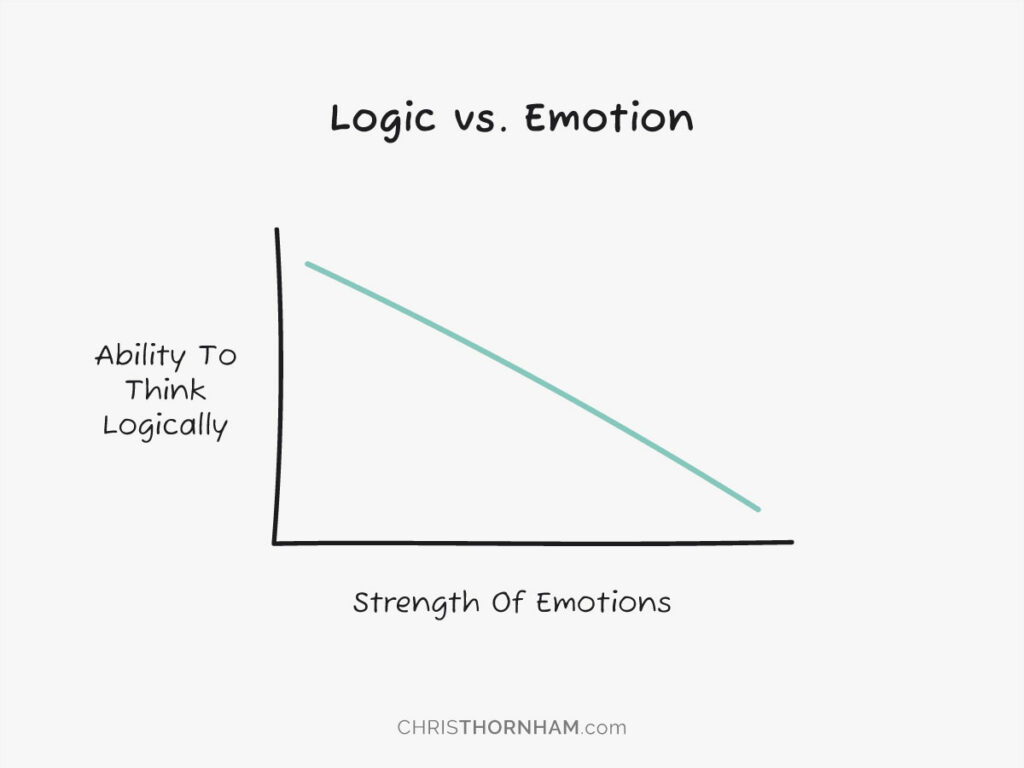
The goal of many fallacious arguments, especially those targeting personal choices, is to trigger a strong emotional response. If your interlocutor can make you angry or defensive, they've pulled you into their preferred battleground and away from the logical inconsistencies in their own position. Your first task is to refuse this invitation by understanding the different states of mind at play.
A useful model for this comes from Dialectical Behavior Therapy, which describes three states of mind: the "Reasonable Mind," the "Emotional Mind," and the "Wise Mind."

- The Reasonable Mind is the state you are in when you apply the Socratic method. It is cool, rational, and task-focused.
- The Emotional Mind is where feelings control thoughts and behavior. Decisions are reactive and impulsive. Fallacious attacks often originate here.
- The Wise Mind is the synthesis of the two. It acknowledges emotions but doesn't let them dictate actions. It responds with reason and perspective. This is the state from which you must operate.
Your objective in any rebuttal is twofold: to stay in your own Wise Mind and to guide your interlocutor out of their Emotional Mind and into their Reasonable Mind.
Diagnosing the Argument's State
Before you can respond, you must diagnose. Is the person in front of you making a logical point that happens to have emotional undertones, or are they making a purely emotional appeal disguised as an argument? An article by conflict resolution consultant T.J. Guttormsen provides a clear breakdown of these two states.
Should We Resolve Conflicts With Logic Or Emotions?
This article offers a practical guide to identifying emotional versus logical states in a conflict and, more importantly, how to influence which state your interlocutor operates from.
Please read the sections titled The pros and cons of emotional and logical conflict resolution, as well as the section on How to elicit a logical state. Focus on the distinct characteristics of each mode of thinking.
As the article explains, when someone is in their Emotional Mind, they are focused on the "here and now," more likely to act immaturely, and less concerned with future consequences. When they are in their Reasonable Mind, they are calmer, more receptive to intellectual arguments, and consider long-term goals.
For your purposes, successfully refuting a fallacy almost always requires moving the conversation into the logical sphere. The key insight from the article is that you can elicit this state through your own communication. By speaking calmly and assertively, focusing on logical topics, and asking questions that require reasoned explanation, you create an environment where logic can re-emerge.
The Anatomy of an Emotional Argument
Now let's examine how emotion is weaponized in an argument. It's crucial to distinguish between arguments that mention emotion and arguments that rely on emotion.
Philosopher Alex O'Connor provides a sharp analysis of this distinction, focusing on the often-misused "Appeal to Emotion" fallacy.
How NOT To Use Logical Fallacies (With Examples)
In this video, O'Connor explains the critical difference between using an emotion as a substitute for an argument and making a valid argument that involves emotional concepts.
Please watch the segment from his discussion of the Appeal to Emotion fallacy. Pay close attention to his examples concerning veganism and abortion, where he clarifies why mentioning suffering or emotional states is not, in itself, a fallacy.
The key takeaway is this: an Appeal to Emotion fallacy occurs when someone tries to persuade you by provoking feelings (pity, fear, disgust) instead of providing evidence or a sound logical premise. Simply mentioning that an action causes emotional distress can be a valid part of a logical moral argument. The fallacy is committed when the emotion is the entirety of the argument.
A related and powerful emotional fallacy is the Appeal to Consequences. This is when someone judges a claim to be true or false based on how they feel about the implications.
Appeal to Consequences - Debate and Argument Tactics
This article from Debate Miraheze offers a deep analysis of the Appeal to Consequences fallacy, including its psychological roots and, most importantly, several robust strategies for refuting it.
Read the introduction, then the sections on the Psychological Basis and Logical Structure. Most importantly, study the sections Refuting the Fallacy, Inverse Tactics, and the Conclusion. These provide a direct playbook for your rebuttals.
The article powerfully states that "feelings aren't falsifiers." The fact that a conclusion would be unpleasant, scary, or disruptive has no bearing on whether it is true. The article also introduces invaluable "inverse tactics" for your toolkit:
- Socratic Courage: The commitment to pursue truth even if it's uncomfortable.
- Intellectual Integrity: The discipline of separating what you want to be true from what is true. A person practicing this says, "That would be terrible if true. Let's find out if it is."
- Tragic Honesty: Acknowledging negative consequences but insisting on facing the truth anyway.
These are not just defensive moves; they are proactive ways to reframe the entire conversation around the principles of reason and courage.
Application: Responding with the Wise Mind
Let's integrate these strategies into your specific scenarios. The goal is to acknowledge the emotional content of the attack before immediately pivoting to a logical framework, demonstrating that you are in your Wise Mind.
Scenario 1: A woman wearing a low-cut outfit.
- Emotional Attack: "That's completely inappropriate. If everyone started dressing like that, it would be the end of decency. It just feels wrong." (This blends an Appeal to Emotion with an Appeal to Consequences).
- Emotional Reaction (to avoid): "What feels wrong is you judging me! You're just an old-fashioned prude!" (This accepts their emotional frame and escalates the conflict).
- Wise Mind Response (Logical Pivot): "I hear that this is causing you some discomfort. Let's set the feeling aside for a moment and examine the logic. You're connecting my outfit to a societal decline. What's the evidence for that link? Let's focus on whether the claim is true, not on how it makes us feel."
- Analysis: This response first validates the emotion ("I hear that...") which can de-escalate the situation. It then immediately reframes the debate around evidence and truth, pulling the conversation into the Reasonable Mind. It embodies the principle of "re-centering the conversation on evidence."
Scenario 2: A wife in a consensual "open vee" relationship.
- Emotional Attack: "I can't even think about that, it's disgusting. To call that a 'marriage' is an insult to everyone who takes their vows seriously. It would be devastating if my kids thought this was normal." (Appeal to Emotion, Appeal to Consequences).
- Emotional Reaction (to avoid): "Your disgust is your problem, not mine. Maybe if you weren't so insecure, you could understand it." (This is an ad hominem attack and keeps the conversation in the Emotional Mind).
- Wise Mind Response (Intellectual Integrity): "I can see this idea is emotionally challenging for you. That's a strong reason to hope, for your sake, that it's not a valid path. But it isn't a reason to conclude that it's not. The question isn't whether the idea is comfortable, but whether a marriage defined by honesty and emotional fidelity can be 'serious,' even if its structure is different from yours."
- Analysis: This is a masterful use of Intellectual Integrity. It acknowledges the other person's emotional stake ("That's a strong reason to hope...") while gently pointing out that their emotional comfort is irrelevant to the truth of the matter. It then uses a Socratic question to pivot the discussion back to the definition of "serious commitment."
Conclusion
You now have the final piece of your foundational strategy. You have the logical tools of the Socratic method and, now, the emotional discipline to deploy them effectively.
The key takeaways from this lesson are:
- High emotion inhibits logical thought. Your first goal is to manage the emotional temperature of the conversation.
- Operate from the Wise Mind: acknowledge emotions without being ruled by them.
- Differentiate between arguments that simply mention emotions and fallacies (like Appeal to Emotion and Appeal to Consequences) that substitute feelings for facts.
- Your response should pivot from the emotional content back to the logical structure of the argument using tactics like reframing, re-centering on evidence, and demonstrating intellectual integrity.
With this, our introductory module is complete. You have a robust framework for approaching any fallacious argument. In our next lesson, we will begin applying this framework to the first category of fallacies in our list: those built on flawed premises and definitions. We will start by deconstructing and countering Begging the Question when it is used to attack a woman's fashion or relationship choices.