Welcome to your second lesson. In our previous session, we established the strategic foundation for a powerful rebuttal, defining its goals as de-escalation, exposing flawed logic, and reframing the conversation. We identified the Socratic method—the art of strategic questioning—as the principal tool for achieving these aims.
Today, we will move from the what to the how. This lesson is dedicated to mastering the application of the Socratic method. You will learn a structured process for guiding a dialogue and specific questioning techniques designed to surgically reveal the contradictions and unexamined assumptions at the heart of fallacious arguments. By the end of this lesson, you'll have a practical toolkit for dismantling flawed reasoning about personal choices.
The Socratic Dialogue: A Structured Process
The power of the Socratic method lies in its structure. It is not a random volley of questions but a deliberate process that guides an interlocutor from a confident assertion to a moment of genuine reflection. The video "How to Use the Socratic Method" provides a clear and concise five-step model for this process.
How to Use the Socratic Method (for Dialogue, Debate and Critical Thinking)
This short video breaks down the Socratic method into a practical, five-step cycle. It provides a simple yet effective framework for structuring your rebuttals.
Please watch the entire video. Pay close attention to the five key steps described from the explanation of the process: Receive, Reflect, Refine, Restate, and Repeat.
These five stages—Receive, Reflect, Refine, Restate, and Repeat—form a conversational loop. You listen, confirm your understanding, probe the reasoning, prompt a new formulation, and then begin again if necessary. This iterative cycle systematically drills down to the core of an issue.
This infographic provides a helpful visual summary of this process:

The most critical stage for our purposes is Stage 3: Refine and Cross-Examine. This is where you deploy targeted questions to test the validity of your interlocutor's argument.
A Typology of Socratic Questions
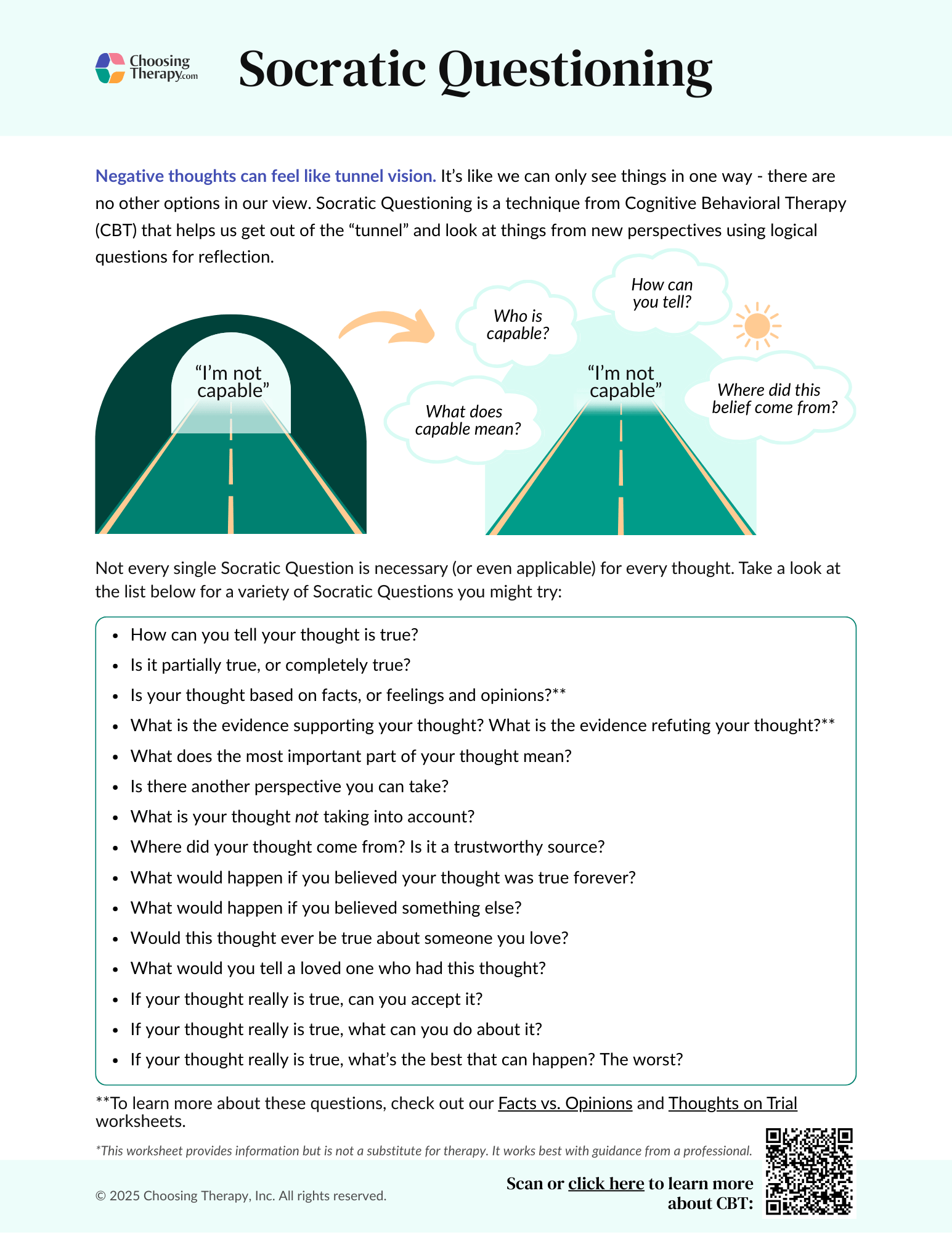
To effectively refine and cross-examine, you need a versatile set of questions. Different types of questions serve different purposes, from clarifying meaning to probing the very foundation of a belief. The article "Using Socratic Questioning to Expose Logical Fallacies" offers an excellent categorization of these questions.
Using Socratic Questioning to Expose Logical Fallacies | LF
This article details the different kinds of Socratic questions and provides concrete examples of how they can be used to target specific logical fallacies.
Please read the introduction and then the sections Understanding Socratic Questioning, Types of Socratic Questions, and Using Socratic Questioning. Focus on the five categories of questions and how they can be applied to fallacies like the Straw Man and False Dilemma.
As the article explains, you can guide a conversation by using:
- Clarification Questions: To ensure you are addressing the actual argument ("What do you mean by 'respectable'?")
- Questions that Probe Assumptions: To uncover the hidden premises ("What are you assuming to be true when you say that?")
- Questions that Probe Evidence: To challenge the factual basis of a claim ("What evidence do you have to support that connection?")
- Questions about Consequences: To explore the logical implications of the argument ("If we were to accept that premise, what would follow?")
- Questions about the Question: To reframe the discussion and challenge its relevance ("Why is this the question we are focusing on?")
This toolkit allows you to select the right kind of question for the specific flaw you identify in an argument.
Advanced Techniques for Revealing Contradictions
Within the "Refine" stage, Socrates himself favored several powerful logical techniques to expose flaws in reasoning. These are not just questions, but miniature logical proofs embedded within a dialogue. They are particularly effective for crafting the "sharp" responses you aim for. The article from Philoparadoxia on Socrates' philosophy provides a brilliant breakdown of three such techniques.
Socrates Philosophy Explained: Life, Method, Virtue & ...
This resource offers a deep dive into the mechanics of the Socratic method, including the specific logical tools Socrates used to dismantle flawed arguments.
Please read the section titled The Seven Stages of the Socratic Method for a more detailed look at the dialogue process. Then, focus intensely on the section Three Techniques Used at Stage Four. This part explains the powerful methods of attacking definitions, reductio ad absurdum, and using counterexamples.
Let's focus on the three core techniques described in the reading:
- Attacking the Definition: Many fallacious arguments hinge on a poorly defined or loaded term (e.g., 'commitment', 'modesty'). By asking for a precise definition, you often expose that the person is using a circular, incomplete, or purely self-serving definition.
- Reductio ad Absurdum (Reduction to Absurdity): This is a particularly elegant technique. You provisionally accept your opponent's premise and trace its logical consequences to a conclusion that is absurd or self-contradictory. This proves the original premise must be false.
- Counterexample: Universal claims ("All women who X are Y," "No one in a relationship like Z can be happy") are extremely fragile. As you know from your work in statistics and logic, a single, valid counterexample is sufficient to invalidate a universal assertion. Your role is to find and present that counterexample.
These techniques shift the burden of proof and force the interlocutor to defend the logical integrity of their position, rather than simply repeating their initial judgment.
The Method in Action: Street Epistemology
To see how these principles come together in a real, unscripted conversation, we will watch a demonstration from Anthony Magnabosco, a leading practitioner of "Street Epistemology." This is a modern adaptation of the Socratic method designed to explore the foundations of deeply held beliefs in a non-confrontational way.
Learn Street Epistemology: Assumptions | Elements | Recovery (Oslo 2018) (blue slides)
This video showcases a live application of the Socratic method with a young woman about her belief in Karma. It's a masterclass in rapport-building, gentle questioning, and guiding someone toward self-reflection.
First, watch the demonstration with Keanu from the beginning of the conversation to its conclusion. Notice how Magnabosco uses questions to help her distinguish between "karmic punishment" and "things just happening." Pay attention to how her self-reported confidence level changes. Next, watch the section from "Elements of an effective SE chat". This part breaks down the practical steps, from assessing goals to using a confidence scale and building rapport.
The "Street Epistemology" approach offers several key takeaways:
- The Goal is Reflection, Not Conversion: The aim is to "place a pebble in someone's shoe"—to make them think critically about how they know what they claim to know.
- The Confidence Scale: Asking "How confident are you, from 0 to 100?" is a brilliant way to quantify a belief. It transforms a binary "I believe/I don't believe" into a measurable spectrum, which is much easier to influence. A shift from 82% to 53%, as seen in the video, is a significant victory for critical thinking.
- Rapport is Essential: The method only works if the other person feels heard and respected. The initial moments of building rapport are not just pleasantries; they are crucial for creating psychological safety.
Applying the Toolkit: Your Scenarios
Let's now apply these techniques to your specific scenarios.
Scenario 1: A woman wearing a low-cut outfit.
- Fallacious Argument: "She's obviously dressing like that for male attention. It's desperate."
Here is how you might apply the Socratic toolkit:
- Receive & Reflect: "So, if I'm hearing you correctly, you believe the only possible reason for her to wear that outfit is to get attention from men, and you see that as an act of desperation."
- Refine (using various techniques):
- Probe Assumption: "What's the thinking that leads you to that conclusion? Are you assuming it's not possible she simply likes the style and feels confident in it?"
- Attack Definition: "You used the word 'desperate.' What does that mean in this context? How do you distinguish between a woman dressing to feel good about herself and a woman being 'desperate'?"
- Counterexample: "What about a runway model wearing a designer's avant-garde creation, or an actress on the red carpet? Their outfits are often revealing. Is their primary motive always desperation for attention, or could it be artistic expression or celebrating a design?"
- Reductio ad Absurdum: "If we follow that logic, does every fashion choice have a simple, externally-focused motive? If a revealing top means 'I want male attention,' what does a turtleneck mean? 'Go away'? Is a person's entire internal state reducible to a code read from their clothes?"
- Restate: "Given that, would it be more accurate to say that while some people might dress for attention, we can't be certain of her specific motive just by looking at her outfit?"
Scenario 2: A wife in a consensual "open vee" relationship.
- Fallacious Argument: "If she's sleeping with another man, she can't be truly committed to her husband. It's a sham marriage."
- Receive & Reflect: "So your position is that sexual exclusivity is the absolute, necessary condition for 'true commitment,' and therefore any relationship without it is, by definition, not real."
- Refine (using various techniques):
- Attack Definition: "This seems to depend on how we define 'commitment.' My husband and I define it as unwavering emotional support, radical honesty, and building a shared life together. Is your definition different, and if so, why is your definition the only valid one?"
- Probe Assumption/Counterexample: "You seem to be assuming that love and commitment are finite, like a pie that gets smaller if you share it. Have you ever felt deep platonic love for a best friend? Did loving that friend diminish the love you had for your partner? Why should romantic love be different?"
- Reductio ad Absurdum: "If we accept that commitment is only sexual exclusivity, what does that imply about a married couple where one person becomes permanently physically disabled and they can no longer have sex? Have they ceased to be committed? Is their marriage now a 'sham'?"
- Restate: "So, perhaps 'commitment' is more complex than just one variable, and different people can build it on different foundations, like honesty and emotional fidelity, rather than solely on sexual exclusivity?"
Conclusion
In this lesson, we have moved from theory to practice. You now have a robust framework for applying the Socratic method to real-world arguments.
Key takeaways from today include:
- A Socratic rebuttal follows a structured, five-step process: Receive, Reflect, Refine, Restate, Repeat.
- The "Refine" stage is your opportunity to deploy different types of Socratic questions to probe assumptions, evidence, and definitions.
- Advanced techniques like Reductio ad Absurdum and Counterexample are powerful tools for exposing logical contradictions in a sharp and definitive way.
- The goal is not to win an argument, but to foster critical reflection in your interlocutor, often measured by a shift in their own confidence.
We have focused today on the logical mechanics of the Socratic method. However, these conversations are rarely purely logical; they are often charged with emotion. In our next lesson, we will address the final piece of our strategic foundation: differentiating between responding to an argument's logic versus reacting to its emotional content. This will prepare you to stay focused and effective, even when faced with heated or emotionally manipulative tactics.